
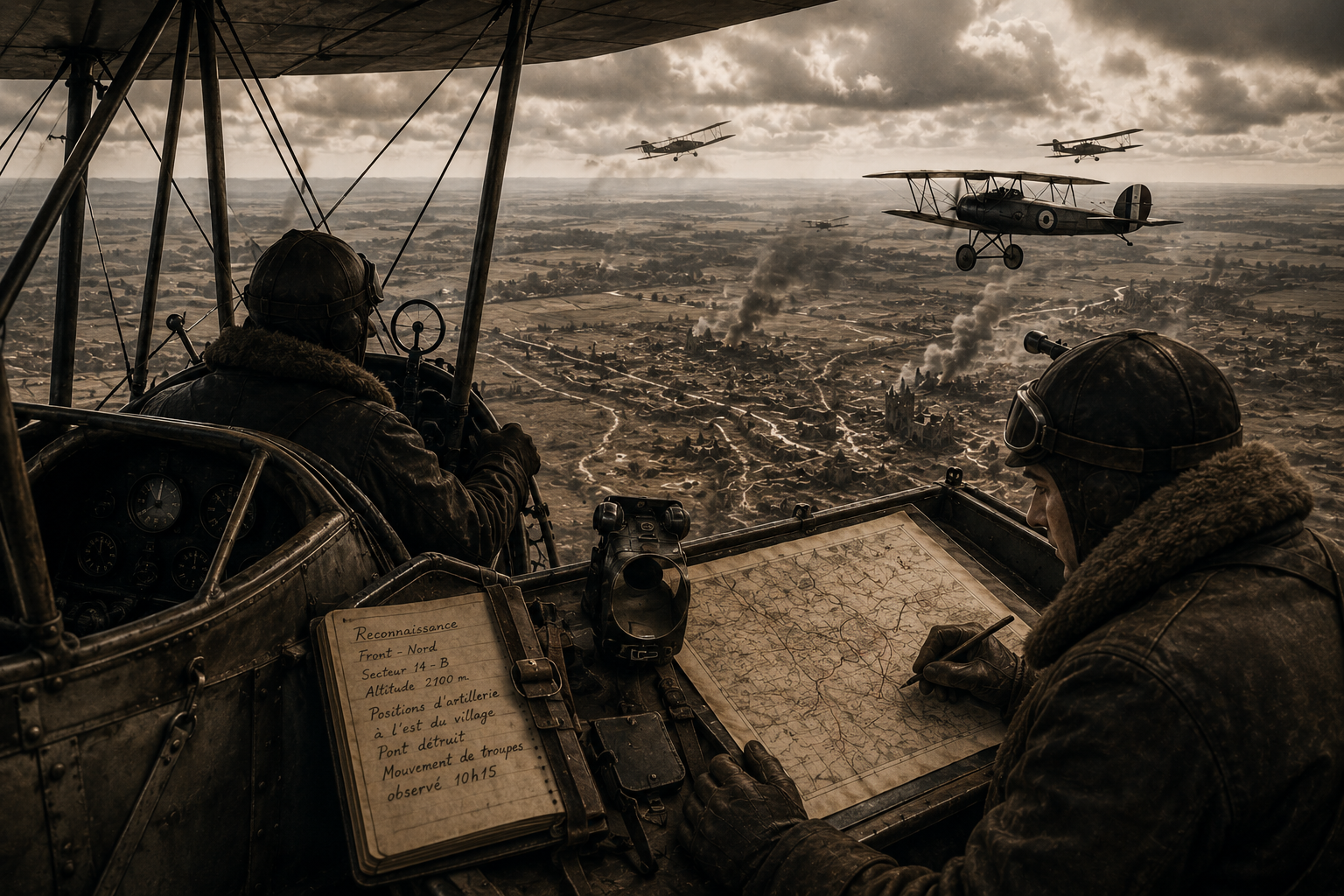
Before dogfights became legend, pilots flew to observe, map and survive.
Long before fighter aces captured newspaper headlines, military aviation served a simpler purpose. Pilots climbed into fragile aircraft not to fight, but to see. Their mission was observation, intelligence gathering and survival above one of history's deadliest battlefields.
At the beginning of the First World War, commanders quickly discovered that aircraft offered something no cavalry patrol or observation post could provide, a view of the battlefield from above. Reconnaissance flights revealed troop movements, supply routes, artillery positions and defensive preparations hidden from soldiers on the ground.
The information gathered by these early crews often influenced entire campaigns. A single successful reconnaissance mission could reveal an enemy offensive before it began.
Many reconnaissance aircraft carried two men. The pilot flew the machine while the observer recorded information, drew maps, photographed enemy positions and communicated artillery corrections back to friendly forces.
These observers became some of the most important intelligence assets on the Western Front, often working under extreme conditions at high altitude and under enemy fire.
Early reconnaissance aircraft were rarely armed. Crews often relied on pistols, rifles or simple courage when encountering enemy aircraft. Their primary objective was not combat but completing the mission and bringing valuable intelligence home.
As reconnaissance became more important, opposing armies sought ways to stop it. This need eventually led to the development of dedicated fighter aircraft and the birth of aerial combat.
Weather, engine failures, anti-aircraft fire and enemy aircraft all threatened reconnaissance crews. Many pilots considered these missions as dangerous as any later dogfight because survival depended on factors largely beyond their control.
The aircraft themselves were fragile structures of wood, wire and canvas. Mechanical failure over enemy territory often meant capture or death.
Although fighter aces became the public face of aviation, reconnaissance remained the true foundation of military air power. Observation, intelligence gathering and artillery spotting continued to shape operations throughout the war.
The first pilots entered the sky not as warriors seeking glory, but as scouts searching for information. Their work laid the foundation for every air force that followed.
The opening episodes of Wings of Iron, particularly The Sky Opens and Canvas and Fire, explore this transitional period when observation flights slowly evolved into armed encounters and the skies began transforming into a battlefield.