
Miserando atque eligendo
Miserando atque eligendo is the episcopal motto of Pope Francis, the 266th pope of the Roman Catholic Church. The Latin phrase has been translated by Vatican Radio as “lowly but chosen,” though it literally means “by having mercy, by choosing him.” The phrase reflects Pope Francis’s emphasis on divine mercy, humility, and pastoral care.
Origin
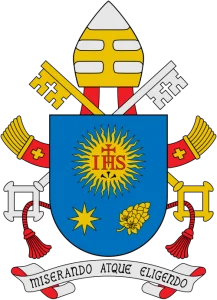
The motto is derived from a homily by the Venerable Bede (c. 672–735), an English monk and Doctor of the Church. In his commentary on the Gospel of Matthew, Bede describes the moment when Jesus calls Matthew the tax collector:
Vidit ergo Iesus publicanum, et quia miserando atque eligendo vidit, ait illi: Sequere me.
(“Jesus saw the tax collector, and because he saw him through the eyes of mercy and chose him, he said to him: Follow me.”)
The phrase highlights the idea that divine vocation arises not from merit but from mercy.
Use by Pope Francis
Pope Francis adopted Miserando atque eligendo as his episcopal motto in 1992 when he was appointed Auxiliary Bishop of Buenos Aires. Upon his election to the papacy in 2013, he retained the motto, signifying a continuity in his spiritual and pastoral outlook. The phrase serves as a central theme of his pontificate, reflecting his desire for a Church that is inclusive, compassionate, and centered on mercy.
Linguistic and Cultural Notes
Pope Francis was born Jorge Mario Bergoglio in Buenos Aires, Argentina. His name in various languages and its pronunciations are as follows:
-
Latin: Franciscus
-
Italian: Francesco
-
Spanish: Francisco
-
Spanish pronunciation: [ˈxoɾxe ˈmaɾjo βeɾˈɣoɣljo]
-
Italian pronunciation: [berˈɡɔʎʎo]
The name Francis was chosen in honor of Saint Francis of Assisi, known for his commitment to peace, poverty, and care for creation.
Papal Naming Traditions
The selection of a papal name often carries symbolic significance and reflects the new pope’s spiritual vision:
-
Pope John Paul I (elected 1978) was the first pope to choose a double name, honoring John XXIII and Paul VI, who had both influenced the Second Vatican Council.
-
Pope John Paul II, who succeeded him, continued the legacy of his immediate predecessor and emphasized themes such as the dignity of the family. He presided over several high-profile marriage ceremonies:
-
In 1994, during the Year of the Family.
-
In 2000, during the Jubilee for Families, couples from around the world were married at the Vatican.
-
-
Pope Benedict XVI (2005–2013), the direct predecessor of Francis, did not follow the double-name tradition. His papacy focused on theological clarity, interfaith dialogue, and tradition.
Significance in Francis’s Papacy
The motto Miserando atque eligendo is closely aligned with the core themes of Pope Francis’s papacy. His emphasis on mercy culminated in the proclamation of the Extraordinary Jubilee of Mercy (2015–2016), a year-long celebration dedicated to forgiveness, reconciliation, and compassion.
Pope Francis has consistently promoted a vision of the Church as a “field hospital” for the wounded, calling on clergy and laity alike to go out to the margins of society and minister to those most in need. The motto is seen as both a personal reflection and a blueprint for his papal mission.
References
-
Vatican Radio. “Pope Francis and the motto Miserando atque eligendo.” [Archived content]
-
Bede, Homilies on the Gospels (Translation and commentary)
-
John Paul II. “Jubilee for Families,” 2000. Vatican.va
-
Holy See Press Office, biographies and official papal documents.