
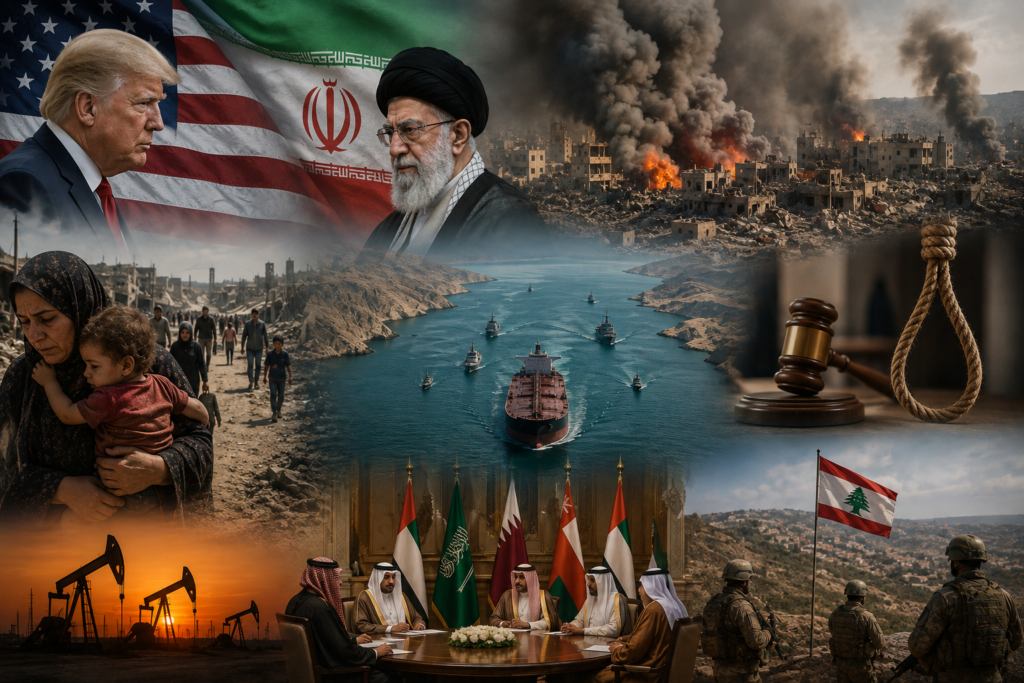
Image Credits: Middle East News Brief: Top Stories Across the Region, August 3, 2026. AI-generated illustration created by Open Chronicle using ChatGPT (OpenAI). August 2026. This image is illustrative and does not depict a real-world scene.
By Open Chronicle with agencies
Diplomatic uncertainty, ongoing conflict and heightened regional security concerns continue to dominate headlines across the Middle East. While Washington and Tehran remain locked in a strategic standoff, fighting in Gaza, tensions around the Strait of Hormuz and regional mediation efforts are shaping the geopolitical landscape.
U.S. and Iran remain at an impasse
The confrontation between the United States and Iran continues to be the region’s dominant story.
President Donald Trump has said Washington is prepared to resume diplomatic negotiations after pausing planned military strikes, but Iranian officials have rejected claims that direct talks are underway.
Tehran has also maintained pressure over the Strait of Hormuz, leaving uncertainty over the future of one of the world’s most strategically important maritime corridors.
Humanitarian crisis deepens in Gaza
Heavy Israeli airstrikes continue across Gaza despite ongoing diplomatic efforts to secure a ceasefire.
Residents report worsening humanitarian conditions as shortages of food, clean water and medical supplies intensify. Large numbers of civilians remain displaced, while negotiations aimed at ending the conflict continue to face significant obstacles.
Iran executes two accused of spying for Israel
Iran has executed two Iranian nationals convicted of collaborating with Israeli intelligence.
Authorities said the pair had provided sensitive military information during the conflict, reflecting Tehran’s intensified internal security campaign amid heightened regional tensions.
Strait of Hormuz remains under pressure
The Strait of Hormuz continues to be one of the world’s most closely watched strategic waterways.
Although diplomatic contacts remain active, commercial shipping companies continue operating cautiously as Iran uses its position over the narrow passage as leverage in its confrontation with Washington.
Any disruption to traffic through the strait has the potential to affect global energy markets and international trade.
Gulf states step up mediation efforts
Saudi Arabia, the United Arab Emirates, Qatar and Oman are continuing diplomatic initiatives aimed at preventing a broader regional conflict.
The Gulf nations have encouraged dialogue between the parties while seeking to preserve regional stability and protect critical energy exports.
Lebanon remains on high alert
Security concerns persist along the Israel, Lebanon border despite ongoing diplomatic contacts.
Officials fear that any escalation between Israel and Iran could quickly spread into southern Lebanon, increasing the risk of a wider regional confrontation.
Markets react to regional uncertainty
The continued confrontation between Iran and the United States remains a major source of uncertainty for global financial markets.
Oil prices continue to react to developments surrounding the Strait of Hormuz, while investors closely monitor diplomatic efforts that could either ease or further escalate tensions across the Middle East.
As conflict, diplomacy and geopolitical competition continue to unfold simultaneously, the Middle East remains one of the world’s most volatile regions, with developments carrying significant implications for global security, energy markets and international relations.