
By Open Chronicle History Desk
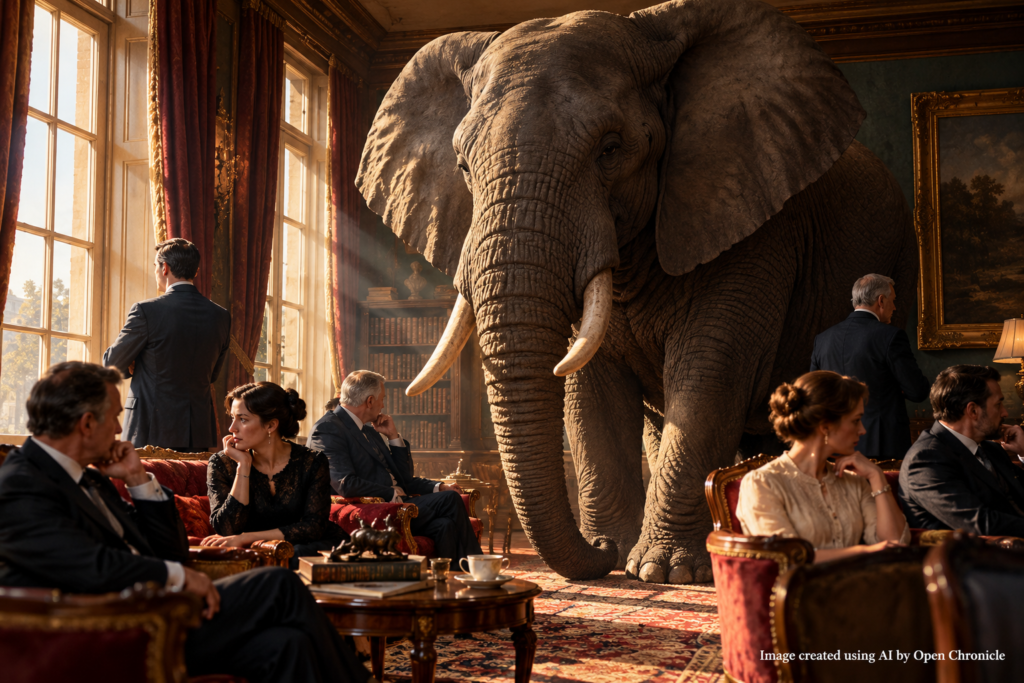
Imagine entering a room and discovering an elephant standing in the middle of it.
It would dominate the space. Everyone would see it. Moving around it would be difficult. Pretending that it was not there would require an extraordinary collective act of denial.
And yet everyone continues the conversation.
Nobody mentions the elephant.
Few expressions capture the strange rituals of human silence quite as effectively as “the elephant in the room.”
Today, the phrase describes an obvious and important problem that everyone knows exists but which, because it is embarrassing, controversial or uncomfortable, nobody wants to discuss.
It appears in political debate, journalism, business meetings, family conversations and everyday speech. A financial crisis can be the elephant in the room. So can an impending divorce, an institutional scandal, an obvious failure or an uncomfortable truth.
The metaphor feels almost self-explanatory.
Its history, however, is more complicated than the familiar story sometimes told about its origin.
The modern English idiom appears to have developed primarily during the twentieth century. But behind it lies a much older literary tradition involving elephants, observation and the extraordinary human capacity to overlook what should be impossible to miss.
A Russian Fable and an Invisible Elephant
One of the most intriguing ancestors of the expression takes us not to Britain or America, but to imperial Russia.
In 1814, the Russian poet and fabulist Ivan Andreyevich Krylov published a short fable generally translated into English as “The Inquisitive Man.”
Krylov, born in 1769, became one of Russia’s most celebrated writers of fables. Like Aesop and Jean de La Fontaine before him, he used short stories, animals and comic situations to expose human weaknesses.
“The Inquisitive Man” presents a wonderfully simple absurdity.
A man has visited a museum containing curiosities of the natural world. Afterwards, a friend asks him what he saw.
The visitor enthusiastically remembers tiny creatures and minute details. He has paid attention to insects and other small exhibits.
But somehow he has failed to notice something enormous.
An elephant.
The joke depends upon the disproportion.
The man capable of noticing the smallest objects has completely overlooked the largest and most obvious thing in the museum.
Krylov’s fable therefore expresses an idea remarkably close to another familiar concept: becoming so absorbed in details that one fails to recognize what is directly in front of oneself.
The elephant was not yet quite the modern “elephant in the room.”
There was no group of people collectively refusing to discuss an uncomfortable subject.
Nevertheless, the central image was already there:
the enormous thing that somehow goes unacknowledged.
Krylov’s fable subsequently became proverbial in Russian culture, and Fyodor Dostoevsky later invoked the image when describing someone who, like Krylov’s inquisitive visitor, could fail to notice the elephant while concentrating on everything else.
An Idea Older Than the Idiom
This distinction is important.
Popular histories of expressions frequently search for a single moment when someone supposedly “invented” a phrase.
Language rarely develops so neatly.
There is currently no firm evidence that Krylov coined the English expression “elephant in the room.”
His fable is better understood as an important conceptual ancestor.
It supplied an image of selective blindness: a person overlooking something so large that overlooking it becomes ridiculous.
During the following century, elephants continued to provide writers and performers with opportunities to explore precisely this kind of absurdity.
Mark Twain and the Missing Elephant
Another fascinating example appeared in 1882, when Mark Twain published The Stolen White Elephant.
Twain’s comic story concerns the search for a supposedly stolen elephant.
Detectives launch an elaborate investigation. Reports arrive from different places. Resources are deployed. The search becomes increasingly absurd.
The comedy derives partly from the enormous size of the missing object.
How does one lose an elephant?
How can something so conspicuous become the object of such extraordinary confusion?
Twain’s story is sometimes presented as another origin for “the elephant in the room.” It certainly belongs to the wider literary tradition of using an elephant to represent something comically difficult to overlook.
But once again, it is not the modern idiom itself.
The historical trail therefore requires caution.
Krylov gives us the unnoticed elephant.
Twain gives us the absurdly elusive elephant.
Neither provides a straightforward documented birth certificate for the phrase we use today.
“Is There an Elephant in the Classroom?”
By the early twentieth century, English-language texts were already using the basic image of an elephant occupying an ordinary interior space.
One intriguing example appeared in a British educational journal in 1915, with the question:
“Is there an elephant in the class-room?”
This was not necessarily being used in today’s idiomatic sense. The example instead demonstrates that the comic juxtaposition of an enormous elephant with an ordinary room was already understandable to English readers.
The image works because of physical impossibility — or at least extreme incongruity.
A chair belongs in a room.
A table belongs in a room.
An elephant does not.
If one were present, everyone would notice.
That basic visual logic would eventually become the foundation of the modern metaphor.
The Elephant Moves into the Living Room
The trail becomes clearer in mid-twentieth-century America.
A 1952 occurrence in the Charleston Gazette contains a reference to getting an elephant “out of your room,” although the context does not clearly establish the modern idiomatic meaning. Researchers therefore treat it cautiously rather than as definitive evidence of the expression as we now understand it.
A much more significant example appeared several years later.
On 20 June 1959, The New York Times used a striking comparison while discussing the problem of financing schools.
The problem was compared to having an elephant in the living room — something so enormous that it could not simply be ignored.
The Oxford English Dictionary has cited this 1959 example as an important early recorded use of the image in English.
Yet there is another subtle distinction.
The 1959 example emphasizes something too large to ignore.
The modern idiom normally describes something that is both obvious and nevertheless being avoided in conversation.
The elephant was now inside the living room.
But the metaphor still had some evolving to do.
From Something Obvious to Something Nobody Will Discuss
During the second half of the twentieth century, the metaphor acquired its familiar psychological and social dimension.
The elephant was no longer simply a gigantic problem.
It became the gigantic problem everyone knew about but avoided mentioning.
That transformation made the expression much more powerful.
Consider the difference.
Calling something “a huge problem” merely describes its scale.
Calling it “the elephant in the room” says something about the people surrounding the problem.
They know.
They see.
But they remain silent.
The metaphor therefore describes not just a problem but a social relationship with a problem.
That is why the phrase became especially useful for subjects surrounded by shame, embarrassment, fear or taboo.
The Elephant in the Living Room
An important stage in the expression’s popularization came through discussions of alcoholism and dysfunctional families.
In 1984, Marion H. Typpo and Jill M. Hastings published An Elephant in the Living Room: A Leader’s Guide for Helping Children of Alcoholics.
The title captured the metaphor perfectly.
Alcoholism could dominate family life while simultaneously becoming the subject nobody was permitted to acknowledge openly.
Everyone lived around it.
Everyone adapted to it.
Everyone experienced its consequences.
Yet the central problem might remain unspoken.
Phrase historian Michael Quinion identifies the book as an important example in the development of the expression toward its familiar modern meaning.
Here the elephant had become something more than an obvious object.
It represented collective denial.
Why an Elephant?
The success of the expression depends partly upon the animal chosen.
An elephant is enormous.
It occupies space.
It cannot easily hide.
Its presence changes the environment around it.
And placing one inside a domestic room creates an instantly absurd mental picture.
That makes the metaphor cognitively efficient.
No elaborate explanation is necessary.
If ten people were sitting around a table with an elephant standing beside them, the absurdity would not be that they failed physically to see it.
The absurdity would be that they behaved as though they had not.
That distinction lies at the heart of the idiom.
The elephant is not invisible.
It is socially invisible.
The Psychology Behind the Expression
The endurance of the phrase also reflects something much older than the expression itself.
Human groups frequently avoid uncomfortable subjects.
Families do it.
Governments do it.
Companies do it.
Institutions do it.
Entire societies can do it.
People may remain silent because acknowledging a problem would require action. They may fear conflict, humiliation, punishment or social exclusion. Sometimes every individual in a group recognizes a problem while simultaneously believing that everyone else prefers not to discuss it.
Silence then reinforces silence.
The elephant grows larger precisely because nobody names it.
This is why the expression can be applied to circumstances ranging from a tense dinner table to major institutional failures.
It describes a surprisingly universal form of human behaviour.
From “Living Room” to “Room”
The American examples frequently referred to an “elephant in the living room.”
Over time, the expression was shortened.
The living room became simply the room.
This made the idiom more flexible.
An elephant could metaphorically occupy a boardroom, parliament, classroom, newsroom, conference hall or diplomatic summit.
By removing the domestic specificity of “living room,” the expression became applicable almost anywhere.
Today, “the elephant in the room” is the dominant form.
Its meaning is immediately understood across much of the English-speaking world.
A Phrase Made for Journalism
Journalists particularly embraced the expression because it performs several tasks simultaneously.
It identifies an issue as important.
It suggests that the issue is obvious.
And it implies that the people involved are reluctant to discuss it.
A headline asking about “the elephant in the room” therefore contains an implicit challenge:
Why is nobody talking about this?
That rhetorical usefulness helped the expression spread through political commentary, business writing and public debate.
Eventually, however, success produced another consequence.
The phrase became a cliché.
Its very familiarity demonstrates how completely the metaphor has entered modern language.
The Expression Travels Beyond English
Like many successful English idioms, “the elephant in the room” has increasingly crossed linguistic boundaries.
Equivalent or directly translated formulations now appear in numerous languages, especially through journalism, international business, politics and social media.
Portuguese provides a good example.
“O elefante na sala” or “o elefante na sala de estar” is readily understood by many contemporary readers even though the construction developed from an English-language idiom rather than from a traditional Portuguese proverb.
This is itself historically interesting.
Expressions migrate just as words do.
Mass media, translation, international institutions, cinema, television and later the internet dramatically accelerated that process during the twentieth and twenty-first centuries.
An image associated with Russian literature in the nineteenth century eventually became part of an international vocabulary for describing uncomfortable silence.
Did Ivan Krylov Really Invent the Phrase?
This is where the historical answer must remain precise.
It is tempting to tell a beautifully simple story:
1814 → Ivan Krylov writes about an unnoticed elephant → “the elephant in the room” is born.
But the evidence does not justify such certainty.
Krylov’s The Inquisitive Man is an important predecessor because it presents the memorable image of someone noticing trivial details while overlooking an elephant.
But the modern English idiom appears much later, and its exact origin remains uncertain. Phrase histories identify mid-twentieth-century American examples, while the 1959 New York Times usage represents an especially important documented stage in its development.
It is therefore more accurate to describe the expression as the product of an evolution of metaphor rather than the invention of one writer on one particular day.
That makes its history more interesting, not less.
Two Centuries of Not Seeing the Obvious
In 1814, Krylov imagined a curious man who could observe the tiniest exhibits in a museum and somehow overlook an elephant.
The joke survived because it recognized something deeply human.
We are not always blind to what is hidden.
Sometimes we are remarkably good at being blind to what is directly in front of us.
Over the following two centuries, the elephant migrated.
From Krylov’s museum it entered literary culture.
Later it appeared in classrooms and living rooms.
Eventually it entered the metaphorical room occupied by families, companies, governments and societies.
And somewhere during that journey, its meaning changed.
The elephant was no longer merely something somebody failed to notice.
It became something everybody noticed but nobody wanted to acknowledge.
That is the reason the expression remains so powerful.
The elephant has never really been the subject of the metaphor.
The people refusing to talk about it are.