
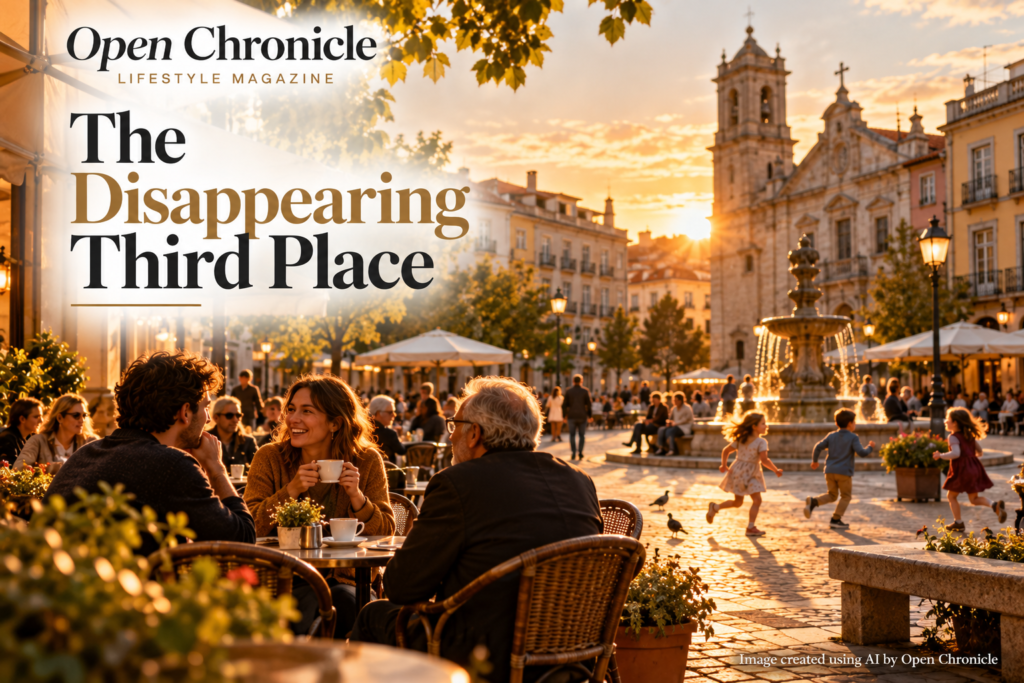
Between home and work, there used to be places where life happened naturally. Cafés, libraries, neighbourhood squares and community spaces offered something increasingly difficult to find: the freedom to belong without an appointment, a purpose or a price.
By Open Chronicle Lifestyle Magazine
There is something quietly remarkable about a neighbourhood café where nobody asks why you have come.
Perhaps you order a coffee.
Perhaps you read the newspaper.
Perhaps you exchange a few words with someone sitting nearby.
You might remain for twenty minutes or an entire afternoon.
Nothing particularly important happens.
And yet, something essential is taking place.
You are participating in the ordinary social life of a community.
For generations, people have found belonging in places that existed outside the responsibilities of home and the demands of employment.
The local café.
The public library.
The neighbourhood square.
The community centre.
The park bench where familiar faces gathered every afternoon.
These spaces rarely appeared in discussions about economic growth or personal success. They were not necessarily fashionable, profitable or architecturally remarkable.
But they provided something that modern societies increasingly struggle to reproduce.
They allowed people to encounter one another without needing a particular reason.
Today, the future of these spaces is uncertain.
Rising commercial rents, changing consumer habits, urban redevelopment, digital entertainment and increasingly private lifestyles are transforming the places where people spend their time.
Some traditional gathering places have disappeared. Others have adapted, while new forms of community have emerged.
The transformation is not uniform, and many cities continue to support vibrant public spaces.
Nevertheless, an important question deserves attention.
What happens when the places that once brought people together become harder to find, harder to access or too expensive to enjoy?
1. The Space Between Home and Work
In 1989, the American sociologist Ray Oldenburg popularised the concept of the third place in his book The Great Good Place.
The idea was straightforward.
Home represented the first place.
Work represented the second.
The third place was somewhere different.
An informal environment where people could gather, talk, relax and participate in community life.
Unlike the workplace, it was not primarily organised around productivity.
Unlike the home, it did not depend on family relationships or private invitations.
Third places offered a form of social freedom.
People could arrive alone and encounter others.
They could become familiar faces without necessarily becoming close friends.
They could participate in conversations that were spontaneous, unpredictable and occasionally meaningful.
Oldenburg associated these environments with the social foundations of community life.
The concept remains influential because it describes something easily overlooked.
A neighbourhood is not simply a collection of buildings.
It is also a network of repeated human encounters.
And those encounters need somewhere to happen.
2. The Café That Knew Everyone
Consider a traditional café in a European neighbourhood.
In the morning, workers stop for coffee before beginning their day.
Later, retired residents arrive to read newspapers and exchange opinions.
At lunchtime, nearby employees gather for a quick meal.
In the afternoon, parents pass through after collecting children from school.
The café becomes part of the neighbourhood’s daily rhythm.
Its importance extends beyond the food and drinks it sells.
People recognise one another.
They exchange information.
They notice when someone has been absent.
They develop a familiarity that does not necessarily require friendship.
Such establishments can provide continuity in environments where other aspects of life are constantly changing.
But the economics of running a café have become challenging in many locations.
Commercial rents, wages, energy costs and changing patterns of consumption can place pressure on independent businesses.
Some close.
Others change ownership or become more expensive.
In certain neighbourhoods, traditional establishments are replaced by businesses designed for a different clientele.
This does not mean every older café was welcoming or every modern establishment is socially inferior.
Some traditional spaces were exclusive, uncomfortable or dominated by particular groups.
New cafés can create vibrant communities of their own.
The important question is whether ordinary residents continue to have affordable, accessible places where they feel comfortable spending time.
3. When Public Space Becomes Commercial Space
Modern urban life increasingly offers opportunities to spend money.
Shopping centres.
Restaurants.
Entertainment venues.
Private leisure facilities.
Ticketed attractions.
These places can contribute significantly to the cultural and economic vitality of cities.
But access often depends on consumption.
A person may be welcome as long as they purchase something.
Remaining without spending money can become uncomfortable or impossible.
This creates a distinction between commercial activity and genuine public accessibility.
A public square allows someone to sit without ordering a drink.
A library provides a place to read without purchasing a book.
A park offers opportunities for recreation without an admission fee.
Such spaces are particularly important for people with limited disposable income.
Children.
Students.
Unemployed residents.
Retirees.
Families facing financial pressure.
When affordable gathering places become scarce, social participation can become increasingly dependent on purchasing power.
Belonging begins to acquire a price.
4. The Loneliness of the Modern City
Cities bring enormous numbers of people into close proximity.
They offer employment, education, culture and opportunities to meet individuals from different backgrounds.
Yet density does not automatically create connection.
People can share apartment buildings without knowing their neighbours.
Travel on crowded trains without speaking.
Work in large offices while experiencing little personal intimacy.
The difficulty is not simply the absence of people.
It is the absence of circumstances in which relationships can develop naturally.
Friendships often require repeated contact.
Familiarity grows when people encounter one another in low-pressure environments.
A conversation may begin with a greeting.
Over time, it becomes a longer exchange.
Eventually, trust can develop.
Third places can support this process.
They create opportunities for connection without requiring people to organise formal social events.
This matters because adult friendship can be difficult to establish.
People have busy schedules.
Existing responsibilities.
Established social circles.
And understandable hesitation about approaching strangers.
A familiar public environment can reduce some of those barriers.
5. The Library as a Democratic Living Room
Among the most valuable third places are public libraries.
Their role extends far beyond lending books.
Libraries can provide quiet study areas, internet access, educational activities, cultural events and opportunities for community participation.
For students, they offer somewhere to concentrate.
For jobseekers, access to information and digital resources.
For older residents, a familiar destination outside the home.
For families, activities that encourage reading and learning.
And for people who simply need somewhere peaceful to spend time, libraries offer something increasingly rare.
A space where remaining does not necessarily require spending money.
Of course, libraries differ considerably in their resources, accessibility and opening hours.
Some communities enjoy modern, well-funded facilities.
Others face reduced services or limited access.
Nevertheless, the broader principle is important.
A library treats knowledge, learning and social participation as public goods.
It represents the idea that valuable experiences should not depend entirely on commercial transactions.
6. The Neighbourhood Square and the Art of Encounter
A public square can appear deceptively simple.
A few benches.
Trees.
A fountain.
Perhaps a small playground.
Yet its design can influence how people interact.
A square with comfortable seating and shade invites people to remain.
One dominated by traffic encourages them to move through quickly.
A space that feels safe and accessible can attract residents of different ages.
One that is poorly maintained or difficult to reach may remain underused.
Urban design therefore shapes social opportunities.
Walkable streets, accessible parks, public seating and well-connected neighbourhoods can make informal encounters more likely.
These details may seem minor compared with major infrastructure projects.
But they influence the texture of daily life.
A city becomes more than a place to work and sleep when residents have opportunities to linger.
To observe.
To converse.
To feel that the surrounding environment belongs to them.
7. The Digital Third Place
It would be misleading to suggest that community life has simply disappeared.
Much of it has moved online.
Discussion forums, gaming communities, messaging groups and social platforms allow people to connect across geographical boundaries.
For individuals living in isolated areas or searching for others with similar interests, digital communities can be particularly valuable.
Someone with an unusual hobby may discover a global network of enthusiasts.
A person with limited mobility may find companionship without travelling.
People who feel excluded from their immediate surroundings may encounter understanding elsewhere.
These are meaningful forms of connection.
But digital spaces also operate under different conditions.
Conversations may be shaped by platform design.
Attention can be interrupted.
Commercial incentives can influence what people see.
Online participation may not provide the same opportunities for physical assistance or neighbourhood familiarity.
The distinction should not become a simplistic competition between online and offline relationships.
Both can matter.
The challenge is ensuring that digital connection does not become the only accessible form of community for people who would also value physical gathering places.
8. The Transformation of the Workplace
Workplaces have historically provided opportunities for social interaction.
Colleagues develop friendships.
Share meals.
Exchange advice.
Build routines.
For some people, employment is one of the principal sources of everyday companionship.
Remote and hybrid working have changed these patterns.
Working from home can offer substantial advantages.
Reduced commuting.
Greater flexibility.
More time with family.
Improved opportunities for people who face barriers to conventional workplaces.
But it can also reduce spontaneous encounters.
The conversation while making coffee.
The informal lunch.
The unexpected discussion that continues after a meeting.
These interactions may appear unimportant until they disappear.
The consequences vary according to personality, occupation and household circumstances.
Some people thrive when working remotely.
Others miss the social structure of the workplace.
This creates an additional reason to consider the importance of third places.
If home and work increasingly occupy the same physical environment, people may need alternative spaces for social participation.
9. The Changing Neighbourhood
Urban neighbourhoods rarely remain unchanged.
New residents arrive.
Businesses open.
Buildings are renovated.
Transport systems develop.
Cultural preferences evolve.
Change can bring investment and opportunity.
But it can also weaken established social networks.
When housing costs rise, long-term residents may relocate.
When independent businesses close, familiar gathering places can disappear.
When neighbourhoods become oriented toward visitors or higher-income consumers, some existing residents may feel increasingly excluded.
The loss is not always visible in economic statistics.
A café can be replaced by a more profitable business.
A public space can be redeveloped.
A street can become more attractive to investors.
Yet the relationships associated with those places may not be easily reproduced.
Community life depends partly on continuity.
People need time to become familiar with one another.
And repeated displacement can interrupt that process.
10. Why Children Need Places Beyond Home and School
Children also benefit from environments that exist outside formal responsibilities.
Playgrounds.
Sports facilities.
Parks.
Youth centres.
Community libraries.
These places offer opportunities to explore, play and develop relationships.
They can encourage independence and social learning.
For adolescents, accessible gathering places may be particularly important.
Young people need environments where they can spend time together without constant commercial pressure.
But public spaces are not always designed with their needs in mind.
Teenagers gathering in groups may be treated as a nuisance.
Facilities may be expensive or located far from residential areas.
Public transport may be limited.
The result can be a shortage of welcoming places for young people to meet.
A community that provides nowhere for its younger residents to gather should not be surprised when they spend more time indoors or online.
11. The Older Person Who Has Nowhere to Go
Third places can become increasingly important later in life.
Retirement changes daily routines.
Professional relationships may weaken.
Children may live elsewhere.
Health or mobility limitations can reduce opportunities for social activity.
For some older adults, a familiar café, park or community centre provides a valuable connection to the outside world.
It offers a reason to leave home.
A place to recognise familiar faces.
An opportunity for conversation.
These interactions do not replace close relationships or professional support when needed.
But they can contribute to a sense of belonging.
Accessibility matters.
Public spaces should be reachable, comfortable and welcoming to people with different physical abilities.
Seating, toilets, safe pedestrian routes and public transport are not merely practical details.
They influence who can participate in community life.
A city that is difficult for older residents to navigate risks making social connection unnecessarily difficult.
12. The Economics of Belonging
Maintaining public and community spaces requires resources.
Libraries need staff.
Parks require maintenance.
Community centres need funding.
Public squares require investment in safety, accessibility and infrastructure.
These costs can make third places vulnerable when public budgets face pressure.
Yet evaluating such spaces solely through immediate financial returns overlooks their wider functions.
A public library may support education and digital inclusion.
A community centre may provide opportunities for volunteering and social participation.
A well-designed park may encourage physical activity and informal interaction.
These benefits are difficult to reduce to a single financial measure.
That does not mean every proposed investment is automatically justified.
Public resources are limited, and different communities have different needs.
But the value of social infrastructure deserves consideration alongside conventional economic indicators.
The question is not only how much a place costs to maintain.
It is what opportunities disappear when that place no longer exists.
13. Can New Third Places Be Created?
The future of community life does not depend exclusively on preserving traditional institutions.
New gathering places can emerge.
Community gardens.
Shared workshops.
Neighbourhood cultural centres.
Public reading rooms.
Local markets.
Multifunctional libraries.
Cooperative cafés.
Spaces combining education, recreation and community activities.
Successful third places do not necessarily require elaborate architecture.
They need accessibility, familiarity and a reason for people to return.
A community garden can bring neighbours together through shared work.
A local book club can create recurring opportunities for conversation.
A public cultural programme can introduce people who would otherwise never meet.
The most effective solutions will depend on local circumstances.
A dense urban neighbourhood may need more accessible public seating.
A suburban area may benefit from a community centre.
A rural town may need improved transport connections to existing facilities.
There is no universal design for belonging.
But there is a common principle.
People need opportunities to encounter one another without excessive financial, physical or social barriers.
14. The Difference Between Being a Customer and Being a Regular
One of the defining qualities of a successful third place is familiarity.
A customer purchases something.
A regular becomes part of the environment.
The distinction is subtle.
A regular may be recognised by name.
Their usual order may be remembered.
They may know other visitors.
They may feel comfortable arriving alone.
Over time, the place becomes part of their personal geography.
It is somewhere they belong.
This sense of familiarity cannot be manufactured instantly.
It develops through repeated encounters and ordinary interactions.
Businesses can encourage it through welcoming environments and consistent service.
Public institutions can support it through regular activities and accessible facilities.
But belonging ultimately depends on people.
The relationships that develop within a place give it meaning.
A beautiful building without human connection may remain emotionally empty.
A modest café filled with familiar faces can become an essential part of someone’s life.
15. The Right to Be Somewhere
There is a deeper question behind the discussion of third places.
Where can someone go simply to exist?
Without working.
Without shopping.
Without needing an invitation.
Without being expected to achieve something.
For people with comfortable homes and disposable income, the question may seem abstract.
For others, it is practical.
A person living in overcrowded accommodation may need somewhere quiet.
A teenager may need a safe place to meet friends.
An older resident may want companionship.
Someone experiencing financial hardship may need an environment where participation does not require spending.
Public space offers a form of freedom that is easy to underestimate.
The ability to be present.
To observe.
To rest.
To encounter others.
To participate in the life of a community.
This freedom is part of what makes a city feel welcoming rather than merely functional.
16. Rebuilding the Everyday Community
The future of third places will not be determined by nostalgia alone.
Traditional cafés will continue to evolve.
Digital communities will remain important.
Work patterns will change.
Cities will grow and adapt.
The objective should not be to recreate an idealised past.
It should be to understand which social functions deserve protection.
Affordable places to gather.
Accessible public environments.
Opportunities for repeated encounters.
Spaces that welcome different generations and backgrounds.
Community institutions that provide continuity.
These are not extravagant ambitions.
They are part of the basic infrastructure of social life.
A society can have impressive buildings, efficient transport and advanced technology while still leaving its residents disconnected.
Physical development and social development are not always the same thing.
The challenge is to design communities that support both.
17. Somewhere to Belong
Imagine a small square on an ordinary afternoon.
A child is playing.
Two older neighbours are talking.
Someone is reading on a bench.
A student is waiting for a friend.
A café owner greets a familiar customer.
Nothing extraordinary is happening.
There is no major event.
No commercial spectacle.
No carefully organised experience.
Just people sharing a place.
Yet these ordinary encounters contribute to something essential.
They make a neighbourhood feel inhabited rather than merely occupied.
They create familiarity.
They allow relationships to begin without planning.
They remind people that they are part of a wider community.
The disappearance of third places is not simply a question of losing cafés, libraries or public squares.
It is about losing some of the environments in which everyday social life becomes possible.
And rebuilding them requires more than constructing attractive spaces.
It requires recognising that human beings need somewhere to belong.
Not only at home.
Not only at work.
But in the ordinary world between them.
Perhaps the most important places in our lives are not always the ones where we achieve something remarkable.
Sometimes they are simply the places where we are allowed to be together.
Sources and Further Reading
The following academic, institutional and public policy references provide the research foundation for this article, examining third places, social infrastructure, public libraries, community spaces and the importance of human connection in contemporary society.
The Great Good Place
Ray Oldenburg
A foundational work introducing the concept of third places and examining the importance of informal public gathering spaces in community life.
Revised edition, 1999
Palaces for the People: How Social Infrastructure Can Help Fight Inequality, Polarization, and the Decline of Civic Life
Eric Klinenberg
An examination of the role of libraries, parks and other forms of social infrastructure in supporting communities.
From Loneliness to Social Connection: Charting a Path to Healthier Societies
World Health Organization
International research examining loneliness, social isolation and the importance of social connection for health and wellbeing.
Global Public Space Programme
UN-Habitat
An international initiative supporting accessible, inclusive and safe public spaces in cities and communities.
Public Libraries
UNESCO
Institutional resources examining the role of public libraries in access to knowledge, education and community participation.
EDITORIAL TRANSPARENCY
This article combines established urban sociology concepts, research on social infrastructure, international public health evidence and original lifestyle commentary. The discussion of disappearing third places does not imply that all traditional gathering spaces are declining, that digital communities are inherently inferior or that every neighbourhood is experiencing the same changes. The accessibility and social value of public spaces vary according to local conditions, income, disability, age, cultural context and public investment. Illustrative scenes are not presented as documented individual case studies. The article examines third places as one dimension of community life rather than a universal solution to loneliness or social disconnection.
Discover More Lifestyle Stories
Explore inspiring stories about contemporary living, remarkable people, travel, style, wellbeing and the experiences that shape our everyday lives.
← Back to Open Chronicle Lifestyle