
OPEN CHRONICLE | TECHNOLOGY · TECH INDUSTRY NEWS & ANALYSIS
By Open Chronicle Technology | November 13, 2026
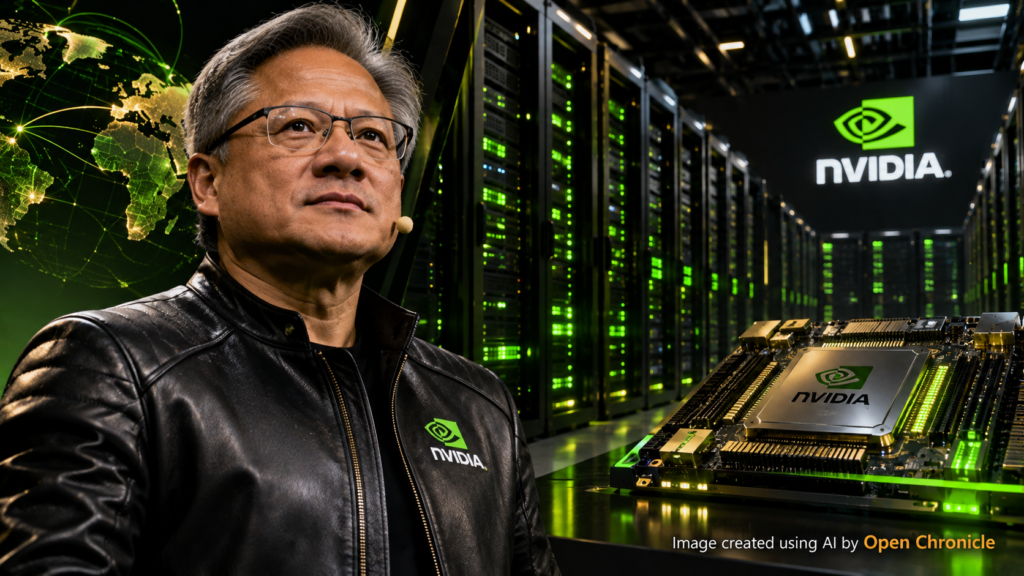
The sudden departure of Nvidia’s co-founder and longtime chief executive has shaken the world’s most influential artificial intelligence chipmaker. As national security concerns, leadership uncertainty and geopolitical tensions converge, the crisis raises a fundamental question: can the AI industry maintain its momentum without the man who helped build its technological foundations?
The end of an era in artificial intelligence
For more than three decades, Jensen Huang was more than the chief executive of Nvidia.
He was the architect of a company that helped transform graphics processing units from specialised gaming hardware into the computational foundation of the artificial intelligence revolution.
Under his leadership, Nvidia became central to the development of advanced AI systems, supplying processors, networking technology and software infrastructure used by some of the world’s largest technology companies.
On November 12, 2026, that era came to an abrupt end.
Nvidia announced that Huang had resigned as president, chief executive officer and a member of its board of directors, effective immediately. The company appointed longtime chief financial officer Colette Kress as interim CEO and named veteran board member Harvey C. Jones as its first board chair.
The leadership transition was confirmed in an official corporate announcement and a regulatory filing with the United States Securities and Exchange Commission.
The departure followed a turbulent period involving revelations about Huang’s personal relationships and allegations that he had been targeted by a foreign intelligence operation.
The company now faces a challenge that extends well beyond replacing a prominent executive.
It must demonstrate that the organisation, technology strategy and business relationships built during Huang’s 33 years at the helm can continue to function without his direct leadership.
For Nvidia, this is a corporate succession crisis.
For the wider technology industry, it is a test of how dependent the artificial intelligence economy has become on one company and, potentially, one individual.
What happened inside Nvidia?
The immediate events leading to Huang’s departure involved both personal controversy and national security concerns.
Reports emerged concerning extramarital relationships involving Huang, including a relationship with a Chinese businesswoman whom American authorities reportedly suspected of connections to Chinese intelligence.
Huang publicly acknowledged marital infidelity and apologised to his family and employees.
Nvidia’s board subsequently announced an independent investigation following reports that its founder and chief executive might have been the target of a foreign intelligence effort.
The company retained outside legal advisers to examine the circumstances.
These developments require an important distinction.
The existence of an investigation does not establish that espionage occurred.
Nor does an alleged relationship with someone suspected of intelligence connections prove that confidential corporate information was compromised.
According to reporting by Reuters and the Associated Press, American authorities were examining aspects of the situation, while Nvidia stated that it had no reason to believe national security information or company secrets had been compromised.
The allegations remain separate from the confirmed corporate developments.
What is established is that Huang has left his executive and board positions, an interim chief executive has been appointed, and Nvidia has begun searching for permanent leadership.
The speed of the transition illustrates how reputational, governance and security concerns can converge at companies operating in strategically sensitive industries.
For Nvidia, whose processors are central to advanced artificial intelligence development and international technology competition, the consequences are particularly significant.
Colette Kress inherits an extraordinary challenge
Colette Kress, Interim Chief Executive Officer
Kress joined Nvidia in 2013 and has overseen the company’s financial operations during its expansion into a dominant supplier of AI computing infrastructure.
Her experience provides continuity at a moment when investors, customers and employees are looking for stability.
Kress is not an outsider arriving to reorganise an unfamiliar business.
She has worked closely with Nvidia’s leadership during a period of exceptional growth and understands the financial structure, customer relationships and investment commitments underpinning the company.
Nevertheless, the challenge is substantial.
Huang’s influence extended beyond traditional executive management.
He played a central role in product strategy, engineering priorities, relationships with major customers and Nvidia’s public positioning as the essential infrastructure provider for artificial intelligence.
He also became one of the industry’s most recognisable advocates, using product launches and technology conferences to communicate a vision of accelerated computing that extended from data centres to robotics and autonomous systems.
Replacing those responsibilities will require more than appointing a new spokesperson.
Nvidia’s board must decide whether to preserve its highly centralised leadership model or distribute responsibilities across a broader executive structure.
The appointment of Harvey Jones as board chair creates a clearer separation between corporate governance and executive management.
It may also provide an opportunity to strengthen oversight, succession planning and internal accountability.
The company has stated that it intends to maintain operations, customer commitments and its technology roadmap without interruption.
That commitment will now be tested.
Why Nvidia matters to the entire AI industry
Nvidia’s importance comes from its position across several interconnected layers of AI infrastructure.
Its GPUs provide the parallel processing capacity required for training and running many advanced machine learning models.
Its networking technologies allow large numbers of processors to operate together within data centres.
Its CUDA software ecosystem gives developers tools and libraries for building accelerated applications.
Its integrated systems connect hardware, software and networking into platforms that can be deployed at enormous scale.
This combination has created a powerful competitive advantage.
A technology company building a large AI system is not simply purchasing individual chips.
It may be adopting an entire computing architecture involving processors, memory, networking, development tools, software libraries and specialised operational expertise.
Changing suppliers can therefore involve significant engineering work.
That dependency helps explain why Nvidia has become so influential.
Major cloud providers, AI developers, research laboratories and enterprise technology companies rely on Nvidia infrastructure for important workloads.
However, Nvidia does not control the entire AI industry.
Competitors including AMD, Intel and specialised AI accelerator developers are pursuing alternative architectures.
Large technology companies are also developing their own processors to reduce costs and improve control over computing infrastructure.
The question is whether these alternatives can expand quickly enough to reduce Nvidia’s influence.
Nvidia’s Technological Empire
NVIDIA AI COMPUTING PLATFORM
An integrated hardware, software and networking ecosystem
AI GPUs
Training and inference acceleration
CUDA
Programming tools and software libraries
Networking
High-speed connections between processors
AI Systems
Integrated data centre infrastructure
Nvidia’s competitive strength extends beyond individual processors. By combining advanced AI GPUs, the CUDA software ecosystem, high-performance networking and integrated computing systems, the company provides a comprehensive technological foundation for artificial intelligence development and large-scale data centre operations.
OPEN CHRONICLE TECHNOLOGY | AI INFRASTRUCTURE
GLOBAL AI APPLICATIONS
Cloud platforms · Generative AI · Scientific computing · Robotics · Enterprise systems
Illustrative overview of Nvidia’s AI technology ecosystem. Individual applications may use competing hardware and software platforms.
The architecture is important because Nvidia’s influence cannot be measured only through its semiconductor sales.
Its competitive position also depends on the software, developer expertise and customer investments accumulated around its platforms.
This makes the company difficult to replace in the short term, even when competing processors offer attractive performance or pricing.
The stock market reacts to uncertainty
Investors responded sharply to Huang’s departure.
Nvidia shares experienced substantial volatility following the announcement, with early trading losses narrowing as the session progressed.
Reuters reported that the stock closed approximately 4.3% lower on Thursday, November 12.
The decline reflected concerns about corporate leadership, governance and the company’s future strategic direction.
Market reactions to major executive departures can be dramatic, particularly when the departing leader is closely associated with a company’s identity.
However, a share price decline does not necessarily indicate that the underlying business has deteriorated.
Nvidia’s customer relationships, intellectual property, engineering workforce and existing products remain in place.
Its immediate financial performance will depend on factors such as demand for AI computing, manufacturing capacity, product availability, operating costs and competitive pressure.
The leadership transition introduces uncertainty into those calculations.
Investors will now examine whether the company can maintain its technological roadmap and commercial relationships under new management.
Nvidia’s next financial results, scheduled for November 17, will provide an early opportunity to assess the company’s operational performance and hear how its leadership intends to manage the transition.
The results will not, by themselves, resolve the longer-term succession question.
The China problem becomes even more complicated
The crisis arrives during a period of intense competition between the United States and China over advanced semiconductor technology.
Nvidia’s most powerful AI processors have become strategically important because of their potential applications in advanced research, commercial artificial intelligence and national security systems.
Washington has imposed export restrictions intended to limit Chinese access to certain advanced computing technologies.
China, meanwhile, is investing heavily in domestic semiconductor development and alternatives to American technology platforms.
Huang had argued for maintaining commercial access to the Chinese market within applicable regulatory limits.
His departure may weaken a prominent industry voice advocating that position.
On November 13, Reuters reported that American lawmakers were increasingly discussing tighter restrictions on advanced chip exports to China, while Chinese technology shares came under pressure amid uncertainty about future access to Nvidia products.
This is not merely a commercial issue.
Advanced semiconductors have become instruments of economic policy and geopolitical influence.
The decisions made by Washington can affect the competitive position of American chipmakers, the development of Chinese AI systems and the global availability of high-performance computing.
Nvidia’s new leadership must navigate these tensions while maintaining relationships with governments, customers and manufacturing partners.
The company may also face increased scrutiny of its international partnerships and internal security procedures.
For the technology industry, the episode demonstrates how corporate governance can intersect with national security policy.
Can Nvidia’s competitors benefit?
The leadership transition creates uncertainty, but it may also create opportunities for competing technology companies.
AMD has been developing AI accelerators intended to compete in data centre workloads.
Intel continues to pursue its own semiconductor and AI computing strategies.
Google has invested in Tensor Processing Units, while Amazon and Microsoft have developed specialised chips for selected cloud and AI applications.
Other companies are pursuing alternative processor architectures designed for particular inference or training workloads.
COMPETITIVE LANDSCAPE | AI COMPUTING
| Company | Strategic position |
| Nvidia | Integrated AI GPUs, networking and CUDA ecosystem |
| AMD | Alternative data centre GPUs and ROCm software ecosystem |
| Custom TPUs for AI workloads | |
| Amazon | Trainium and Inferentia cloud accelerators |
| Microsoft | Maia AI accelerators and Azure infrastructure |
| Intel | Data centre processors and AI acceleration technologies |
Strategic overview, not a performance ranking or market share comparison.
A change in Nvidia’s leadership does not automatically make these alternatives more competitive.
Technology adoption depends on performance, software compatibility, availability, total cost of ownership and long-term support.
Nevertheless, large customers may see an opportunity to reconsider procurement strategies and reduce dependence on a single supplier.
For Nvidia, preserving customer confidence will be essential.
A leadership crisis is not necessarily an AI crisis
The most dramatic interpretation of Huang’s resignation is that it threatens the entire artificial intelligence boom.
That conclusion would be premature.
Demand for AI computing is driven by many forces, including investment in data centres, development of new AI models, enterprise adoption, scientific research and government technology programmes.
Those forces do not disappear because one company’s chief executive resigns.
Nvidia also possesses substantial engineering expertise, established product development processes and a global network of suppliers and partners.
Its technical capabilities are not dependent on Huang personally performing every engineering or commercial function.
However, leadership matters when an industry is evolving rapidly.
Decisions about future processor architectures, manufacturing partnerships, software strategy, pricing and international markets can influence competitive performance for years.
Huang’s departure therefore creates a strategic risk rather than proof of technological decline.
The distinction is essential.
The AI industry could continue expanding while Nvidia experiences a period of uncertainty.
Alternatively, a poorly managed transition could give competitors opportunities to gain ground.
Neither outcome is inevitable.
Five Questions That Will Determine Nvidia’s Future
Nvidia’s next chapter will be shaped by leadership decisions, technological execution, geopolitical pressures, competition and investor confidence.
Who will permanently replace Jensen Huang?
Nvidia must identify a leader capable of balancing engineering, commercial strategy, international politics and investor expectations.
Will the technology roadmap remain on schedule?
Customers will look for evidence that product development, manufacturing commitments and software innovation remain unaffected.
Will the United States tighten semiconductor export restrictions?
Changes in policy could reshape Nvidia’s access to China and influence the international AI computing market.
Can competitors reduce Nvidia’s market dominance?
Alternative accelerators and custom chips could become increasingly attractive to customers seeking greater flexibility.
Will investors continue supporting the enormous AI infrastructure buildout?
Nvidia’s performance will remain closely connected to confidence in the commercial returns of artificial intelligence investment.
Nvidia’s long-term position will depend on its ability to sustain technological innovation, manage geopolitical uncertainty, preserve customer confidence and respond to an increasingly competitive artificial intelligence infrastructure market.
OPEN CHRONICLE TECHNOLOGY | TECHNICAL & STRATEGIC
The deeper issue: has the AI economy become too concentrated?
Nvidia’s leadership crisis exposes a structural issue that extends beyond the company itself.
The modern AI industry depends on a relatively small number of companies controlling critical layers of infrastructure.
Advanced semiconductor manufacturing is concentrated among a limited group of producers.
High-performance AI processors are supplied by a relatively small number of major developers.
Large-scale cloud computing is dominated by a handful of global platforms.
Leading AI models require enormous investments in computing, energy, networking and specialised engineering expertise.
This concentration creates efficiencies and accelerates technological development.
It also introduces dependencies.
A disruption involving a major semiconductor manufacturer, a cloud provider or an important AI hardware supplier can affect organisations far beyond the company directly involved.
The departure of a prominent executive is different from a technical outage or a manufacturing interruption.
Nevertheless, it raises a related question about institutional resilience.
How well can the world’s most important technology companies continue operating when the individuals who shaped their strategies are no longer in charge?
For Nvidia, that question has become immediate.
For the AI industry, it is part of a broader debate about whether the infrastructure supporting artificial intelligence has become too concentrated.
What happens next?
The coming weeks will be critical.
Nvidia’s board must manage the leadership search while maintaining confidence among employees, customers, shareholders and government partners.
Colette Kress will have to demonstrate that the company can continue executing its strategy during the transition.
Investors will closely examine the financial results scheduled for November 17, particularly management’s comments on demand, product development and operational continuity.
Regulators and lawmakers may continue scrutinising the circumstances surrounding Huang’s departure and the wider national security implications.
Meanwhile, competitors will watch for signs that Nvidia’s customers are reconsidering their dependence on its technology.
The most important developments may not emerge immediately.
Corporate leadership transitions often influence product decisions, organisational structures and strategic partnerships over several years.
Nvidia’s response will therefore be measured not only by its next quarterly results but by its ability to sustain technological leadership.
Conclusion: the AI revolution enters a new chapter
Jensen Huang helped transform Nvidia from a graphics technology company into one of the defining businesses of the artificial intelligence era.
His departure marks a historic turning point.
But the future of Nvidia and the future of artificial intelligence are not the same thing.
The industry has grown beyond any single executive, even one as influential as Huang.
AI research, commercial adoption, semiconductor innovation and investment in computing infrastructure will continue.
The uncertainty lies in how Nvidia will adapt to the absence of the leader who guided its transformation for more than three decades.
Its response will test the strength of its management, technology ecosystem, corporate governance and relationships with customers and governments.
For the wider technology industry, the lesson is equally important.
The artificial intelligence revolution is no longer simply a story about increasingly powerful models and processors.
It is also a story about the institutions, infrastructure and strategic decisions that determine who controls those technologies.
Nvidia helped build the foundations of the AI economy. Its next challenge is proving that those foundations are stronger than the leadership of any one individual.
Sources and Further Reading
Official corporate documentation, regulatory filings and independent reporting supporting this analysis of Nvidia’s leadership transition and its implications for the global artificial intelligence industry.
NVIDIA Announces CEO Transition
Official corporate announcement confirming Huang’s resignation, the appointment of Colette Kress and the new board leadership.
NVIDIA Corporation, Form 8-K
Regulatory documentation of the leadership transition and board appointments.
Nvidia CEO Jensen Huang Resigns in Blow to AI Boom
Reporting on the resignation, corporate governance concerns, market reaction and geopolitical implications.
What We Know After Jensen Huang Resigns as Nvidia CEO
Coverage distinguishing confirmed corporate developments from allegations and ongoing investigations.
China’s Access to Nvidia Chips in Doubt as U.S. Restrictions Gain Support
Reporting on export controls, congressional developments and implications for China’s semiconductor industry.
This article draws on Nvidia’s official statements, regulatory filings and independent reporting available on November 13, 2026. Allegations involving foreign intelligence activities are presented as unproven and are distinguished from confirmed corporate developments. Assessments of Nvidia’s competitive position, future leadership and implications for the AI industry represent editorial analysis rather than established outcomes. The situation remains subject to further investigation and developments.
OPEN CHRONICLE TECHNOLOGY | INDEPENDENT TECHNOLOGY JOURNALISM