
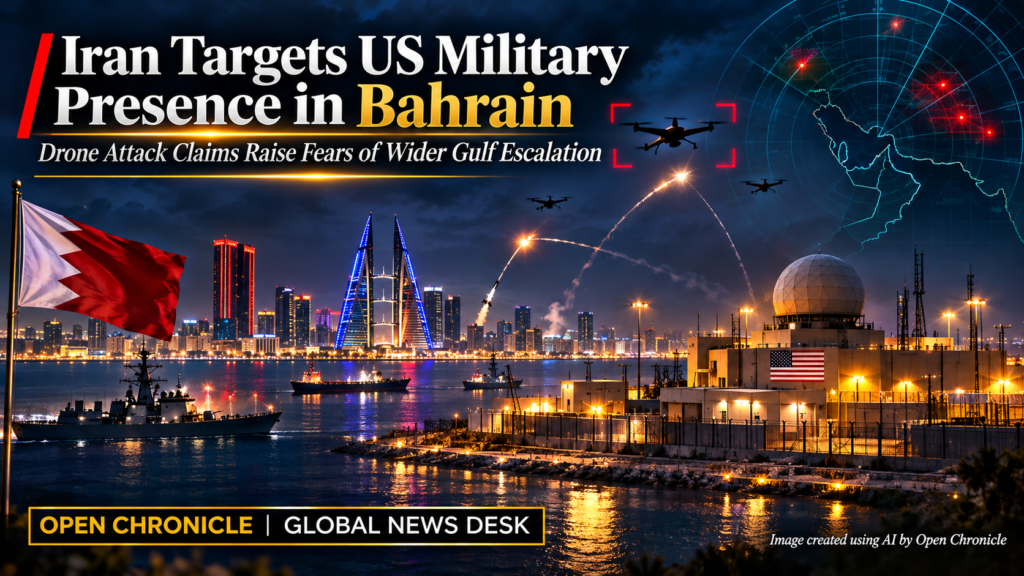
Tehran says it targeted an American military radar installation in Bahrain with six drones, while Bahraini authorities report intercepting Iranian aerial attacks. The incident raises fears of a wider confrontation in the Gulf, placing US military installations, regional air defences and vital maritime routes under renewed scrutiny.
By Open Chronicle News Desk
November 15, 2026 | Middle East | Defence & Geopolitics | Special Report
1. A New Flashpoint in the Persian Gulf
The confrontation between Iran and the United States has entered another dangerous phase following Iranian claims of a drone operation against an American military facility in Bahrain.
On Sunday, November 15, Iran’s Islamic Revolutionary Guard Corps (IRGC) said it had launched six drones against a US radar installation in the Gulf kingdom.
Bahraini authorities separately reported that their air defence systems had intercepted and destroyed several Iranian aerial threats.
The announcements point to a serious security incident in a country that hosts one of the United States’ most important military presences in the Middle East.
However, a crucial distinction remains: Iran’s claim that it targeted an American installation does not establish that the facility was successfully struck or damaged.
The number of drones that reached their intended targets, the extent of any damage and the precise sequence of events have not been independently established.
The incident comes amid mounting tensions over Iran’s military capabilities, American operations in the region and the security of strategic maritime corridors.
For Washington and its regional partners, the immediate concern is whether the reported operation represents a limited act of retaliation or the beginning of a broader campaign against American military infrastructure.
2. What Iran Says Happened at Al-Riffa Air Base
According to statements carried by Iranian state media, the IRGC’s Aerospace Force directed six drones toward an American air defence radar system at the Al-Riffa helicopter base, south of Bahrain’s capital, Manama.
Tehran described the operation as retaliation for what it considers hostile American military actions, including an alleged US strike against communications infrastructure in Sirik, southern Iran.
The IRGC presented the attack as part of a broader military response rather than an isolated operation.
Iranian media circulated material purportedly showing the strike, but the existence of such footage does not independently verify that the intended target was hit.
The distinction is especially important because military statements issued during active hostilities frequently serve both operational and political objectives.
The reported target was not an ordinary civilian installation. An air defence radar supports the detection and tracking of aerial threats and can form part of a wider military warning network.
Disrupting such a system could, in principle, reduce the effectiveness of regional surveillance or air defence coordination.
There is, however, no independently confirmed evidence that Sunday’s operation achieved that objective.
3. Bahrain Reports Interceptions as Air Raid Sirens Sound
Bahrain’s account differs from the Iranian version in a significant respect.
The Bahrain Defence Force said its air defence systems intercepted several Iranian aerial attacks before they reached their targets.
Residents reported explosions and air raid sirens during the early morning hours.
The Interior Ministry issued two security alerts, urging people to remain calm and move to safe locations.
These were the first such public threat warnings since September, according to Reuters.
Bahrain’s Foreign Ministry condemned the attacks and rejected the use of its territory as a battleground for confrontation between Iran and the United States.
The government held Tehran responsible for the incidents and their potential consequences.
The immediate public safety implications were considerable. Even when incoming drones are intercepted, debris, defensive missiles and uncertainty over additional attacks can create risks for populated areas.
Bahrain is a densely populated island kingdom, and its proximity to Iran makes it particularly exposed to military escalation in the Gulf.
As of the reporting reviewed for this article, authorities had not established a confirmed damage assessment for the alleged American radar strike.
4. The Second Iranian Attack Claim in Three Days
Sunday’s developments followed another Iranian claim involving an American radar facility in Bahrain on November 13.
On that occasion, Tehran asserted that its forces had destroyed a US early-warning radar.
United States Central Command rejected the claim.
CENTCOM stated that two Iranian attack drones had approached Bahrain and that American forces intercepted both.
The command reported no injuries or damage.
That earlier incident provides an important reference point for assessing the latest claims.
It demonstrates that Iranian statements about successful strikes have not always matched subsequent American accounts.
However, the outcome of Friday’s incident cannot be used to determine the outcome of Sunday’s operation.
Each attack must be evaluated separately, using evidence concerning the drones involved, interception activity, potential damage and official military assessments.
The renewed attacks suggest that Bahrain has again become a direct point of confrontation after a period of relative quiet.
5. Why Bahrain Matters to American Military Strategy
Bahrain occupies a strategically important position in the American military network across the Middle East.
The kingdom hosts the headquarters of the US Navy’s Fifth Fleet, which supports maritime operations across the Persian Gulf, Gulf of Oman, Red Sea and surrounding waters.
Its geographical position provides access to several of the world’s most important commercial and energy shipping routes.
The American presence also supports regional security cooperation, maritime surveillance and the protection of navigation.
Bahrain’s importance is therefore not measured solely by the size of individual military installations.
It lies in the role the country plays within a much wider operational network.
An attack on American military infrastructure in Bahrain can have implications beyond the immediate target.
It may affect perceptions of US deterrence, the security calculations of Gulf governments and the confidence of commercial operators using nearby maritime routes.
The latest incident also creates a diplomatic challenge for Manama.
Bahrain maintains close security ties with Washington but has a direct interest in avoiding a prolonged confrontation with neighbouring Iran.
Its government must balance those relationships while protecting its own territory and population.
6. The Wider Conflict Between Washington and Tehran
The reported drone operation cannot be understood without the wider conflict involving Iran, the United States and Israel.
The current confrontation began with American and Israeli military strikes against Iran on February 28, 2026.
Subsequent hostilities, temporary diplomatic arrangements and renewed military exchanges have produced a prolonged and unstable security environment.
Although ceasefire efforts and indirect negotiations have taken place, the underlying disputes remain unresolved.
They include Iran’s nuclear programme, sanctions, regional military activities, maritime security and the presence of American forces in the Gulf.
Recent US operations against Iranian facilities have further complicated negotiations.
Iran has described some of those operations as provocations requiring retaliation.
Washington, meanwhile, has continued to emphasize military deterrence and economic pressure.
President Donald Trump has indicated that further major strikes may not be necessary if Iran avoids additional provocations.
Yet the latest events demonstrate how quickly that position could be tested.
A drone strike causing American casualties or substantial damage could generate demands for retaliation, even if neither government initially intended a broader escalation.
7. The Strait of Hormuz Adds an Economic Dimension
The military confrontation is unfolding alongside renewed concerns about shipping through the Strait of Hormuz.
This narrow waterway connects the Persian Gulf with the Gulf of Oman and international sea routes.
It is one of the most strategically important passages for global energy trade.
Disruptions can affect oil exports, tanker insurance, shipping costs and international energy markets.
Iranian authorities have reported incidents involving oil tankers and naval mines in the strait.
The United Kingdom Maritime Trade Operations organisation has also issued information about an attack reported against an energy tanker travelling through Gulf waters.
The precise causes of individual incidents, responsibility for the attacks and the full extent of damage remain subject to investigation.
Tehran has claimed that the strait remains closed and has questioned American efforts to secure navigation.
Such statements must be distinguished from independently verified assessments of shipping activity.
Nevertheless, the combination of drone attacks against military facilities and threats to commercial navigation creates a potentially dangerous environment.
Even limited military operations can increase the costs and risks associated with maritime transport.
A sustained disruption could affect energy-importing economies far beyond the Middle East.
8. Could the Attacks Undermine Regional Air Defences?
The reported selection of an air defence radar as the intended target deserves particular attention.
Radar systems provide information that helps military personnel identify, track and respond to aircraft, missiles and unmanned aerial vehicles.
Depending on their configuration, they may support early warning, airspace surveillance or the engagement of incoming threats.
An attempt to disable such equipment could be intended to weaken defensive capabilities before additional operations.
It could also serve as a demonstration of the attacker’s ability to threaten important military assets.
However, neither intention can be established solely from Iran’s public statements.
The actual effectiveness of Sunday’s operation remains unknown.
Bahrain’s reported interceptions suggest that its defensive systems were active during the incident.
But the public information does not establish how many drones were launched, intercepted, diverted or reached their intended locations.
Nor does it establish whether American equipment was damaged.
Those details are essential before making conclusions about the performance of either Iranian drones or Gulf air defence systems.
9. How the Gulf States Are Responding
The renewed attacks are creating concern across the Gulf.
The Arab League condemned the targeting of Bahrain and expressed support for the kingdom’s sovereignty and security.
Saudi Arabia has separately reported intercepting missiles and drones attributed to Houthi forces in Yemen.
These incidents are not necessarily part of a single coordinated operation, but their proximity illustrates the wider regional security pressures.
Gulf governments face several overlapping risks.
They must protect their populations and infrastructure while maintaining economic activity and diplomatic relationships.
They also need to assess whether their territory could become a target because of foreign military facilities or security partnerships.
For Bahrain, the challenge is especially immediate.
The kingdom has publicly rejected becoming an arena for military confrontation between larger powers.
Yet its strategic location and American military presence make complete separation from the crisis difficult.
The possibility of additional attacks could also complicate regional diplomatic efforts intended to reduce tensions.
10. Three Scenarios for the Coming Days
Three Scenarios for the Coming Days
The confrontation between Iran and the United States could develop in several directions. The following scenarios examine potential consequences for regional security, military infrastructure and international shipping.
Scenario 01 | Limited Escalation
Contained Confrontation
Iran and the United States avoid further major attacks. Gulf governments strengthen defensive measures while diplomatic contacts continue. Military activity remains limited, although tensions persist.
Scenario 02 | Rising Military Pressure
Repeated Attacks on Regional Military Infrastructure
Additional drones or missiles target installations associated with American forces. Even successful interceptions could increase pressure for a military response and heighten risks for neighbouring states.
Scenario 03 | Wider Regional Crisis
A Broader Gulf Security Crisis
Military exchanges intensify alongside serious disruption to shipping through the Strait of Hormuz. The consequences could extend to international energy markets, regional trade and wider diplomatic relations.
These scenarios are editorial assessments of possible developments, not predictions or announced military plans. They illustrate different potential levels of escalation based on the regional security environment and should not be interpreted as forecasts of the actions of any government or military organization.
11. What Remains Unconfirmed
Several important questions remain unanswered.
First, there is no independently verified confirmation that Sunday’s six reported Iranian drones successfully struck the American radar installation.
Second, the number of drones intercepted by Bahraini forces has not been fully reconciled with the number Iran claims to have launched.
Third, the available reporting does not establish casualties or confirmed damage at the alleged target.
Fourth, the relationship between Sunday’s attack and wider Iranian military operations remains partly dependent on statements issued by Tehran.
Finally, the potential response from Washington has not been definitively established.
These uncertainties are central to understanding the incident.
A claim of military success should not be presented as an established battlefield result without supporting evidence.
Likewise, a defensive interception announcement does not necessarily provide a complete account of every aspect of an attack.
12. What Happens Next?
The most immediate development to watch is an official American assessment of Sunday’s incident.
A statement from US Central Command could clarify whether American facilities were targeted, whether incoming drones were intercepted and whether any damage occurred.
Bahraini authorities may also release additional information about the air defence operation and any effects on civilian areas.
Diplomatic reactions from Saudi Arabia, other Gulf governments and international organisations will help indicate whether the incident is being treated as an isolated attack or part of a broader escalation.
The situation in the Strait of Hormuz will be equally important.
Verified information about tanker incidents, shipping restrictions and maritime security measures could reveal whether military tensions are beginning to produce more substantial economic consequences.
Above all, the next American and Iranian decisions will determine whether the crisis remains contained.
Conclusion | A Dangerous Test of Deterrence in the Gulf
Iran’s claim that it targeted an American radar installation in Bahrain with six drones represents a serious development in an already unstable regional confrontation.
Bahrain has confirmed that its air defences responded to Iranian aerial attacks and has condemned the violation of its security.
What remains uncertain is whether the intended American target was struck.
That distinction matters.
The political consequences of an attempted attack can be significant even when defensive systems prevent damage.
But confirmed destruction of American military equipment, or casualties among US personnel, would create a different and potentially more dangerous situation.
The latest confrontation therefore tests more than military technology.
It tests the ability of Washington, Tehran and their regional partners to prevent a limited exchange from becoming a wider conflict.
For Bahrain, the immediate priority is protecting its territory. For the United States and Iran, the greater challenge is preventing another military confrontation from destabilising the entire Gulf.
Sources and Further Reading
Selected international reporting and military statements concerning the November 15, 2026, attacks on Bahrain and the wider Gulf security crisis.
Bahrain Intercepts Iranian Aerial Attacks
November 15, 2026. Reporting on Bahrain’s air defence interceptions, Iranian claims of a drone attack on a US military installation and regional diplomatic tensions.
Bahrain Says It Intercepted Iranian Attacks
November 15, 2026. Coverage of the IRGC’s claim involving six drones, Bahraini security alerts and the government’s response.
US and Iran Confrontation in the Middle East
November 15, 2026. Regional reporting including the Bahrain attack claim, US military statements and related developments across the Middle East.
CENTCOM Denies Earlier Iranian Radar Strike Claim
November 13, 2026. The US military’s account of an earlier attempted drone attack, reporting two interceptions and no injuries or damage.
Iran Says It Targeted US Radar Site With Six Drones
November 15, 2026. Reporting on Iranian statements identifying Al-Riffa as the intended target, together with the absence of confirmed damage information.
Iran Says It Targeted US Radar in Bahrain: What Do We Know?
November 15, 2026. An explanatory report examining the Iranian attack claim, Bahrain’s defensive response and the unresolved questions surrounding the incident.
This report distinguishes confirmed security alerts and Bahraini interception announcements from Iranian military claims concerning the intended US target. The reported launch of six drones, the alleged strike on an American radar installation and any resulting damage have not all been independently verified. Information reflects reporting available on November 15, 2026. Further official assessments may change the understanding of the incident.