
Open Chronicle Technology
TECH INDUSTRY NEWS & ANALYSIS | 15 NOVEMBER 2026
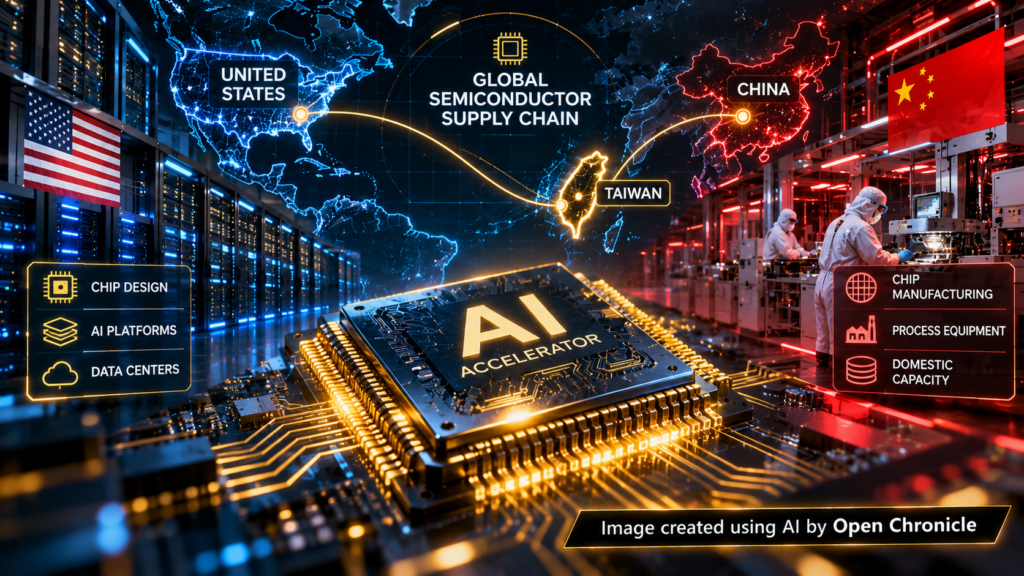
As American lawmakers push for tighter restrictions on advanced semiconductor exports, the struggle over artificial intelligence infrastructure is becoming a defining contest for technological power, economic influence and national security.
By Open Chronicle Technology | Technology & Strategic Analysis
The battle for artificial intelligence is becoming a battle for computing power
The global competition for artificial intelligence is entering a more confrontational phase.
For years, the United States and China have competed to develop increasingly powerful AI models, attract leading researchers and dominate emerging technological industries.
But the strategic centre of that competition is shifting.
The decisive question is no longer simply which country can develop the most sophisticated algorithms.
It is increasingly about which country can secure the computing infrastructure required to train and operate advanced artificial intelligence systems.
At the centre of this contest are specialised semiconductors, particularly the advanced graphics processing units and AI accelerators used in modern data centres.
These chips are not ordinary electronic components.
They are essential building blocks of the infrastructure supporting large AI models, scientific computing, military research and increasingly sophisticated industrial applications.
On November 15, 2026, the Financial Times reported that American lawmakers were advancing efforts to tighten restrictions on China’s access to advanced AI semiconductors.
The development follows renewed discussions in Congress about limiting exports of powerful computing chips, including products manufactured by Nvidia.
Earlier in the week, House Speaker Mike Johnson indicated that lawmakers were developing a consensus around additional restrictions on advanced semiconductor exports to China.
These developments reflect a growing conviction among American policymakers that access to advanced computing hardware has become a strategic national security issue.
For China, the consequences could be substantial.
For American semiconductor companies, the stakes are equally significant.
And for the rest of the world, the emerging confrontation raises a broader question: is the global technology industry moving towards a permanent division between competing computing ecosystems?
1. Why AI chips have become strategic assets
Artificial intelligence depends on three fundamental resources: algorithms, data and computing power.
The first two attract much of the public attention.
The third is increasingly becoming a geopolitical instrument.
Modern AI systems require enormous computational capacity, particularly during the training of large models.
Advanced accelerators perform the mathematical operations that allow neural networks to process vast quantities of information.
Companies such as Nvidia have become central to this infrastructure because their hardware and associated software ecosystems are widely used in AI development.
The strategic importance of these chips extends beyond commercial applications.
Advanced computing supports scientific research, materials modelling, intelligence analysis and a range of defence-related technologies.
That does not mean every advanced AI chip is a military component.
Most are developed and sold for legitimate commercial and scientific purposes.
However, the same underlying computing capabilities can potentially support both civilian and military applications.
This dual-use characteristic is one of the principal reasons governments increasingly treat semiconductor exports as a matter of national security.
Washington’s concern is that unrestricted access to the most advanced computing hardware could accelerate the development of Chinese capabilities in areas considered strategically sensitive.
Beijing, by contrast, has consistently criticised American semiconductor restrictions as discriminatory measures intended to contain China’s technological development.
The result is a confrontation in which commercial technology is increasingly governed by strategic calculations.
2. Washington moves towards tighter controls
American restrictions on advanced semiconductor exports to China are not new.
Successive US administrations have introduced measures intended to limit access to certain high-performance chips and semiconductor manufacturing technologies.
The current debate concerns how far those restrictions should extend and how effectively they can be enforced.
According to Reuters reporting on November 12, House Speaker Mike Johnson said Congress was developing a consensus around limiting exports of advanced computing chips to China.
The November 15 reporting by the Financial Times indicates that lawmakers are continuing to pursue tighter controls.
The precise legislative outcome remains uncertain.
Congressional discussions do not automatically translate into enacted law, and proposals may change during negotiations.
Nevertheless, the political direction is significant.
Advanced semiconductor exports are increasingly being treated as part of a broader strategy to preserve American technological advantages.
That strategy involves more than individual chip models.
It includes semiconductor manufacturing equipment, software, cloud computing access and the international supply chains that support advanced electronics.
A restriction affecting one category of hardware may therefore have consequences throughout the wider AI industry.
3. Nvidia at the centre of the confrontation
Few companies illustrate the intersection of technology and geopolitics more clearly than Nvidia.
The American semiconductor company has become one of the most influential suppliers of AI computing hardware.
Its products are widely used by cloud providers, technology companies, research institutions and organisations developing advanced machine learning systems.
Nvidia’s importance is not limited to chip performance.
Its CUDA software ecosystem, networking technologies and integrated computing platforms have helped create an extensive development environment around its hardware.
That ecosystem makes the company particularly important to organisations building large-scale AI infrastructure.
But Nvidia’s global commercial position also creates political exposure.
China represents a major technology market, while American export restrictions determine which products may legally be supplied to certain Chinese customers.
The company must therefore navigate competing pressures.
On one side are commercial incentives to serve international demand.
On the other are government restrictions intended to protect national security interests.
This tension has intensified as policymakers examine whether existing export controls are sufficiently effective.
For Nvidia, the question is not merely how many chips can be sold.
It is how an increasingly fragmented regulatory environment may reshape the company’s international business.
4. The problem of indirect access
Restricting direct exports does not necessarily eliminate access to advanced computing capabilities.
Global semiconductor supply chains are complex.
Products may pass through distributors, intermediaries and international commercial networks.
Cloud computing introduces an additional complication.
An organisation does not always need to own advanced chips to benefit from their computing power.
It may instead access hardware remotely through commercial infrastructure.
This distinction has become increasingly important in the policy debate.
Traditional export controls focus heavily on the movement of physical goods.
AI computing can also be delivered as a service.
Consequently, governments must consider whether restrictions on hardware exports are sufficient when computing resources may be accessible through international cloud platforms.
The challenge is both technical and legal.
Authorities must distinguish legitimate international computing services from arrangements intended to circumvent applicable restrictions.
They must also consider the consequences for cloud providers, research institutions and multinational companies.
Broad restrictions could reduce access to advanced computing for legitimate users.
Narrow restrictions might leave pathways that policymakers consider strategically problematic.
The effectiveness of export controls therefore depends on implementation, enforcement and international cooperation.
5. China’s response: building technological independence
American restrictions have strengthened China’s incentives to develop domestic alternatives.
Chinese semiconductor manufacturers, AI companies and research institutions are working to reduce dependence on foreign technology.
This effort extends across several layers of the computing industry.
It includes processor design, semiconductor manufacturing, memory technologies, software development and the infrastructure required to operate large AI systems.
The objective is not simply to replace one imported chip with a domestic equivalent.
It is to create a more independent technological ecosystem.
That ambition faces substantial obstacles.
Advanced semiconductor manufacturing requires specialised equipment, sophisticated materials, highly skilled personnel and extensive industrial coordination.
Leading-edge chip production is among the most complex manufacturing activities in the global economy.
Even when a country can design competitive processors, producing them at scale with high yields and acceptable costs can remain difficult.
Software compatibility presents another challenge.
AI developers often build applications around established computing platforms and development tools.
Moving to alternative hardware may require changes to software, optimisation techniques and engineering workflows.
Nevertheless, restrictions can accelerate domestic investment.
A technology denied through international trade may become a strategic priority for national industrial policy.
The long-term outcome is therefore uncertain.
Export controls may slow access to particular capabilities while simultaneously encouraging the development of alternative technologies.
6. Taiwan and the geography of semiconductor power
The semiconductor confrontation cannot be understood without considering Taiwan.
The island occupies an exceptionally important position in the global advanced semiconductor manufacturing industry.
Taiwan Semiconductor Manufacturing Company, commonly known as TSMC, manufactures advanced chips designed by numerous international technology companies.
Its role makes Taiwan a critical location in the global electronics supply chain.
This concentration creates strategic vulnerabilities.
A major disruption affecting Taiwanese semiconductor production could have consequences for technology companies around the world.
The United States, Europe, Japan and other economies have therefore pursued initiatives intended to strengthen domestic or geographically diversified semiconductor manufacturing.
However, building new fabrication plants does not immediately reproduce the full capabilities of an established semiconductor ecosystem.
Advanced manufacturing depends on equipment suppliers, materials, engineering expertise, production processes and long-term customer relationships.
Geographical diversification can improve resilience, but it requires sustained investment and technical development.
The geopolitical significance is unmistakable.
The competition over AI chips is inseparable from the geography of semiconductor manufacturing.
It connects industrial policy, international trade and regional security.
The Strategic Geography of AI Computing
The global semiconductor industry depends on a geographically distributed network of chip designers, advanced manufacturers, equipment suppliers and specialised technology companies. Understanding these relationships is essential to assessing the strategic consequences of the AI chip war.
Chip Design & AI Platforms
Advanced processor design, AI software and computing ecosystems.
Advanced Manufacturing
Foundry capacity and leading-edge semiconductor production.
Memory & Manufacturing
High-bandwidth memory and advanced chip production.
Equipment & Materials
Specialised machinery, materials and industrial technologies.
The semiconductor supply chain is globally distributed. These are representative areas of industrial strength, not exclusive national capabilities. China and other economies also participate across multiple stages.
OPEN CHRONICLE TECHNOLOGY | GLOBAL SEMICONDUCTOR INDUSTRY
What Will Determine the Next Phase?
The future of the AI chip war will be shaped by a combination of regulatory enforcement, technological innovation, industrial independence and international political decisions.
Export Control Enforcement
The ability to restrict sensitive hardware while monitoring indirect supply channels.
Chinese Semiconductor Independence
Progress in domestic processor design, manufacturing capacity and software ecosystems.
International Supply Chain Coordination
The degree of alignment among major semiconductor-producing economies.
AI Computing Efficiency
Advances that reduce the hardware requirements of model training and inference.
Commercial and Political Pressure
The balance between national security objectives and international technology markets.
The next phase of semiconductor competition will not be determined by export restrictions alone. Industrial capacity, software efficiency, international coordination and commercial incentives will collectively influence the balance of technological power between the United States, China and the wider global semiconductor ecosystem.
OPEN CHRONICLE TECHNOLOGY | AI COMPUTING & TECHNOLOGY GEOPOLITICS
7. The consequences for global technology companies
The growing use of semiconductor export controls creates uncertainty for companies operating across international markets.
Chip designers must determine which products can be supplied to particular customers.
Cloud providers must assess applicable restrictions on computing services.
Manufacturers must manage increasingly complex compliance obligations.
AI developers may face different hardware availability depending on their location.
These developments could reshape investment decisions.
Companies may reconsider where to establish data centres, how to structure international partnerships and which computing platforms to support.
Some organisations may invest in alternative chip architectures to reduce dependence on a single supplier or regulatory jurisdiction.
Others may accelerate efforts to improve computational efficiency.
The result could be a more diversified computing market.
But diversification does not necessarily mean greater global integration.
Different regions may increasingly develop their own technology standards, suppliers and infrastructure arrangements.
Such fragmentation could increase costs and complicate international research collaboration.
For multinational businesses, the challenge will be balancing technological performance with regulatory compliance and supply chain resilience.
8. Can software efficiency reduce dependence on advanced chips?
One possible response to hardware restrictions is to make AI systems more computationally efficient.
Researchers are developing techniques intended to reduce the computing resources required to train and operate models.
These approaches include model compression, quantisation, more efficient architectures and specialised optimisation methods.
Improvements in software efficiency can reduce costs and make advanced AI capabilities accessible on less powerful hardware.
This matters strategically.
If comparable AI performance can be achieved using fewer computing resources, restrictions on the most advanced chips may become less decisive for certain applications.
However, efficiency gains do not eliminate the importance of computing power.
More efficient models can also encourage wider adoption, increasing total demand for AI infrastructure.
And the development of frontier systems may continue to benefit from access to large-scale computing clusters.
The relationship between hardware restrictions and AI progress is therefore complex.
Export controls may constrain particular development pathways without preventing all technological advancement.
9. The danger of technological fragmentation
The global technology industry has historically benefited from international specialisation.
American companies have played leading roles in semiconductor design and software.
Taiwanese and South Korean manufacturers have become central to advanced chip production.
European and Japanese companies supply essential manufacturing equipment, materials and specialised technologies.
Chinese companies occupy important positions in electronics manufacturing and increasingly in domestic technology development.
This interconnected system has supported innovation and economies of scale.
But geopolitical competition is placing it under pressure.
If major powers increasingly restrict access to strategic technologies, the global industry may evolve towards partially separate ecosystems.
Such a development could have several consequences.
Research collaboration may become more difficult.
Companies may duplicate infrastructure to satisfy different regulatory requirements.
Supply chains may become more expensive.
Technical standards could diverge.
And emerging economies may face pressure to align with competing technological systems.
This fragmentation is not inevitable.
International trade and scientific cooperation remain important, even amid strategic competition.
But the direction of current policy suggests that governments are increasingly willing to accept economic costs in pursuit of technological security.
10. What the next phase could look like
The future of semiconductor export controls will depend on several interacting developments.
The first is American domestic politics.
Congress and the executive branch may differ over the appropriate scope and implementation of restrictions.
The second is technological progress.
New chip architectures, manufacturing techniques and software efficiency improvements could alter the strategic value of particular hardware categories.
The third is China’s domestic semiconductor development.
Progress in manufacturing and computing alternatives could reduce dependence on imported technology.
The fourth is international coordination.
Restrictions are more effective when relevant supplier countries maintain compatible policies.
Finally, commercial pressure will remain influential.
Semiconductor companies have strong incentives to preserve access to international markets.
Governments must balance those economic interests against national security objectives.
The next phase of the confrontation is therefore unlikely to be determined by a single legislative proposal or semiconductor product.
It will emerge from the interaction of industrial capabilities, regulation, innovation and geopolitical strategy.
11. Open Chronicle Strategic Assessment
The intensifying confrontation over advanced AI chips represents a fundamental change in the relationship between technology and state power.
Computing infrastructure is becoming a strategic resource.
The countries and companies able to design, manufacture and deploy advanced semiconductors will possess important advantages in artificial intelligence, scientific research and industrial innovation.
American policymakers increasingly view restrictions on China’s access to advanced computing as a means of preserving those advantages.
China is responding by strengthening efforts to develop domestic alternatives.
Both approaches carry risks.
Restrictions may slow access to strategically sensitive technologies, but they can also encourage technological fragmentation and accelerate investment in competing ecosystems.
Domestic substitution can strengthen resilience, but it may involve substantial costs and technical limitations.
For the international technology industry, the challenge is maintaining innovation and commercial efficiency while governments increasingly treat semiconductor supply chains as national security assets.
The most consequential outcome may not be the immediate success or failure of any particular export restriction.
It may be the gradual restructuring of the global computing economy.
If advanced AI infrastructure becomes divided into competing geopolitical systems, the consequences will extend far beyond the semiconductor industry.
They will affect cloud computing, scientific research, industrial automation, defence technology and the future development of artificial intelligence itself.
The struggle for AI supremacy is becoming a struggle over who controls the machines that make artificial intelligence possible.
Sources and Further Reading
The following references provide reporting, regulatory documentation and industry research concerning advanced AI semiconductor export controls, international supply chains and the strategic competition over computing infrastructure.
Financial Times | US Lawmakers Push for Tighter AI Chip Export Restrictions
Reporting on congressional efforts to strengthen restrictions on advanced AI semiconductor exports to China.
Reuters | Speaker Johnson Says Congress Developing Consensus on Limiting Chip Exports to China
Coverage of the political debate surrounding restrictions on advanced computing hardware.
US Bureau of Industry and Security | Advanced Computing and Semiconductor Export Controls
American export control policies and regulatory guidance concerning advanced computing and semiconductor technologies.
Semiconductor Industry Association | Industry Research and Policy
Information on the global semiconductor ecosystem, supply chains, investment and industry competitiveness.
TSMC | Annual Reports and Corporate Information
Information on advanced semiconductor manufacturing, capital investment and global production operations.
Editorial Transparency
This article examines US semiconductor export control policy, the strategic importance of advanced AI computing and the implications for international technology supply chains. It draws on reported congressional discussions, publicly available regulatory information and semiconductor industry documentation. Proposed legislative measures are distinguished from enacted restrictions. Assessments of China’s technological development, supply chain fragmentation and future geopolitical outcomes represent independent editorial analysis by Open Chronicle Technology. Forward-looking scenarios are analytical possibilities rather than confirmed developments.
Source Verification:
The references above are provided for editorial documentation. The availability of individual links and the details of November 2026 reporting have not been independently reverified for this publication module.
OPEN CHRONICLE TECHNOLOGY | SEMICONDUCTORS & TECHNOLOGY GEOPOLITICS