
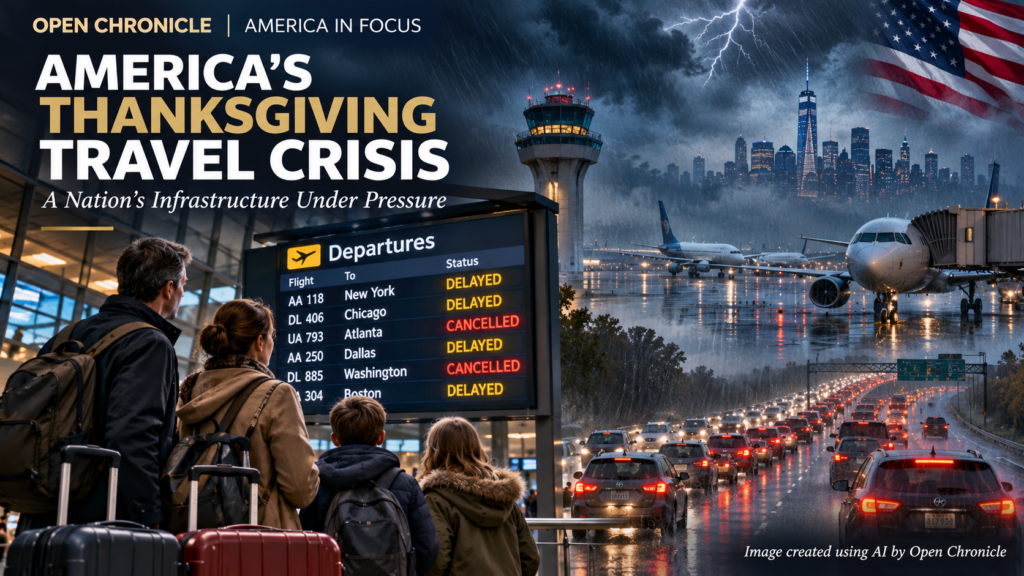
Extreme weather, flight disruptions and unprecedented travel demand are putting America’s transportation networks under renewed scrutiny, raising questions about the resilience of the infrastructure upon which millions of Americans depend.
By Open Chronicle News Desk
November 26, 2026 | United States
OPEN CHRONICLE | AMERICA IN FOCUS
Thanksgiving Under Pressure
Transportation • Extreme Weather • Infrastructure • Consumer Rights
INFORMATION • CONTEXT • UNDERSTANDING
Thanksgiving is one of the most important annual traditions in American society. Every November, millions of people travel across the United States to reunite with relatives, visit friends and celebrate a holiday deeply embedded in the nation’s cultural identity.
But behind this annual movement of people lies an increasingly important question about America’s transportation infrastructure.
The combination of concentrated travel demand, severe weather, technological dependencies and operational constraints can transform an ordinary journey into hours of uncertainty.
The Thanksgiving travel period offers a particularly revealing examination of how America’s airports, highways, railways, electricity networks and emergency services function under extraordinary pressure.
The challenge is not simply getting Americans home for the holidays. It is ensuring that the systems connecting the country remain reliable when they are needed most.
01 | A Thanksgiving Disrupted by Extreme Weather
Severe weather affected large parts of the United States on Thanksgiving Day, November 26, disrupting transportation, damaging infrastructure and leaving hundreds of thousands of electricity customers without power.
The Associated Press reported extensive flight disruptions, coastal flooding, heavy rainfall and strong winds. In New York, adverse weather conditions even forced the postponement of the traditional Macy’s Thanksgiving Day Parade until Saturday.
Thanksgiving disruption in numbers
👥︎ 81.5m Projected Thanksgiving travelers | ⏱︎ 1,700+ Reported flight delays |
✈︎ 400+ Reported flight cancellations | ⚡︎ 800,000+ Homes and businesses affected by power outages |
The disruption illustrates how several forms of infrastructure can become vulnerable simultaneously.
A flooded highway may prevent passengers from reaching an operational airport. Electricity failures can disrupt traffic management and communications. Adverse weather at a major aviation hub can affect passengers traveling between destinations hundreds of miles away.
Thanksgiving has become a national test of the ability of these interconnected systems to absorb disruption.
02 | Nearly 82 Million Americans on the Move
Despite rising travel costs and economic uncertainty, Thanksgiving travel remains close to historic levels.
According to AAA’s November 16 forecast, approximately 81.5 million Americans were expected to travel at least 50 miles from home between November 24 and November 30.
Although this represents a slight decline compared with 2025, it demonstrates the continuing importance of holiday travel in American life.
Thanksgiving travel remains near historic highs
| 2024 | 80.2m |
| 2025 | 81.6m |
| 2026 | 81.5m |
■
Historical estimates
■
2026 forecast
The significance of these numbers extends beyond tourism.
Every additional traveler creates demand for fuel, accommodation, airport capacity, highway services, emergency assistance and transportation personnel.
When such demand is concentrated within a single holiday period, even relatively small disruptions can generate substantial consequences.
03 | America’s Continuing Dependence on the Automobile
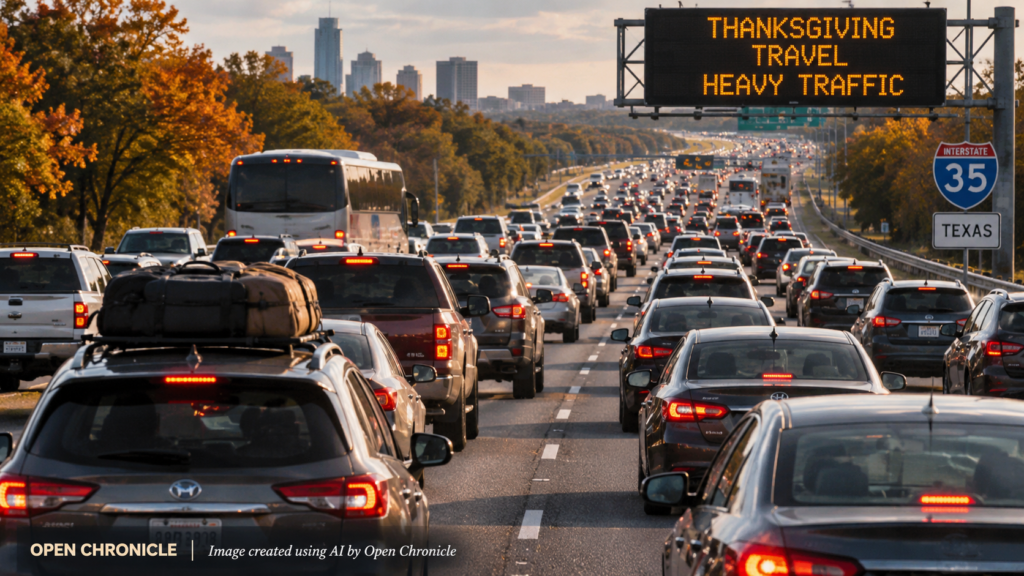
Despite decades of investment in aviation and public transportation, the private automobile remains the foundation of American holiday mobility.
AAA estimates that approximately 72.9 million people will travel by car during the Thanksgiving period.
How Americans travel for Thanksgiving
| ■ | 🚗︎ | Automobile 72.9m | 89.4% |
| ■ | ✈︎ | Air travel ~6.0m | 7.4% |
| ■ | 🚆︎ | Other transportation ~2.6m | 3.2% |
This dependence reflects the geographical scale of the United States, suburban development patterns and the flexibility that personal vehicles provide to families.
However, it also exposes travelers to several structural challenges, including congestion, deteriorating road surfaces, bridge closures, fuel costs and limited alternative transportation options in many communities.
Unlike travelers in regions with extensive intercity passenger rail networks, many Americans have few practical alternatives to driving.
For millions of families, the automobile is not merely a preference. It is an essential component of everyday mobility.
04 | Why Airport Disruptions Spread Across America
The American aviation system operates as a complex network connecting regional airports, major metropolitan hubs and international destinations.
An aircraft scheduled to operate several flights during a single day may encounter delays during its first journey. Those delays can then affect subsequent departures, crew assignments and connecting passengers.
This creates a cascading effect.
How a local disruption becomes a national problem
⛈︎ | Severe weatherReduced airport capacity and operational restrictions. |
✈︎ | Aircraft delaysAircraft arrive late or are diverted to alternative airports. |
👥︎ | Crew and scheduling disruptionPersonnel availability and aircraft rotations become affected. |
🔗︎ | Network-wide consequencesConnecting flights and subsequent departures experience disruption. |
💼︎ | Passenger impactMissed connections, cancellations and additional travel expenses. |
Airlines must also comply with safety regulations governing flight operations and crew working hours.
Consequently, recovering from a major weather event requires more than reopening an airport. Airlines must reposition aircraft, restore crew schedules and accommodate passengers whose original journeys have been interrupted.
The effects can continue long after the weather itself has improved.
05 | America’s Aging Air Traffic Control Infrastructure
The Thanksgiving disruptions have occurred less than two weeks after another significant incident exposed vulnerabilities within the American aviation system.
On November 13, 2026, technical instability within the Federal Aviation Administration’s telecommunications infrastructure prompted a nationwide ground stop.
According to the FAA, approximately 12,462 flights were canceled that Friday, including 9,082 operated by major airlines. The agency emphasized that not every cancellation was directly attributable to the ground stop.
The FAA also stated that available evidence did not indicate a cyberattack.
The November 13 aviation disruption
✈︎ 12,462 Total flight cancellations reported that Friday | 🏢︎ 9,082 Major airline cancellations |
🛡︎ ✓ ~3,500 Airborne aircraft that landed safely | 📅︎ NOV 13 Date of nationwide ground stop |
The incident highlights the difficulties associated with maintaining essential aviation infrastructure while simultaneously replacing legacy technologies.
Air traffic management depends upon communications, radar, navigation systems, telecommunications networks, software and highly trained personnel.
Modernizing these systems is particularly challenging because the national airspace cannot simply be shut down for an extended period while new infrastructure is installed.
New technologies must be introduced, tested and integrated while existing systems continue to support safe operations.
The Thanksgiving storms and the November 13 technical failure were separate events. Nevertheless, both demonstrate the importance of operational resilience.
06 | Extreme Weather and America’s Infrastructure Challenge
The United States faces an unusually diverse range of environmental hazards.
Its transportation infrastructure must operate through hurricanes, winter storms, extreme heat, wildfires, flooding and severe thunderstorms.
Thanksgiving 2026 demonstrated how different environmental pressures can emerge across multiple regions simultaneously.
A nation facing multiple weather hazards
🌧︎ | East CoastHeavy rainfall, strong winds and coastal flooding affecting transportation corridors. |
❄︎ | MidwestHeavy snowfall affecting communities in Missouri and Illinois. |
≋ | West CoastExceptionally high tides and coastal flooding threatening communities and infrastructure. |
⚡︎ | Electricity networksWidespread outages affecting households and commercial establishments. |
The economic consequences of such events extend beyond the immediate damage.
Businesses may experience interruptions to deliveries. Employees may be unable to reach workplaces. Emergency services may face increased demand precisely when transportation networks become less accessible.
Infrastructure planning must therefore consider not only the probability of individual failures but also the consequences of multiple systems experiencing difficulties simultaneously.
Although climate change can influence certain categories of extreme weather, attributing a particular storm to climate change requires specific scientific evidence.
07 | The Rising Cost of Traveling in America
For American families, transportation resilience is not exclusively a question of engineering or public investment.
It is also a question of affordability.
Higher fuel prices, airline fares, accommodation expenses and additional travel charges can place considerable pressure on household budgets.
Associated Press reporting ahead of Thanksgiving indicated that domestic roundtrip flights booked through AAA averaged approximately $800, representing a 17% increase compared with the previous year.
The same reporting identified higher gasoline prices as another source of financial pressure.
The cost of getting home
🎫︎ $800 Average domestic roundtrip airfare booked through AAA | ↗ +17% Annual increase in those airfares |
⛽︎ $3.82 Reported national gasoline price per gallon before Thanksgiving | ⛽︎ $3.08 Comparable gasoline price one year earlier |
Travel disruptions can introduce additional expenses that families did not anticipate.
A canceled flight may require an overnight hotel stay. A missed connection can generate additional meal expenses. A road closure can increase fuel consumption and extend journey times.
For households with limited financial flexibility, these unexpected costs can become more significant than the original price of the journey.
Transportation reliability is therefore also an issue of economic accessibility.
08 | What Happens When America’s Traditions Are Disrupted?
The postponement of the Macy’s Thanksgiving Day Parade represents one of the most visible consequences of the November storms.
New York City authorities officially announced on November 25 that the parade’s centennial edition would be rescheduled for Saturday, November 28, amid forecasts of dangerous winds, heavy rainfall and coastal flooding.
A century of Thanksgiving tradition
📅︎ ✕ NOV 26 Original scheduled date Postponed | 📅︎ ✓ NOV 28 Rescheduled date Saturday |
Beyond its cultural significance, the decision demonstrates the complexity of organizing major public events in densely populated metropolitan areas.
Public safety, transportation, crowd management, emergency preparedness and commercial activity must all be coordinated.
The postponement also serves as a reminder that infrastructure resilience is not necessarily measured by the ability to continue operating regardless of circumstances.
Sometimes, resilience means having the capacity to suspend activities safely and restore them when conditions improve.
09 | Know Your Rights: What American Travelers Should Understand
One of the most important questions for passengers affected by the Thanksgiving disruptions concerns their rights when flights are canceled or significantly delayed.
The United States Department of Transportation provides consumer protection rules covering refunds and certain changes to airline itineraries.
However, passengers should distinguish between the right to a ticket refund and entitlement to additional compensation.
Your rights when flights are disrupted
🎫︎ | Flight cancellationPassengers who decline alternative travel or compensation are entitled to a refund, including when weather causes the cancellation. |
🕑︎ | Domestic flightsAn arrival delay of three hours or more can qualify as a significant itinerary change. |
🌐︎ | International flightsAn arrival delay of six hours or more can qualify as a significant itinerary change. |
💳︎ | Automatic refundsEligible passengers who decline alternative arrangements should receive refunds without having to submit a separate request when booked directly with the airline. |
🏨︎ | Hotels and mealsAdditional assistance depends on the circumstances and the airline’s commitments. Weather disruptions do not automatically qualify. |
💵︎ | Travel vouchersPassengers entitled to a refund are not required to accept a voucher instead. |
Passengers should retain booking confirmations, airline communications and receipts for additional expenses.
Those considering a refund should carefully review any alternative transportation or travel credits offered before accepting them.
The Department of Transportation also maintains an airline customer service dashboard explaining the commitments made by individual carriers.
Understanding these protections can make a significant financial difference for families experiencing unexpected travel disruptions.
10 | Can America Build a More Resilient Transportation System?
The Thanksgiving disruptions raise a broader question about the future of American infrastructure.
Should transportation systems be designed primarily to maximize efficiency during normal operations, or should greater investment be directed toward maintaining reliability during exceptional circumstances?
These objectives are not necessarily incompatible. However, achieving both requires long-term planning and sustained investment.
Before the holiday, federal transportation authorities projected more than 417,000 flights over a nine-day travel period and highlighted the importance of modernizing air traffic management.
Several areas deserve particular attention.
Six priorities for a more resilient America
01 📡︎ | Air traffic control modernizationReplacing aging communications, navigation and traffic management infrastructure while maintaining operational safety. |
02 ⛈︎ | Weather forecasting and early warningImproving predictive capabilities and coordination between meteorological and transportation authorities. |
03 🛣︎ | Highway and bridge resilienceStrengthening critical transportation corridors against flooding, extreme temperatures and structural deterioration. |
04 ⚡︎ | Electricity network reliabilityReducing vulnerabilities through grid modernization, backup capabilities and improved emergency restoration. |
05 🚆︎ | Transportation diversificationExpanding practical alternatives to automobile and aviation travel where economically and geographically viable. |
06 🛡︎ | Emergency preparednessImproving coordination between federal agencies, state authorities, local governments and private operators. |
The challenge is particularly complex because American transportation infrastructure is managed through a combination of federal agencies, state governments, municipal authorities and private companies.
Effective modernization therefore requires cooperation across institutional and commercial boundaries.
Technology alone cannot solve every problem. Investment must also address workforce training, maintenance, operational procedures and emergency planning.
11 | What to Watch Over the Coming Days
The Thanksgiving travel period is far from over.
Millions of Americans will begin their return journeys during the weekend, potentially placing renewed pressure on transportation networks as recovery operations continue.
| Development | What to watch |
|---|---|
| Aviation recovery | Restoration of normal airline schedules and aircraft availability. |
| Highway conditions | Flood damage, road closures and weekend congestion. |
| Electricity networks | Progress in restoring power to affected communities. |
| Weather conditions | Updated forecasts and regional emergency warnings. |
| Passenger protection | Refunds, rebooking arrangements and airline customer service. |
| Macy’s Thanksgiving Day Parade | Preparations for the rescheduled November 28 event. |
| Household expenditure | Additional travel costs resulting from disruptions. |
| Federal infrastructure policy | Further announcements concerning transportation modernization. |
The return travel period will provide another indication of how effectively transportation operators and public authorities can recover from simultaneous disruptions.
12 | Open Chronicle Strategic Assessment
Four dimensions of America’s infrastructure challenge
⚙︎ Operational resilienceMaintaining essential services during unexpected disruptions. | ▣ Technological modernizationReplacing legacy systems without compromising reliability. |
💳︎ Economic accessibilityKeeping transportation affordable for American households. | ⛈︎ Environmental preparednessAdapting infrastructure to a diverse range of weather hazards. |
America’s Thanksgiving travel disruptions should not be interpreted as evidence that the country’s entire transportation system is failing.
The United States continues to operate one of the world’s largest and most complex transportation networks, supporting millions of journeys and extensive commercial activity.
Nevertheless, the events of November 2026 illustrate the consequences of operating interconnected infrastructure under simultaneous environmental, technological and economic pressures.
The central question is not whether disruptions can be eliminated entirely.
No transportation system can guarantee uninterrupted operations under every possible circumstance.
The more important question is whether America can reduce the frequency, severity and duration of disruptions while ensuring that transportation remains safe, reliable and accessible.
Thanksgiving offers a powerful reminder of why this matters.
Behind every delayed aircraft, closed highway and canceled journey are individuals attempting to reach their families, maintain personal connections and participate in traditions that help define American society.
The strength of a nation’s infrastructure is measured not only by how many people it can move during ordinary circumstances, but also by how effectively it protects and supports them when extraordinary circumstances arise.
That is the challenge facing America’s transportation system today.
13 | Sources and Further Reading
01 | PRIMARY TRAVEL DATA American Automobile Association (AAA)November 16, 2026. National Thanksgiving travel projections and comparison with previous holiday periods. |
02 | INTERNATIONAL NEWS REPORTING Associated PressNovember 26, 2026. Reporting on severe weather, flight disruptions, flooding and electricity outages across the United States. |
03 | OFFICIAL AVIATION DOCUMENTATION Federal Aviation Administration (FAA)November 15, 2026. Official explanation of the nationwide ground stop, telecommunications instability and operational recovery. |
04 | OFFICIAL TRANSPORTATION POLICY U.S. Department of TransportationFederal aviation preparations, projected holiday traffic and air traffic control modernization. |
05 | OFFICIAL MUNICIPAL COMMUNICATION New York City Emergency ManagementNovember 25, 2026. Official weather advisory and confirmation of the postponement of the Macy’s Thanksgiving Day Parade. |
06 | ECONOMIC AND CONSUMER REPORTING Associated Press | The Business JournalNovember 2026. Reporting on holiday airfares, gasoline prices and household travel expenditure. |
07 | OFFICIAL CONSUMER PROTECTION U.S. Department of Transportation | Aviation Consumer ProtectionOfficial guidance concerning flight cancellations, significant itinerary changes, refunds and alternative compensation. |
08 | AIRLINE CUSTOMER SERVICE U.S. Department of Transportation | Airline Customer Service DashboardOfficial information concerning individual airline commitments and assistance during qualifying flight disruptions. |
09 | HISTORICAL TRAVEL COMPARISON The Washington PostNovember 17, 2026. Reporting on Thanksgiving travel forecasts, historical travel volumes and affordability pressures. |
10 | SUPPLEMENTARY NEWS REPORTING Business InsiderNovember 26, 2026. Additional reporting on airport disruptions, electricity outages and severe weather conditions. |
Editorial Note
This article was prepared by Open Chronicle News Desk using official government documentation, travel industry forecasts and independently retrieved news reporting. Projected travel volumes have been distinguished from recorded operational disruptions. Flight cancellations, delays and electricity outage figures represent reporting snapshots and remain subject to revision. The November 13 aviation incident and the Thanksgiving weather disruptions are separate events. Infrastructure investment priorities and strategic conclusions represent independent editorial analysis. No direct causal relationship between individual weather events and climate change is asserted.
America in Focus
Understanding the challenges shaping American society.
Discover More Lifestyle Stories
Explore inspiring stories about contemporary living, remarkable people, travel, style, wellbeing and the experiences that shape our everyday lives.
← Back to Open Chronicle Lifestyle