
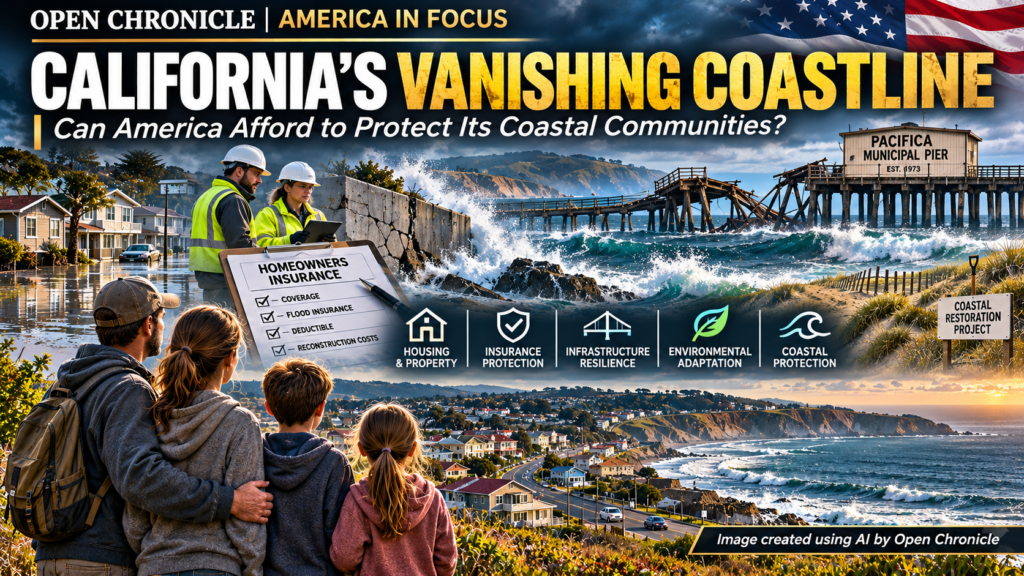
The partial collapse of Pacifica’s historic pier and widespread coastal flooding during Thanksgiving week have exposed the growing vulnerability of California’s coastal infrastructure, raising fundamental questions about housing, insurance, public expenditure and the future of America’s coastal communities.
By Open Chronicle News Desk
November 27, 2026 | United States | California | Climate, Infrastructure & Society
OPEN CHRONICLE | AMERICA IN FOCUS
A Coastline Under Pressure
Climate • Housing • Infrastructure • Insurance • Community Protection
INFORMATION • CONTEXT • UNDERSTANDING
01. When the Pacific Ocean Reclaimed Part of California’s Coast
California’s Thanksgiving week has provided a dramatic reminder of the increasingly complex relationship between America’s coastal communities and the ocean.
On November 25, 2026, exceptionally high tides combined with powerful Pacific swells, causing significant damage to coastal infrastructure in Pacifica, a community located south of San Francisco.
A section of the city’s historic municipal pier collapsed into the ocean. Coastal defenses sustained damage, seawater entered residential neighborhoods and emergency authorities faced the challenge of protecting communities from further flooding.
The pier had already been closed to the public following the discovery of structural deterioration earlier in the year. Its partial destruction therefore raises questions not only about extreme environmental conditions but also about the vulnerability of aging public infrastructure.
By November 27, further damage to sections of the local seawall had been reported, complicating recovery efforts.
The Pacifica emergency in numbers
|
📏︎
1,140 ft
Original length of Pacifica Municipal Pier |
📅︎
1973
Year the historic pier was built |
|
🌊︎
20–30 ft
Forecast breaking wave heights during the warning |
🗓︎
25 NOV
Date of the partial pier collapse |
Sources: Associated Press, Los Angeles Times and National Weather Service warnings reported on November 25, 2026. Forecast wave heights are not measurements of the individual wave responsible for the collapse.
The destruction of part of Pacifica’s pier represents a visible manifestation of a much broader challenge.
Across the United States, coastal communities must increasingly confront difficult decisions concerning the protection of homes, public infrastructure, local economies and the natural environment.
02. A Regional Emergency With National Implications
Pacifica was not the only California community affected by the exceptional coastal conditions.
Flooding and emergency restrictions were reported across parts of Northern and Southern California, including communities surrounding San Francisco Bay and exposed sections of the Pacific coastline.
Selected locations associated with reported flooding, exceptional tides or emergency restrictions. The map does not represent the geographical extent or severity of inundation.
The emergency demonstrated that coastal vulnerability is not restricted to properties directly overlooking the Pacific Ocean. Low lying neighborhoods around bays and estuaries can also experience flooding as elevated water levels extend inland.
Roads, drainage systems, commercial districts and residential properties can become interconnected points of vulnerability.
The consequences of a coastal emergency can therefore extend considerably beyond the immediate shoreline.
03. What Are King Tides?
King tides are exceptionally high astronomical tides associated with the gravitational interaction of the Earth, Moon and Sun.
They are natural and broadly predictable events. However, their consequences can become considerably more severe when they coincide with elevated ocean temperatures, unusually powerful waves or adverse meteorological conditions.
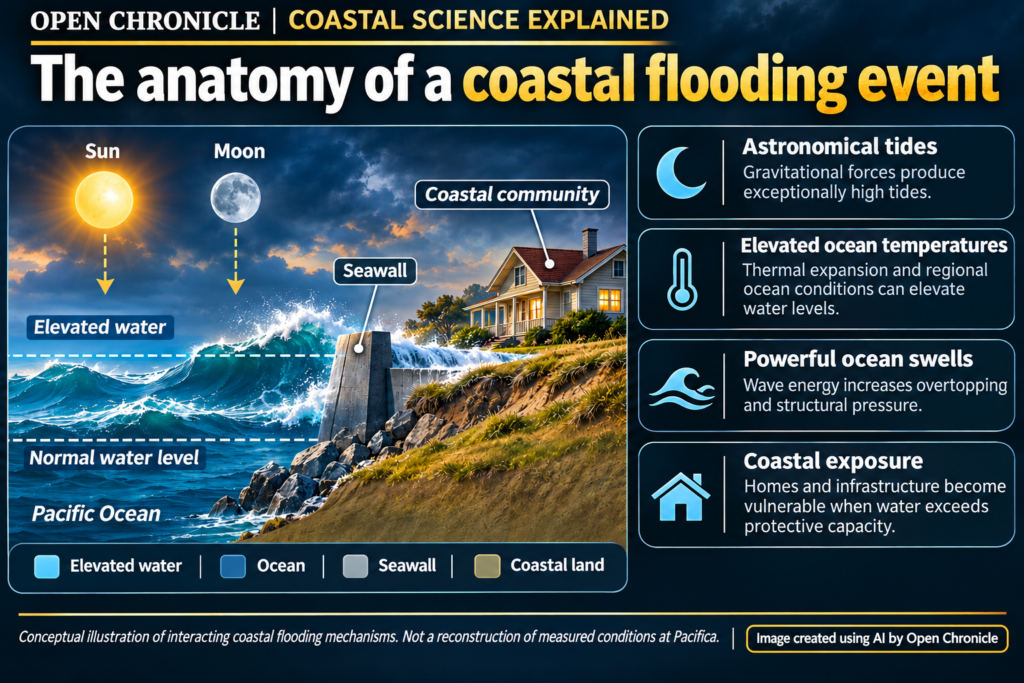
The exceptional conditions experienced in California during November 2026 have also been associated in contemporary reporting with unusually warm Pacific waters and a particularly strong El Niño event.
Nevertheless, it is important to distinguish the immediate mechanisms behind the flooding from the long term effects of climate change.
An individual king tide is not itself evidence of climate change. Rising background sea levels can, however, increase the likelihood that naturally occurring high tides and powerful waves exceed existing coastal defenses.
04. The Scale of California’s Exceptional Tides
Preliminary measurements reported on November 25 illustrated the exceptional water levels experienced at several Southern California monitoring locations.
Reported high tide measurements
|
Santa Barbara
|
8.21 ft
|
| 0 ft | 3 ft | 6 ft | 9 ft |
Previous reported record: 8.04 ft
|
Los Angeles Harbor
|
8.19 ft
|
| 0 ft | 3 ft | 6 ft | 9 ft |
Previous reported record: 8.19 ft
|
La Jolla
|
8.11 ft
|
| 0 ft | 3 ft | 6 ft | 9 ft |
Previous reported record: 7.98 ft
■
November 25■
Previous record
Source: preliminary tide measurements reported by the Los Angeles Times, November 25, 2026. Heights are relative to local gauge reference levels, not flood depths or elevations above residential properties.
05. Rising Sea Levels and America’s Changing Coastline
The challenge facing Pacifica extends beyond the immediate consequences of exceptional tides.
Coastal infrastructure is generally designed around assumptions concerning water levels, wave energy, erosion and the expected frequency of extreme events. When those assumptions change, infrastructure that previously provided adequate protection may become increasingly vulnerable.
The 2022 United States Sea Level Rise Technical Report provides an important scientific framework for understanding these challenges.
Projections summarized by NOAA indicate that the American West Coast could experience approximately four to eight inches of additional sea level rise between 2020 and 2050. Local outcomes will vary according to regional ocean conditions and vertical land movement.
America’s West Coast by 2050
Approximately 10 to 20 centimetres
Projected regional sea level rise between 2020 and 2050.
Source: NOAA and the 2022 United States Sea Level Rise Technical Report. Regional projections are not precise forecasts for individual properties. Conceptual illustration not to scale.
An increase of several inches may appear relatively modest when compared with the height of powerful ocean waves.
However, higher baseline water levels can allow waves to reach infrastructure that was previously less exposed. They can also increase the frequency of tidal flooding and reduce the effectiveness of existing drainage systems.
The economic consequences depend not simply on how much the ocean rises, but on how communities prepare for changing conditions.
06. The History of Pacifica’s Infrastructure Emergency
The November collapse was preceded by concerns about the structural condition of Pacifica’s municipal pier.
The landmark dates from 1973 and had been closed during the summer of 2026 after structural cracks were identified.
Its destruction during November’s extreme coastal conditions illustrates the importance of preventive maintenance, engineering assessments and infrastructure investment.
From coastal landmark to infrastructure emergency
|
1973
Construction of Pacifica Municipal PierThe coastal landmark becomes part of the city’s public infrastructure. |
|
|
JUNE 2026
Structural concernsThe pier is closed following the identification of cracks. |
|
|
24 NOVEMBER 2026
Exceptional coastal tidesElevated water levels affect communities around the Bay Area. |
|
|
25 NOVEMBER 2026
Partial pier collapsePowerful ocean waves destroy a section of the structure. |
|
|
26 NOVEMBER 2026
Thanksgiving recovery effortsCommunities continue addressing flooding and damage to coastal infrastructure. |
|
|
27 NOVEMBER 2026
Continuing infrastructure concernsFurther seawall damage and access restrictions are reported. |
Sources: Los Angeles Times, Associated Press, KQED and San Francisco Chronicle reporting, November 25 to 27, 2026.
The existence of earlier structural concerns does not establish negligence or determine legal responsibility for the collapse. Those conclusions would require detailed engineering investigations and examination of maintenance records.
07. The Hidden Vulnerability of America’s Coastal Infrastructure
The pier represents only one component of a much larger network of infrastructure exposed to coastal hazards.
The failure of a seawall, drainage system or transportation route can generate consequences throughout an entire community.
Six critical areas of coastal vulnerability
Coastal defensesSeawalls, breakwaters, dunes and shoreline protection systems. |
TransportationCoastal highways, bridges, local roads and emergency access routes. |
Drainage systemsStormwater infrastructure, pumping stations and floodwater management. |
Energy networksElectricity distribution, substations and essential power supplies. |
Residential infrastructureHomes, foundations, utilities and community facilities. |
Maritime infrastructurePiers, harbors, recreational facilities and waterfront businesses. |
Independent Open Chronicle assessment of infrastructure categories potentially exposed to coastal hazards. Not an inventory of confirmed November 2026 damage.
Infrastructure resilience must therefore be understood as a community wide challenge rather than simply a question of constructing stronger seawalls.
08. The Environmental Limits of Coastal Defenses
For generations, communities have attempted to protect valuable coastal land through engineering.
Seawalls and rock barriers can reduce immediate exposure to wave action and erosion. Nevertheless, these structures can also alter natural shoreline processes, require substantial maintenance and affect neighboring beaches.
Natural coastal defenses offer another approach.
Sand dunes, wetlands and restored coastal habitats can absorb energy, provide ecological benefits and reduce certain forms of flooding.
Neither approach offers universal protection.
Two approaches to shoreline protection
Engineered defenses• Seawalls and revetments
• Breakwaters and barriers
• Structural reinforcement
• Flood protection infrastructure
|
Natural defenses• Dune restoration
• Wetland conservation
•Beach nourishment
•Coastal vegetation
|
Conceptual comparison informed by California Coastal Commission adaptation guidance. The suitability of individual measures depends on local environmental and engineering conditions.
A sustainable coastal strategy may require a combination of engineering, environmental restoration and changes in land use.
09. America’s Coastal Housing Dilemma
For many American families, residential property represents their most important financial asset.
Coastal housing can offer significant economic and lifestyle benefits. Yet properties exposed to recurring flooding, erosion or unstable cliffs may also face growing uncertainty.
Potential buyers must consider not only the purchase price of a property but also its future maintenance costs, insurance availability and exposure to environmental hazards.
These considerations can influence mortgage decisions, property transactions and household financial security.
How coastal risk can affect property markets
Increasing environmental exposureRecurring flooding, erosion or damage to protective infrastructure. |
Insurance reassessmentChanges in premiums, coverage conditions and insurer risk assessments. |
Higher ownership costsAdditional maintenance, protection and insurance expenditure. |
Mortgage considerationsLenders assess insurance requirements and the security of financed properties. |
Property market adjustmentPotential changes in buyer demand, transaction conditions and property valuations. |
Conceptual economic transmission mechanism. Individual property markets may respond differently. No specific decline in Pacifica property values has been established by this analysis.
The potential financial consequences are not limited to wealthy owners of oceanfront properties.
Renters, retirees, small businesses and residents of mobile home communities may have considerably fewer financial resources available to absorb unexpected losses or relocate.
10. The Insurance Protection Gap
One of the most important issues facing American households is the distinction between conventional homeowners insurance and flood insurance.
Many homeowners may assume that their existing residential insurance provides protection against every form of water damage.
In reality, standard homeowners policies generally exclude flooding. Separate flood insurance is normally required to cover qualifying flood losses.
The National Flood Insurance Program provides an important mechanism for obtaining such coverage in participating communities.
Understanding federal flood insurance coverage
|
$250,000
Residential building coverageMaximum standard NFIP residential building coverage. |
$100,000
Personal belongingsMaximum standard NFIP residential contents coverage. |
Important coverage limitation |
Standard NFIP coverage does not generally pay for temporary accommodation or additional living expenses during property repairs.
Source: FEMA National Flood Insurance Program. Actual payments depend on policy terms, deductibles, covered losses and applicable exclusions.
These limitations can become particularly significant in regions where property reconstruction costs are high.
Insurance coverage may reduce financial exposure without eliminating it.
11. The Potential Cost of Coastal Flooding for American Families
A coastal flood can generate multiple categories of household expenditure.
Even where insurance is available, families may face deductibles, uncovered losses, temporary accommodation expenses and interruptions to employment.
Six potential household costs
Structural repairsRestoration of damaged buildings, foundations and utilities. |
Personal belongingsReplacement of furniture, appliances and household possessions. |
Temporary accommodationHousing expenses while residential properties remain inaccessible. |
Employment disruptionPotential income losses associated with displacement and business closures. |
Insurance gapsDeductibles, exclusions and losses exceeding available coverage. |
Preventive investmentAdditional property protection and future resilience improvements. |
Independent editorial assessment of potential household expenses. These categories do not represent verified financial losses from the November 2026 California flooding.
12. Interactive Coastal Flood Cost Calculator
The following educational calculator illustrates how flood damage and insurance limitations could affect household finances.
What could coastal flooding cost your household?
Adjust the hypothetical expenses and expected financial support.
Estimated household financial impact
The calculator demonstrates why the existence of insurance does not necessarily guarantee complete financial recovery.
Families with limited savings may struggle to absorb even a relatively small proportion of total reconstruction costs.
13. Who Pays for America’s Coastal Protection?
The financing of coastal resilience raises difficult questions about the distribution of economic responsibility.
Individual homeowners can undertake protective improvements to their properties. Local governments can invest in drainage systems, public roads and seawalls. State and federal institutions can provide regulatory guidance, technical assistance and funding through applicable programs.
However, financial resources are not unlimited.
The financial architecture of coastal resilience
HouseholdsPrivate property protection, insurance premiums and uncovered losses. |
Local governmentsMunicipal infrastructure, emergency response and local adaptation planning. |
State governmentsRegional coordination, regulatory oversight and infrastructure investment. |
Federal governmentEligible disaster assistance, scientific research and resilience funding programs. |
Insurance industryRisk assessment and payment of covered losses under applicable policies. |
Conceptual overview of potential financial responsibilities. Actual obligations and funding eligibility depend on applicable laws, policies and individual circumstances.
A central public policy question is whether repeated reconstruction in highly exposed locations represents the most effective long term use of taxpayer resources.
The answer requires consideration of community needs, engineering feasibility, environmental consequences and economic sustainability.
14. The Economics of Prevention Versus Reconstruction
Preventive infrastructure investment can be expensive.
Nevertheless, repeated emergency repairs and reconstruction may also generate substantial cumulative expenditure.
A meaningful economic comparison must consider the entire operational life of infrastructure rather than simply the immediate cost of construction.
The lifecycle of coastal protection investment
Preventive investment
Engineering and environmental assessments
Infrastructure modernization
Routine maintenance
Natural habitat restoration
Long term adaptation planning |
Reactive expenditure
Emergency response operations
Temporary infrastructure repairs
Residential and commercial losses
Business and transportation disruption
Repeated reconstruction requirements |
Independent editorial comparison of potential expenditure categories. No specific benefit to cost ratio has been calculated for Pacifica.
Prevention is not automatically economically preferable in every location. Some protection projects may cost more than the assets they are designed to safeguard, while others may provide substantial social and economic benefits.
The challenge is identifying where investment offers durable protection.
15. California’s Regulatory Response to Rising Seas
California has already developed a policy framework for addressing the consequences of sea level rise.
On November 13, 2024, the California Coastal Commission adopted updated Sea Level Rise Policy Guidance.
The revised framework incorporated newer scientific assessments, environmental justice considerations and requirements associated with California Senate Bill 272, which addresses coastal adaptation planning by local governments.
Four foundations of coastal adaptation planning
Scientific evidenceUse of updated research and locally relevant sea level scenarios. |
Risk assessmentEvaluation of future hazards affecting infrastructure and communities. |
Environmental justiceConsideration of vulnerable communities and equitable access to protection. |
Adaptive managementRegular reassessment of strategies as environmental conditions evolve. |
Source: California Coastal Commission Sea Level Rise Policy Guidance, adopted November 13, 2024. Simplified editorial overview.
The November 2026 emergency illustrates the practical importance of translating long term adaptation policies into local infrastructure decisions.
16. Protect, Accommodate or Retreat?
Coastal adaptation strategies generally fall into three broad categories.
The California Coastal Commission recognizes that communities may need to combine different approaches and modify them over time as environmental conditions change.
Three choices for the future of coastal communities
Protect
Maintain existing communities through engineered or natural coastal defenses.
Construction costs, maintenance requirements and environmental tradeoffs.
Accommodate
Modify buildings and infrastructure to function under changing coastal conditions.
Retrofitting costs and the limits of adaptation under severe exposure.
Managed retreat
Gradually relocate vulnerable development away from areas facing persistent coastal hazards.
Compensation, housing availability, community identity and social disruption.
Conceptual illustrations based on recognized coastal adaptation strategies. These are not specific proposals or approved engineering plans for Pacifica.
Managed retreat is particularly controversial because it involves more than engineering.
It raises questions concerning property rights, compensation, housing affordability and the preservation of communities with deep historical connections to the coast.
Any relocation strategy must therefore consider the people affected, not merely the geographical movement of infrastructure.
17. A Challenge Extending Beyond California
California’s experience forms part of a broader American coastal resilience debate.
Different regions face different combinations of environmental hazards, economic pressures and infrastructure requirements.
Four states facing coastal adaptation challenges
|
CA
CaliforniaPacific swells, coastal erosion, cliff instability and tidal flooding. |
FL
FloridaHurricanes, storm surge, coastal flooding and insurance affordability. |
|
LA
LouisianaLand subsidence, wetland loss, hurricane exposure and coastal restoration. |
NC
North CarolinaBarrier island erosion, storm surge and vulnerable coastal transportation networks. |
Illustrative regional comparison of coastal hazards. The selected states are not ranked by vulnerability or economic losses.
The national challenge is developing policies that recognize regional differences while ensuring that vulnerable communities have access to appropriate scientific expertise, infrastructure investment and financial protection.
18. The Institutions Behind America’s Coastal Resilience
Effective coastal protection requires coordination between scientific institutions, regulatory authorities, emergency management organizations and local governments.
Six institutional foundations of coastal protection
NOAAOcean monitoring, sea level science and coastal risk information. |
National Weather ServiceWeather forecasts, coastal flood warnings and public safety information. |
FEMAEmergency management coordination, eligible assistance and flood insurance administration. |
U.S. Army Corps of EngineersCoastal engineering expertise and authorized flood risk management projects. |
California Coastal CommissionCoastal development regulation and adaptation policy guidance. |
Local authoritiesCommunity planning, municipal infrastructure and local emergency response. |
General overview of institutional responsibilities. Inclusion does not establish that every organization has been mobilized for the November 2026 Pacifica emergency.
Institutional coordination becomes especially important when coastal emergencies affect infrastructure under different jurisdictions.
Communities need clarity regarding which authorities are responsible for emergency assistance, reconstruction, environmental assessment and long term planning.
19. The Social Dimension of Coastal Adaptation
Environmental resilience cannot be measured exclusively through the value of protected buildings or infrastructure.
The ability of residents to recover from flooding varies considerably according to income, age, employment circumstances, insurance coverage and access to alternative housing.
A household with substantial financial reserves may be able to undertake repairs or relocate temporarily. A household with limited savings may face a prolonged financial crisis following the same environmental event.
Six priorities for protecting vulnerable communities
|
01
|
Accessible emergency informationClear warnings, evacuation guidance and communication accessible to all residents. |
|
02
|
Affordable temporary housingSupport for displaced households unable to absorb additional accommodation costs. |
|
03
|
Financial recovery assistanceTransparent information about insurance, grants and eligible assistance programs. |
|
04
|
Protection of vulnerable residentsConsideration of older people, individuals with disabilities and households with limited resources. |
|
05
|
Community participationMeaningful public involvement in infrastructure and adaptation decisions. |
|
06
|
Equitable long term planningProtection strategies that consider social consequences alongside engineering and economic factors. |
Independent Open Chronicle assessment of social resilience and equitable coastal adaptation priorities.
A successful coastal protection strategy must therefore address both physical infrastructure and the social conditions that determine whether communities can recover.
20. Three Possible Futures for America’s Coastal Communities
The events in Pacifica raise broader questions about the direction of American coastal policy over the coming decades.
Three illustrative scenarios demonstrate the range of possible outcomes.
Three possible coastal adaptation outcomes
|
SCENARIO 01
|
Successful infrastructure adaptation
Communities invest in modern coastal defenses, environmental restoration and improved risk management before exposure becomes economically unsustainable.
Reduced vulnerability, more predictable recovery costs and improved community resilience.
|
SCENARIO 02
|
Repeated damage and gradual adaptation
Communities continue rebuilding after extreme events while introducing selective improvements to infrastructure and land use planning.
Recurring financial pressure, uneven protection and increasing demands on public budgets.
|
SCENARIO 03
|
Accelerating coastal displacement
Environmental exposure and rising protection costs make continued occupation of some locations increasingly difficult.
Greater relocation requirements, property market uncertainty and substantial social challenges.
Independent Open Chronicle scenario analysis. These hypothetical outcomes are not probability forecasts or predictions for individual California communities.
The future will probably involve different combinations of these scenarios across different communities.
The most important variable may be the ability of public authorities to make difficult decisions before emergencies force them to act.
21. What to Watch Over the Coming Days and Months
| Development | What to monitor |
|---|---|
| Pacifica Municipal Pier | Engineering assessments and decisions concerning reconstruction. |
| Beach Boulevard seawall | Structural inspections, temporary repairs and permanent protection proposals. |
| Residential damage | Verified assessments of affected properties and household losses. |
| Coastal transportation | Road repairs, access restrictions and infrastructure safety. |
| Future king tides | Updated forecasts and preparations for subsequent exceptional tides. |
| Insurance claims | Coverage decisions and the financial recovery of affected households. |
| Emergency assistance | Availability and eligibility requirements for public support. |
| Municipal expenditure | Local reconstruction budgets and funding requirements. |
| California coastal policy | Implementation of adaptation planning requirements. |
| Environmental assessments | Erosion, shoreline changes and effects on coastal habitats. |
| Property markets | Evidence of changes in buyer demand and property valuations. |
| Federal infrastructure policy | Potential funding and technical assistance for coastal resilience. |
| Community participation | Public involvement in reconstruction and adaptation decisions. |
22. Open Chronicle Strategic Assessment
The partial destruction of Pacifica’s historic pier is a reminder that America’s coastal infrastructure cannot be treated as a permanent asset operating within an unchanging environment.
The physical coastline is dynamic. Ocean conditions evolve, infrastructure deteriorates and communities develop new economic and social requirements.
The challenge facing California is not simply whether damaged structures should be rebuilt.
It is whether reconstruction can provide sustainable protection under future environmental conditions.
Four foundations of America’s coastal future
|
⚙︎
Infrastructure resilienceModernizing public infrastructure to withstand evolving coastal hazards. |
💳︎
Economic sustainabilityBalancing protection expenditure, insurance affordability and long term financial responsibility. |
|
🌿︎
Environmental adaptationIntegrating scientific evidence and natural coastal processes into planning decisions. |
👥︎
Community protectionEnsuring that vulnerable households remain central to adaptation and recovery policies. |
America’s coastal communities represent important centers of economic activity, cultural heritage and residential life.
Protecting them will require more than emergency repairs following exceptional weather events.
It will require scientific understanding, responsible infrastructure investment, transparent public policy and an honest assessment of the limits of coastal protection.
Ultimately, the question is not simply whether America can afford to protect its coastline.
It is whether America can afford to postpone the decisions that will determine the future of its coastal communities.
23. Sources and Further Reading
King tides and strong waves destroy part of Pacifica pier
Reporting on the partial pier collapse, coastal flooding, emergency warnings and the environmental conditions affecting California.
Pacifica’s damaged seawalls and flooded communities
Updated reporting concerning damage to coastal defenses, recovery operations and continuing public safety concerns.
California’s exceptional tides and coastal infrastructure damage
Regional reporting, preliminary tide measurements and information concerning the history of Pacifica Municipal Pier.
Part of Pacifica Pier Collapses As King Tides and Strong Waves Batter Bay Area
Regional coverage of the coastal emergency and its effects on Bay Area communities.
Pacifica Pier partially collapses as powerful waves batter Bay Area coast
Contemporary reporting documenting flooding, coastal conditions and transportation disruption.
United States Climate Resilience Toolkit: Sea Level Rise
Scientific information concerning regional sea level projections and the 2022 Sea Level Rise Technical Report.
Sea Level Calculator
Official scientific data, regional projections and tools for assessing future sea level conditions.
2024 Sea Level Rise Policy Guidance
Official California policy guidance addressing scientific evidence, coastal planning, adaptation and environmental justice.
Coastal Adaptation Strategies
Official overview of protection, accommodation, retreat and combined adaptation approaches.
Sea Level Rise Guidance for Critical Infrastructure
Technical and policy considerations concerning the adaptation of essential coastal infrastructure.
Flood Insurance Coverage and Policy Information
Official information concerning residential flood insurance limits, eligible coverage and policy exclusions.
Flood Insurance Eligibility
Information concerning insurance eligibility, residential insurance limitations and federal disaster assistance requirements.
Editorial Note
This article was prepared by Open Chronicle News Desk using contemporary reporting, federal scientific resources, official California coastal adaptation guidance and National Flood Insurance Program documentation.
Confirmed infrastructure damage has been distinguished from potential future economic, environmental and social consequences. Regional sea level projections do not constitute precise forecasts for individual communities or properties.
The interactive calculator, conceptual illustrations, economic transmission mechanisms and future scenarios constitute independent educational and editorial analysis. No unverified aggregate financial losses, reconstruction budgets, property valuation changes or insurance settlements have been presented as established findings.
Understanding the challenges shaping American society.
Discover More Lifestyle Stories
Explore inspiring stories about contemporary living, remarkable people, travel, style, wellbeing and the experiences that shape our everyday lives.
← Back to Open Chronicle Lifestyle