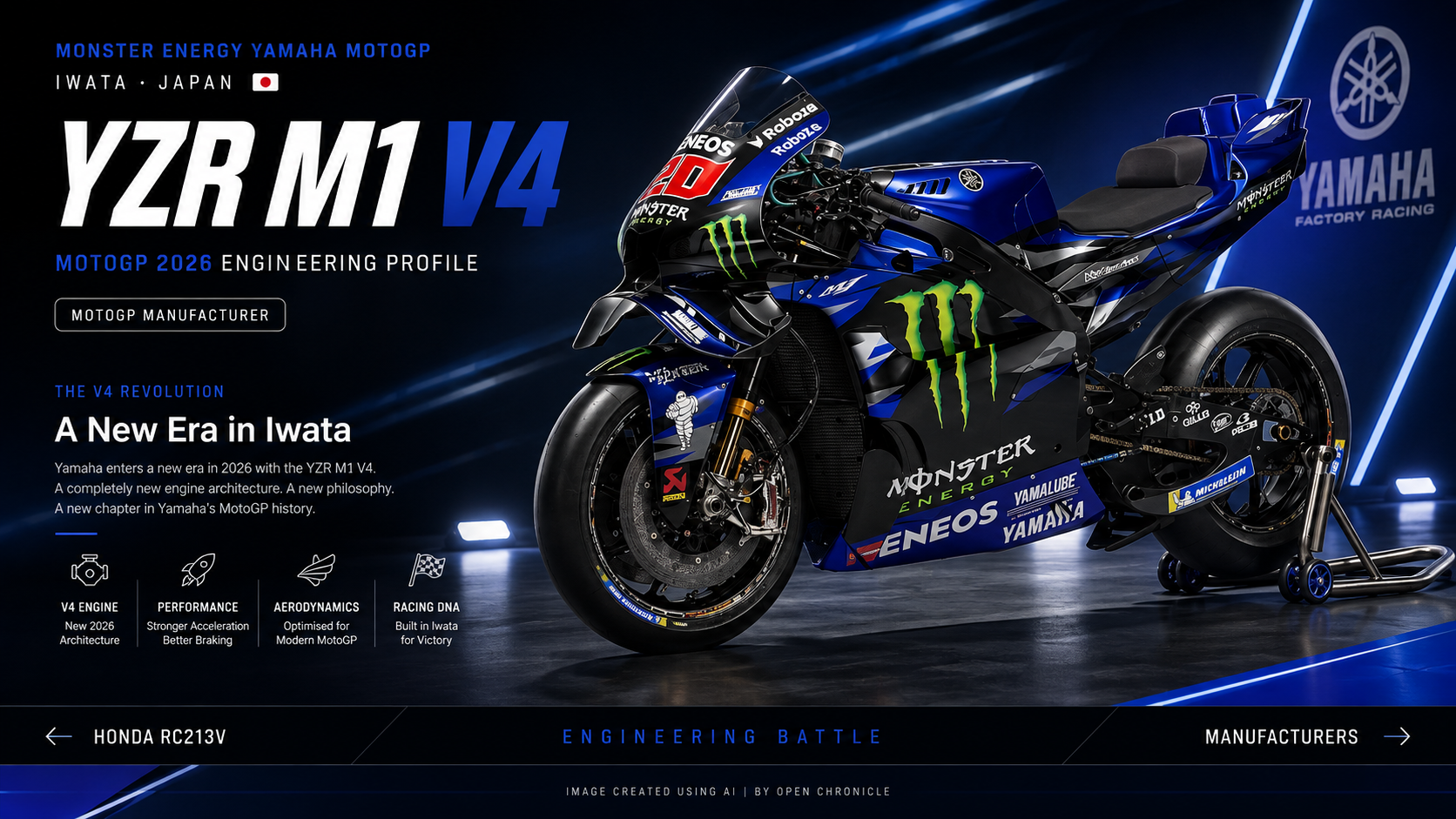
YZR M1 V4
Reinventing the YZR M1
The 2026 YZR M1 represents a fundamental rethink of Yamaha's MotoGP philosophy.
After decades of developing its characteristic inline four architecture, Yamaha committed to a V4 engine configuration for the 2026 season. The decision created a completely new technical foundation for the YZR M1.
Engine packaging, chassis behaviour, aerodynamics, braking characteristics and acceleration all had to be reconsidered around the new architecture.
Yamaha developed the V4 project alongside its existing race programme during 2025 before committing every MotoGP machine to the new configuration for 2026. :contentReference[oaicite:1]{index=1}
Yamaha changes philosophy
Yamaha officially ended the long running inline four era at the conclusion of 2025 and committed its MotoGP programme exclusively to a V4 configuration from 2026. :contentReference[oaicite:2]{index=2}
The new architecture was pursued to create greater potential in acceleration, braking behaviour and compatibility with the aerodynamic and tyre demands of contemporary MotoGP. :contentReference[oaicite:3]{index=3}
The result is a motorcycle that represents a change not only in engine layout, but in the fundamental engineering philosophy surrounding Yamaha's premier class programme.
Anatomy of the new YZR M1
Yamaha's new technical direction brings engine architecture, acceleration, braking performance and aerodynamic integration together within an entirely redesigned prototype.
V4 Architecture
Yamaha's completely redesigned engine architecture replaces the inline four configuration used throughout the previous era.
Corner Exit
One objective of the V4 project is improving acceleration performance and the transfer of power to the rear tyre.
Entry Stability
The new architecture provides Yamaha with new opportunities to optimise braking behaviour and corner entry performance.
Integrated Aero
Packaging the V4 differently allows Yamaha to reconsider airflow, bodywork and aerodynamic integration around the motorcycle.
Built for the new Yamaha era
V4 Power Unit
The defining component of Yamaha's 2026 project and the centre of its new MotoGP engineering philosophy.
Carbon Brakes
MotoGP braking hardware manages the enormous deceleration forces generated at modern Grand Prix speeds.
Michelin Tyres
Yamaha's chassis and electronics are calibrated around MotoGP's control tyre characteristics.
Aerodynamic Package
Wings, fairings and airflow management form a fully integrated element of the new V4 prototype.
Factory Riders
Fabio Quartararo and Álex Rins lead Yamaha's factory programme during the first full season of the new V4 powered YZR M1. :contentReference[oaicite:4]{index=4}
 France
Fabio Quartararo
The 2021 MotoGP World Champion remains Yamaha's central competitive reference and plays a major role in evaluating the new V4 project at the highest level.
 Spain
Spain
Álex Rins
Rins brings extensive MotoGP experience and detailed technical feedback to Yamaha's V4 development programme during his third season with the factory team. :contentReference[oaicite:5]{index=5}
Augusto Fernández and the V4 laboratory
Yamaha's V4 transformation was supported by an extensive test programme. Augusto Fernández played a direct role in bringing the prototype into public competition during its development phase and continues as Yamaha's official MotoGP test rider for 2026 and 2027. :contentReference[oaicite:6]{index=6}
Test kilometres, wildcard appearances and factory rider feedback provide Yamaha engineers with the data required to accelerate development of a motorcycle whose architecture is fundamentally new.
2026 Campaign
Yamaha's 2026 season is less an ordinary evolutionary campaign than the first competitive year of an entirely new technical platform.
Building the V4 while racing it
Yamaha entered 2026 knowing that the new YZR M1 would require rapid development under race conditions. The factory had already undertaken the unusual challenge of developing the V4 prototype alongside its existing MotoGP programme during 2025. :contentReference[oaicite:7]{index=7}
The resulting motorcycle creates new opportunities in acceleration, braking, packaging and aerodynamic development, but also demands constant adaptation as Yamaha builds experience with an architecture fundamentally different from its traditional MotoGP concept.
Every Grand Prix therefore has two objectives: score championship points and accelerate the technical learning process.
Closing one chapter, opening another
Yamaha's inline four engine became one of the defining technical signatures of its MotoGP identity and powered the manufacturer through championship winning eras.
The final race of 2025 closed that chapter. From 2026, Yamaha committed all of its MotoGP machines to the V4 concept. :contentReference[oaicite:8]{index=8}
The YZR M1 name remains. The engineering philosophy underneath it has changed profoundly.
Image disclosure: The Yamaha YZR M1 V4 image used on this page is an Open Chronicle AI generated editorial illustration inspired by Yamaha's 2026 MotoGP programme. It is used for editorial presentation and is not official Yamaha, Monster Energy Yamaha MotoGP or MotoGP photography.
MotoGP 2026
Riders, manufacturers, machines, races, results and championship battles from the 2026 MotoGP World Championship.
← Back to MotoGP Portal