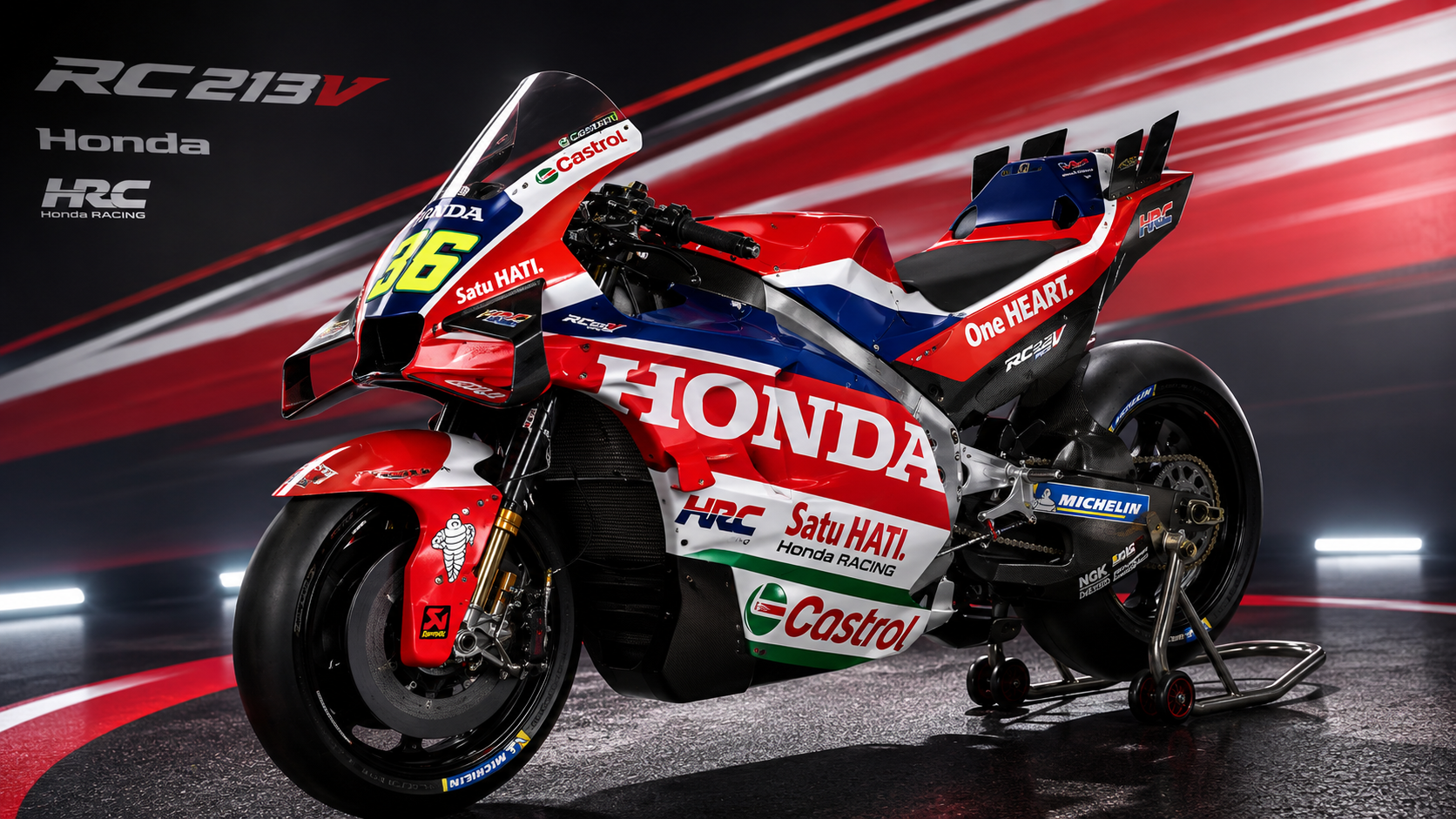
RC213V
Honda's MotoGP prototype
The RC213V represents the highest expression of Honda Racing Corporation's prototype motorcycle engineering.
Developed exclusively for MotoGP competition, the RC213V brings together a liquid cooled V4 engine, aluminium racing chassis, aerodynamic bodywork, sophisticated electronics and competition braking hardware.
Every system influences another. Engine performance affects tyre load. Aerodynamics influences braking and acceleration. Chassis geometry influences grip, turning and rider confidence.
The 2026 campaign continues Honda's recovery programme while HRC simultaneously prepares for MotoGP's new technical regulations in 2027.
Built by Honda Racing Corporation
Honda Racing Corporation is responsible for the development of Honda's premier class prototype. MotoGP functions as one of HRC's most demanding laboratories, exposing every component to extreme mechanical, thermal and aerodynamic loads.
The RC213V therefore evolves continuously. Chassis revisions, aerodynamic configurations, electronics and engine characteristics are refined through data collected during races, tests and development sessions.
The objective is not simply to create maximum power. It is to create a complete motorcycle that allows the rider to exploit that performance through braking, corner entry, mid corner grip and acceleration.
Anatomy of the RC213V
Honda's MotoGP prototype combines the manufacturer's V4 engine architecture with an aluminium chassis, aerodynamic development and modern electronic control systems.
Honda V4
Liquid cooled, four stroke, DOHC V4 developed exclusively for MotoGP prototype competition.
Aluminium Frame
The aluminium racing chassis balances rigidity, flex characteristics and the rider feedback required at MotoGP speeds.
Maximum Speed
The RC213V is capable of exceeding 360 kilometres per hour at MotoGP's fastest circuits.
Aero Package
Modern aerodynamic surfaces influence front tyre loading, stability, acceleration and braking performance.
Built exclusively for Grand Prix racing
Carbon Brakes
MotoGP carbon braking hardware provides the extreme stopping performance required from speeds above 350 km/h.
Michelin Tyres
The RC213V chassis and electronics are developed around the characteristics of MotoGP's control tyre package.
Pro Link Rear Suspension
Honda's rear suspension layout forms part of the prototype's mechanical grip and tyre management package.
17 Inch Wheels
Competition wheels front and rear are designed around MotoGP's current tyre regulations and performance demands.
Factory Riders
Joan Mir and Luca Marini lead Honda's factory MotoGP programme and play a central role in the continuing development of the RC213V.
 Spain
Spain
Joan Mir
A MotoGP World Champion with extensive premier class experience, Mir provides Honda with elite race knowledge and detailed technical feedback during the RC213V development programme.
 Italy
Italy
Luca Marini
Marini's analytical approach and consistency make him an important development reference for HRC as Honda continues to refine the RC213V throughout the 2026 season.
2026 Campaign
Honda continues its recovery programme in 2026 while developing the final version of the current 1000 cc RC213V generation.
Progress through development
Honda entered 2026 after making significant progress with the RC213V during the previous campaign. The current season continues that development path with the objective of moving the factory programme closer to regular front running performance.
Joan Mir and Luca Marini provide HRC with two different riding styles and large volumes of technical data, allowing engineers to evaluate chassis behaviour, aerodynamic concepts, electronics and tyre management across different circuits.
The programme also operates against the background of MotoGP's major 2027 regulation change, meaning Honda is simultaneously racing the current RC213V and preparing the next generation of prototype machinery.
One of MotoGP's defining machines
The RC213V belongs to one of the most significant prototype lineages in modern Grand Prix motorcycle racing.
Through multiple technical eras, championship campaigns and generations of elite riders, Honda has used MotoGP as a laboratory for engineering development at the highest possible level.
The 2026 version represents the closing phase of the current 1000 cc chapter before MotoGP moves into a new regulatory era.
Image disclosure: The Honda RC213V image used on this page is an Open Chronicle AI generated editorial illustration inspired by Honda's 2026 MotoGP programme. It is used for editorial presentation and is not official Honda HRC, Honda HRC Castrol or MotoGP photography.
MotoGP 2026
Riders, manufacturers, machines, races, results and championship battles from the 2026 MotoGP World Championship.
← Back to MotoGP Portal