
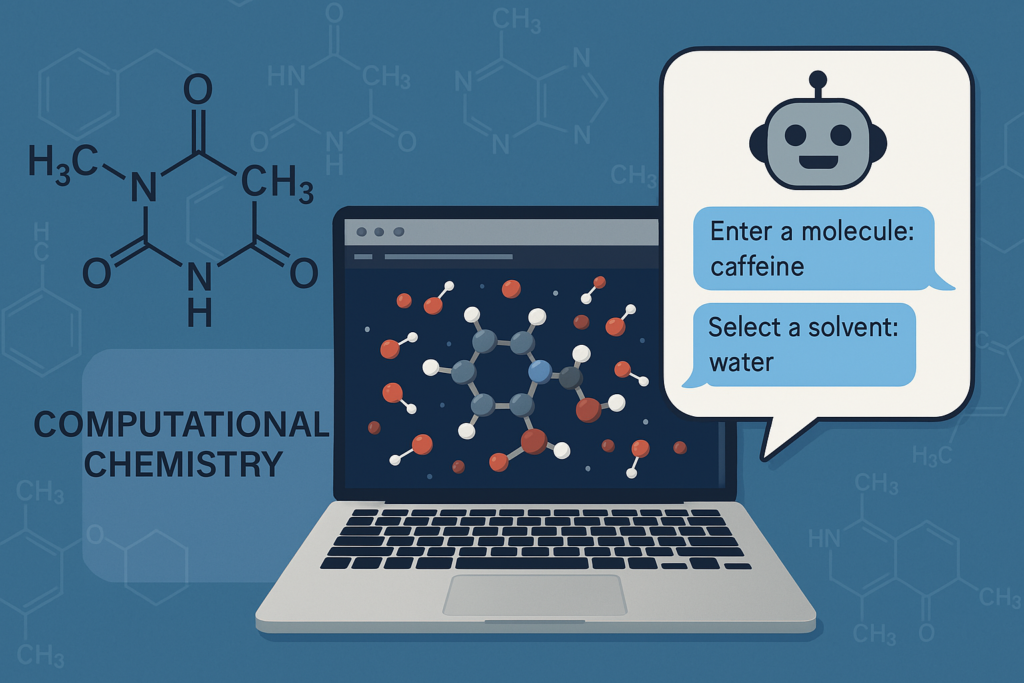
Image Credentials: Image Title: utoSolvateWeb: A Chatbot-Driven Platform for Democratizing Quantum Chemistry Simulations Source: AI-Generated Image (DALL-E) Date: April 2025 Attribution: Created by AI-generated imagery (DALL-E), and it does not depict a real-world scene.
By Staff Writer
Authors: Rohit Gadde, Fang Liu, Fangning Ren, Lechen Dong, Yao Wang, Sreelaya Devaguptam, Rajat Mittal
Affiliations: Department of Chemistry, Emory University; Clemson University
Recent advancements in computational chemistry have made it possible to simulate molecular interactions at quantum mechanical levels with unprecedented accuracy. However, the complexity of current simulation tools restricts their accessibility to only highly trained theoretical chemists. To address this barrier, researchers at Emory University have developed AutoSolvateWeb, a web-based platform that incorporates a chatbot to guide users—ranging from professional researchers to undergraduate students—through the process of setting up and executing molecular simulations in solution. By combining cloud infrastructure with an intuitive interface, AutoSolvateWeb represents a significant leap toward democratizing access to advanced computational tools and accelerating scientific discovery in chemical research.
AutoSolvateWeb is a publicly available, cloud-based platform with an integrated chatbot, designed to set up simulations to show how particular molecules – a solute and a solvent – interact in solution.https://t.co/wzzTJW1CQb
— Chemistry World (@ChemistryWorld) April 3, 2025
Introduction
Computational chemistry plays a pivotal role in understanding molecular dynamics and reactions, especially in solution-phase studies. However, preparing and executing such simulations requires not only deep theoretical knowledge but also significant computational expertise. Despite advancements like the original AutoSolvate system (2022), which simplified simulation setup via a graphical user interface, there remained a significant barrier for non-specialists.
AutoSolvateWeb builds upon this foundation by introducing a natural-language chatbot that automates and simplifies simulation configuration, making quantum chemical research accessible even to undergraduate students.
Methods
The AutoSolvateWeb platform operates on cloud infrastructure and integrates a rules-based chatbot to interact with users. Key technical features include:
-
Natural language interface: Users input molecule names (e.g., caffeine) and select solvents (e.g., water) through simple chat prompts.
-
Data sourcing: The platform retrieves chemical structures and properties from PubChem, a free chemical information repository.
-
Automation backend: The chatbot automates the multistep processes typically required for solvation setup, geometry optimization, and quantum mechanical calculation.
-
High-performance computing: Simulations are executed on a National Science Foundation supercomputer, returning trajectory files to the user.
-
Visualization: Users can convert simulation outputs into 3D molecular movies using open-source tools.
Results and Applications
AutoSolvateWeb significantly reduces the effort needed to run molecular simulations, lowering the entry barrier for a wide range of users. Among the key achievements:
-
Enabled non-experts to complete advanced solvation simulations with no prior coding experience.
-
Streamlined simulation workflows from hundreds of lines of code to chat-based interaction.
-
Delivered atomic-level visualizations of molecular interactions, enhancing both research and education.
The system was tested with undergraduate chemistry curricula, where students used simulations to explore phenomena like solvatochromism, gaining insights beyond textbook theory.
Educational Impact
AutoSolvateWeb is particularly useful in pedagogical contexts. For instance, the traditional teaching of solvatochromism often leaves exceptions unexplained. With this platform, students can observe hydrogen bonding and polarity effects in real time, helping them transition from rote learning to critical analysis and hypothesis testing.
Future Directions
Liu’s team is currently working to:
-
Expand AutoSolvateWeb to accommodate larger and more complex chemical systems.
-
Enable data storage and sharing in open-source formats to build collaborative scientific datasets.
-
Integrate AI across disciplines to foster interdisciplinary research and increase reproducibility in computational science.
Conclusion
AutoSolvateWeb represents a groundbreaking step in making computational chemistry broadly accessible. By transforming a highly specialized, code-intensive process into a user-friendly, conversational tool, this innovation opens new pathways for scientific exploration, education, and collaboration.
Story Source:
Materials provided by Emory University. Original written by Carol Clark. Note: Content may be edited for style and length.
Journal Reference:
- Rohit S. K. Gadde, Sreelaya Devaguptam, Fangning Ren, Rajat Mittal, Lechen Dong, Yao Wang, Fang Liu. Chatbot-assisted quantum chemistry for explicitly solvated molecules. Chemical Science, 2025; 16 (9): 3852 DOI: 10.1039/d4sc08677e