
Open Chronicle | Technology, Energy & US Economy | November 10, 2026
By Open Chronicle News Desk
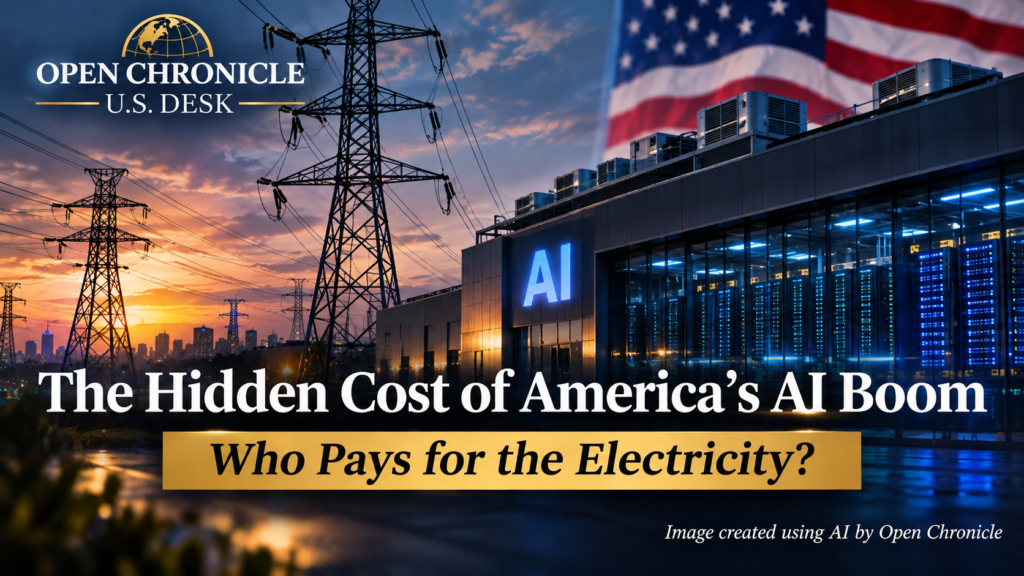
As artificial intelligence companies accelerate the construction of massive data centres across the United States, a growing question is moving from technology boardrooms into American households: who should pay for the electricity infrastructure needed to power the AI revolution?
The United States is experiencing an extraordinary expansion of artificial intelligence infrastructure. Technology companies are investing in increasingly powerful computing systems, building enormous data centres and securing access to electricity on a scale that is beginning to reshape the country’s energy landscape.
For the companies developing artificial intelligence, reliable power is essential. For electric utilities, the expansion represents an opportunity for investment and growth. But for millions of American households already managing electricity bills, housing expenses and other living costs, the financial consequences deserve closer scrutiny.
At the centre of the debate is a deceptively simple question: should ordinary electricity customers contribute to the cost of infrastructure built primarily to serve some of the world’s largest technology companies?
The answer depends on how electricity markets are regulated, how new infrastructure is financed and whether the benefits of investment are shared fairly.
1. America’s AI revolution is becoming an energy revolution
Artificial intelligence depends on physical infrastructure.
Behind every advanced AI model are servers, specialised processors, cooling equipment, networking systems and enormous quantities of electrical power.
Training sophisticated AI systems requires substantial computing capacity. Operating those systems for millions of users creates additional demand that continues long after initial training has finished.
Unlike some industrial operations that can reduce consumption during particular periods, many large data centres require continuous, dependable electricity.
This creates new challenges for the American power system.
Utilities must determine whether existing generation facilities, transmission lines and local distribution networks can accommodate new demand. Where they cannot, companies may need to construct additional infrastructure, upgrade substations or secure new electricity supplies.
The International Energy Agency estimated in its Energy and AI analysis that global data centre electricity consumption reached approximately 415 terawatt hours in 2024 and could more than double to around 945 terawatt hours by 2030.
The United States accounts for a substantial share of that demand.
The scale of projected growth makes electricity supply one of the most important constraints on the continued expansion of artificial intelligence.
2. The question facing American electricity customers
Electricity bills reflect more than the cost of generating power.
Customers also pay for the infrastructure needed to transport and deliver electricity, maintain system reliability and recover approved investments made by utilities.
In regulated markets, state utility commissions generally determine which costs companies may recover from customers and how those costs are distributed among residential, commercial and industrial users.
That process becomes more complicated when a single large data centre requires infrastructure that may cost hundreds of millions of dollars.
A utility might need to expand a substation, construct new transmission connections or acquire additional generation capacity to meet the projected demand.
If the data centre pays the full incremental cost of serving its operations, the financial burden may remain largely with the company benefiting from the investment.
But if those costs are distributed across a broader customer base, households and smaller businesses could contribute to infrastructure developed partly because of the new facility.
There is another possibility.
Infrastructure constructed to serve a major customer may also strengthen the wider electricity network, improve reliability or create capacity for future economic development.
The challenge for regulators is to distinguish investments that provide broad public benefits from those primarily serving an individual commercial customer.
That distinction is central to the debate over AI infrastructure and electricity affordability.
3. Washington enters the debate
The rapid expansion of data centres has also become a federal policy issue.
On November 9, the United States Senate advanced consideration of legislation addressing energy infrastructure permitting, an issue closely connected to the country’s ability to accommodate new electricity demand.
Supporters of permitting reform argue that delays in approving energy projects and transmission infrastructure can increase costs, discourage investment and weaken electricity reliability.
Critics of particular reform proposals have raised concerns about environmental oversight, public participation and the consequences of accelerating infrastructure development without sufficient safeguards.
The policy debate also intersects with questions about how utilities recover the costs associated with major new electricity customers.
However, federal permitting reform and state electricity rate regulation are distinct processes.
Congress may influence the development of energy infrastructure, but many decisions about whether residential customers share the costs of serving data centres remain within the jurisdiction of state regulators and utilities.
The distinction matters because changes to federal permitting procedures do not automatically determine who pays for every new transmission line, substation or generating facility.
4. Why data centres are different from ordinary businesses
Large industrial facilities have always required significant electricity supplies.
Steel plants, chemical factories and manufacturing complexes can consume enormous quantities of power, and utilities have decades of experience negotiating arrangements with industrial customers.
AI data centres nevertheless introduce several distinctive challenges.
One is the speed of expansion.
A utility planning infrastructure investments over several decades may suddenly receive requests for large amounts of additional capacity within a much shorter period.
Another is concentration.
Several major data centres may be proposed within the same geographic area, creating demand that exceeds the capacity of existing local networks.
A third challenge concerns uncertainty.
Companies may announce projects, reserve potential electricity capacity or negotiate supply arrangements before final investment decisions have been made.
If utilities construct infrastructure in anticipation of demand that never materialises, regulators must determine who bears the cost of those investments.
This is sometimes described as the risk of stranded infrastructure.
Long term contracts, minimum payment obligations and financial guarantees can help reduce that risk.
For regulators, the central question is whether agreements with large electricity customers adequately protect other users from paying for projects that do not deliver their expected benefits.
5. The states at the centre of the AI electricity debate
The issue is particularly relevant in regions where data centre development is concentrated.
Illustrative locations where large data centre markets and energy infrastructure planning intersect.
Northern Virginia is one of the world’s most important data centre markets. Its concentration of digital infrastructure has made electricity demand and transmission planning major issues for utilities and regional authorities.
Texas presents a different set of circumstances.
Its electricity system operates largely within the ERCOT market, where rapid population growth, industrial investment and new computing facilities are increasing the importance of generation and grid planning.
Arizona, Ohio and Georgia are also attracting substantial digital infrastructure investment.
Each state has its own regulatory structure, electricity market conditions and approaches to allocating infrastructure costs.
Consequently, the financial impact of AI development cannot be assessed through a single national electricity price.
A project that creates manageable costs in one region could present very different challenges elsewhere.
6. Could artificial intelligence make electricity more expensive?
The expansion of AI infrastructure could influence electricity prices through several mechanisms.
First, higher demand may require utilities to invest in additional generating capacity.
Second, the need for transmission and distribution upgrades can increase the amount of capital that utilities seek to recover through electricity rates.
Third, rapid demand growth may place pressure on electricity markets during periods when available supply is constrained.
However, rising demand does not automatically mean that every household will experience higher bills.
New large customers can also contribute substantial revenue to electricity systems.
If infrastructure investments are appropriately financed and capacity is efficiently utilised, those customers may help spread certain fixed costs across a larger volume of electricity sales.
The outcome depends on project economics, electricity supply, regulatory decisions and the terms negotiated with data centre operators.
This is why the distinction between electricity demand growth and household bill increases is essential.
The former can be measured through energy consumption and infrastructure forecasts. The latter requires examining actual utility tariffs, regulatory decisions and customer bills.
7. Renewable energy, natural gas and the search for reliable power
Technology companies have increasingly sought renewable electricity to support their operations and meet corporate climate commitments.
Wind and solar generation can provide substantial quantities of electricity, but their variable output creates additional requirements for storage, transmission and system flexibility.
Natural gas generation remains an important component of electricity supply in many parts of the United States.
Nuclear power has also attracted renewed attention because it can provide large quantities of relatively steady, low carbon electricity.
The expansion of AI infrastructure is therefore contributing to a wider debate over the country’s future energy mix.
Some companies are exploring long term power purchase agreements, dedicated generation facilities and investments in advanced nuclear technologies.
Others are examining ways to improve the efficiency of computing systems and reduce the energy required for individual AI operations.
Efficiency improvements are important, but they do not necessarily guarantee lower total electricity consumption.
If computing becomes cheaper and AI adoption expands rapidly, overall demand may continue to increase despite improvements in the efficiency of individual systems.
8. The environmental and community consequences
Electricity is not the only resource affected by data centre development.
Cooling systems can require significant quantities of water, depending on the technology used and local environmental conditions.
Large facilities may also occupy extensive areas of land, require new transmission corridors and generate concerns about noise, construction activity and local infrastructure.
Communities evaluating proposed projects must balance these potential effects against promised economic benefits.
Those benefits may include construction employment, local tax revenue and investment in electricity infrastructure.
However, the number of permanent jobs created by highly automated data centres can be relatively limited compared with the scale of capital investment.
The economic case therefore requires careful examination.
Local authorities need to assess not only the value of announced investment but also the long term employment, tax, environmental and infrastructure consequences.
For residents, transparency about water consumption, electricity requirements and public incentives is particularly important.
9. What regulators can do to protect consumers
Several approaches can help address the financial risks associated with large data centre projects.
Dedicated electricity tariffs can establish pricing arrangements specifically designed for customers with unusually large power requirements.
Minimum payment commitments can help ensure that utilities recover agreed costs even if a facility consumes less electricity than originally expected.
Financial guarantees can protect other customers if a proposed project is cancelled after infrastructure investments have begun.
Long term contracts can provide greater certainty about future demand and the recovery of infrastructure costs.
Transparent regulatory reviews can allow consumers, businesses and community representatives to examine the assumptions underlying major utility investments.
None of these mechanisms eliminates every risk.
But together they can help regulators determine whether the costs and benefits of AI infrastructure are being allocated appropriately.
The effectiveness of these protections depends on the details of individual agreements and the willingness of regulators to scrutinise projected demand.
10. The broader question: who benefits from the AI economy?
Artificial intelligence is frequently presented as a technology capable of transforming productivity, scientific research, medicine, education and industrial processes.
Those possibilities are substantial.
Yet the physical infrastructure supporting AI must be financed, constructed, maintained and supplied with electricity.
The benefits of AI investment may extend across the economy, but they will not necessarily be distributed evenly.
Technology companies may capture commercial returns from their computing systems.
Utilities may benefit from additional electricity sales and approved infrastructure investments.
Communities may receive new tax revenue or economic development opportunities.
Households, meanwhile, will judge the expansion partly through its effects on electricity affordability, reliability and local resources.
This creates a broader public policy question.
If AI becomes essential to the American economy, how should the costs of supporting that transformation be shared?
The answer cannot be determined solely by the technology industry or by electricity providers.
It requires public oversight, transparent economic analysis and regulatory decisions that account for the interests of both major investors and ordinary consumers.
Conclusion | The AI boom has an electricity bill
America’s artificial intelligence expansion is no longer simply a story about faster processors, larger language models and competition between technology companies.
It is increasingly a story about power stations, transmission networks, electricity tariffs, water resources and the financial responsibilities associated with major infrastructure investment.
The central issue is not whether AI data centres should have access to electricity.
It is whether the rules governing their expansion ensure that the companies creating extraordinary new demand pay an appropriate share of the costs.
For American households, the consequences will depend on decisions made by utilities, regulators, lawmakers and technology companies over the coming years.
As the AI economy grows, electricity affordability may become one of the clearest tests of whether the benefits of technological progress are reaching the people expected to support its infrastructure.
Sources and Further Reading
International Energy Agency | Energy and AI
Electricity demand, data centre growth and energy projections.
Reuters | US Congress and Data Centre Electricity Costs
November 9, 2026. Coverage of bipartisan permitting legislation and cost allocation.
Associated Press | Senate Advances Energy Legislation
November 9, 2026. Reporting on the 73 to 25 procedural vote and competing positions.
US Senate Energy and Natural Resources Committee | Permitting Reform
November 9, 2026. Official statements from senators supporting the proposal.
Federal Energy Regulatory Commission | Data Centre Co-location
February 20, 2025. Regulatory examination of reliability and fair cost allocation.
EDITORIAL NOTE
Electricity demand projections are estimates, not guaranteed outcomes. Legislative proposals are distinguished from enacted law. Potential impacts on household bills depend on local tariffs, regulatory decisions and actual infrastructure costs.