
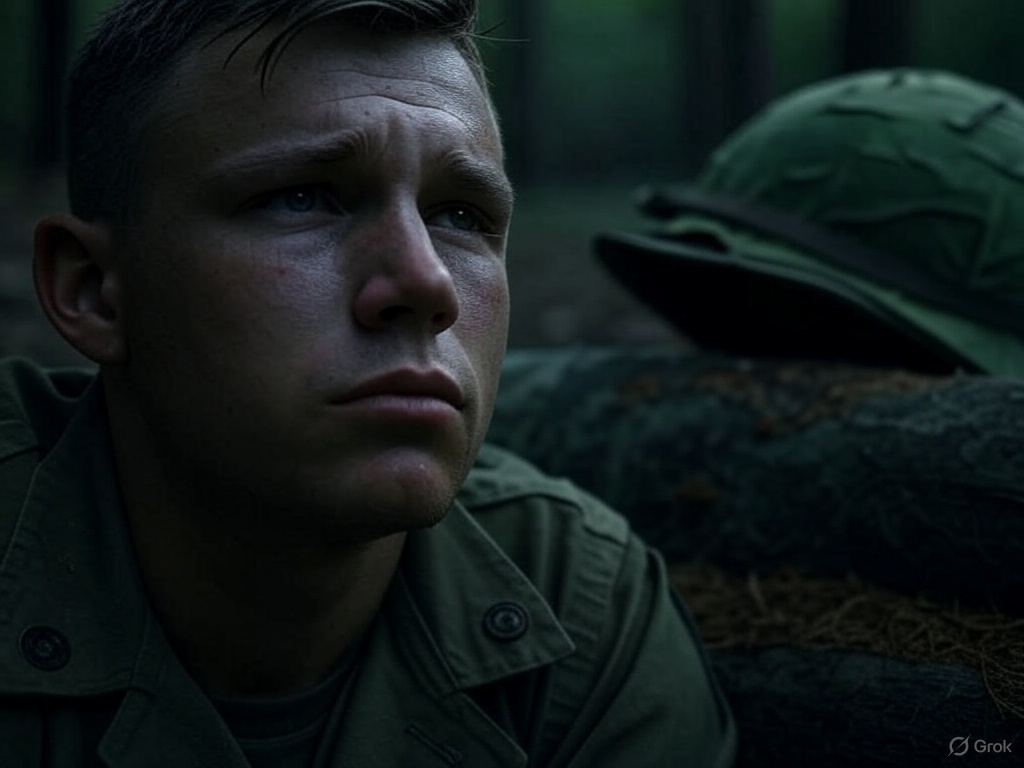
Image Credentials: Image Title: The Phantom War: How the Vietnam MIA Myth Shaped American Memory and Power Source: (Grok, xAI) Date: May 2025 Attribution: Created by AI-generated imagery (Grok, xAI), and it does not depict a real-world scene.
By Open Chronicle
The Missing in Action (MIA) narrative of the Vietnam War is a potent myth that originated as a propaganda effort by the Nixon administration and evolved into a politically and culturally entrenched belief that shaped U.S. foreign policy and domestic sentiment for decades. What began as a politically expedient designation became a lasting symbol of unresolved trauma and mistrust toward government institutions.
Origins of the MIA Designation
The MIA narrative began in earnest during the early years of the Richard Nixon presidency. In March 1969, Secretary of Defense Melvin Laird publicly announced the existence of between 500 and 1,300 Americans designated as “POW/MIAs,” a term that had not previously existed in U.S. military nomenclature. Before that, downed aviators who had not been confirmed as captured were categorized as “Killed in Action/Body Unrecovered.” The new term allowed officials to blur the distinction between those missing and those definitively held prisoner, creating the illusion that all could still be alive and awaiting rescue.
This narrative served political and propaganda purposes. It recast the war, not as a failed intervention, but as an ongoing moral crusade to bring American heroes home. It helped Nixon’s administration rally public support, reframe North Vietnam as a uniquely inhumane enemy, and distract from the broader failure of U.S. military strategy in Southeast Asia.
Propaganda and Public Symbolism
The Nixon administration capitalized on family organizations like the League of Wives of American Prisoners of War, later known as the National League of Families of American Prisoners and Missing in Southeast Asia. Although originally formed independently, the League was co-opted by the Pentagon for public relations. Chapters were sometimes invented or controlled by officials to maintain messaging discipline.
POW bracelets, first introduced at a 1970 Los Angeles “Salute to the Military” event, quickly became a national craze. Promoted by celebrities such as Sonny & Cher, the bracelets bore the names of the “missing” and were said—only half-jokingly—to possess healing powers. Media campaigns, bumper stickers, and military flyovers at public events reinforced the narrative. The now-iconic POW/MIA flag, featuring the slogan “You Are Not Forgotten,” emerged from this cultural milieu and became a fixture at veterans’ organizations and government buildings.
Operation Homecoming and Propaganda Runaway
When U.S. involvement in Vietnam ended in 1973, Operation Homecoming repatriated 587 prisoners of war. However, the U.S. government had been citing 1,600 individuals as POW/MIA, leaving over 1,000 unaccounted for. Instead of closing the chapter, this discrepancy fueled further conspiracy theories. Officials hinted that Americans might still be held in Laos or other secret prisons.
This narrative became self-perpetuating. Reports of photographic sightings, unverified radio transmissions, and supposed eyewitness accounts kept the issue alive. The League of Families, now a powerful lobby, demanded full accounting and refused to accept the death of their loved ones without physical proof.
Impact on U.S.-Vietnam Relations
The POW/MIA issue became a major obstacle to normalizing relations between the United States and Vietnam. Vietnamese officials, confused and exasperated, insisted they were not holding any Americans and questioned the intense U.S. focus on a small number of missing when tens of thousands of Vietnamese remained unaccounted for themselves.
Congressional investigations, such as those led by Representative Clem Zablocki and later by Gillespie “Sonny” Montgomery, found no credible evidence that any live prisoners remained in Southeast Asia. Intelligence agencies and military personnel admitted that much of the “evidence” was fabricated, exaggerated, or commercially motivated.
Political and Cultural Legacy
Despite mounting evidence to the contrary, the myth endured. Ronald Reagan, as a presidential envoy in 1973, suggested bombing Vietnam if POWs were not returned. In 1976, he campaigned on the claim that normalization could not occur until all MIAs were accounted for. The cause became a litmus test of patriotic fidelity, particularly within conservative circles.
The movement took on a quasi-religious tone, with symbols, rituals, and fervent belief resistant to contradiction. Historian Richard Slotkin described the POW/MIA mythos as “a lunatic semiology” where symbols no longer corresponded to reality. Scholar H. Bruce Franklin and historian Michael J. Allen both documented how the Nixon administration’s disinformation campaign spiraled out of control and permanently altered the political landscape.
Enduring Symbolism
The POW/MIA flag continues to fly at federal and state institutions across the U.S., and POW/MIA license plates, such as those issued in Illinois, suggest that many Americans still believe prisoners remain alive. Presidents routinely appear at League of Families events, signaling ongoing official recognition of an issue that, by all investigative accounts, was resolved decades ago.
The legacy of the MIA myth is one of emotional manipulation, historical distortion, and prolonged diplomatic fallout, all rooted in a cynical but effective propaganda maneuver. What began as a ploy to manage public opinion during a losing war evolved into a deeply entrenched national narrative, one that still resonates in American culture and politics.
References
- Allen, Michael J. Until the Last Man Comes Home: POWs, MIAs, and the Unending Vietnam War. Chapel Hill: University of North Carolina Press, 2009.
- Franklin, H. Bruce. M.I.A., or Mythmaking in America. New Brunswick, NJ: Rutgers University Press, 1993.
- Kuzmarov, Jeremy. The Myth of the Addicted Army: Vietnam and the Modern War on Drugs. Amherst: University of Massachusetts Press, 2009.
- Schell, Jonathan. The Time of Illusion. New York: Vintage Books, 1976.
- Slotkin, Richard. Lost Battalions: The Great War and the Crisis of American Nationality. New York: Henry Holt, 2005.
- Appy, Christian G. American Reckoning: The Vietnam War and Our National Identity. New York: Viking, 2015.
Explore this subject
Continue exploring related Open Chronicle Encyclopedia entries through the categories associated with this article.

Staff Writers at Open Chronicle produce trusted journalism, strategic analysis and authoritative reference content across global affairs, geopolitics, defense, science, history, technology, business, culture and sport. Their work combines accurate reporting with historical perspective and analytical depth, helping readers understand not only what is happening, but why it matters. Beyond daily news coverage, Staff Writers contribute to the Open Chronicle Encyclopedia, investigative features, original research projects and long-form reports, building a comprehensive knowledge platform designed to inform, educate and preserve reliable information for a global audience.