
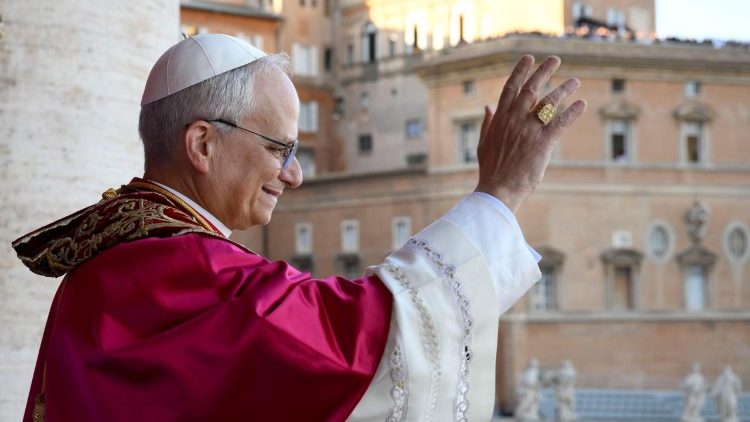
Image Vatican News
VATICAN CITY, May 8, 2025 — White smoke billowed from the Sistine Chapel chimney, and the ancient words rang out from the balcony of St. Peter’s Basilica: “Habemus Papam!” The new leader of the Catholic Church is Cardinal Robert Francis Prevost, who has taken the name Pope Leo XIV, becoming the first American-born Pope in the history of the Church.
At 69 years old, Leo XIV brings a unique profile to the papacy, a missionary spirit, deep roots in Latin America, and a track record of pastoral and institutional leadership at the heart of the Church. Seen as a progressive within the College of Cardinals, his election signals both continuity with Pope Francis’ reformist path and a historic shift in the Church’s global narrative.
From Chicago to the Chair of Peter
Born in Chicago, Illinois, on September 14, 1955, Robert Francis Prevost is the son of Louis Marius Prevost, of French and Italian descent, and Mildred Martínez, of Spanish heritage. His religious formation began early at the Augustinian Minor Seminary, and he later earned a degree in Mathematics and Philosophy from Villanova University in 1977.
That same year, he entered the novitiate of the Order of St. Augustine (OSA) and took solemn vows in 1981. He was ordained a priest in Rome in 1982 and studied Theology in Chicago and Canon Law at the Pontifical University of St. Thomas Aquinas (Angelicum), completing his doctorate in 1987.
Between 1985 and 1986, Prevost served in the Augustinian missions in Chulucanas, northern Peru — an experience that would leave a lasting mark on his life and ministry.
Meet Pope Leo XIV, the first American Pope in history.
Chicago-born Cardinal Robert Francis Prevost elected to succeed Pope Francis on the second day of the conclave pic.twitter.com/cmcFbhuRFU
— Larry Madowo (@LarryMadowo) May 8, 2025
A Missionary Bishop in Peru
Prevost spent more than two decades in Peru, taking on various roles: judicial vicar, seminary professor, formation director, and parish priest in poor urban communities. He became known for his dedication to the marginalized and his advocacy for a Church close to the people.
In 1999, he was elected Prior Provincial of the Midwest Augustinian Province, and in 2001, his fellow Augustinians chose him as Prior General of the Order, a post he held for two terms until 2013.
In 2014, Pope Francis appointed him Apostolic Administrator of the Diocese of Chiclayo, Peru. He was ordained a bishop on December 12, 2014, the feast of Our Lady of Guadalupe. He became the full bishop of Chiclayo in 2015 and later served as Vice President of the Peruvian Bishops’ Conference.
A Rising Leader in the Vatican
Prevost’s rise in the Roman Curia was swift. In 2019 and 2020, Pope Francis named him a member of key Vatican congregations, including those for the Clergy and Bishops. He was also appointed Apostolic Administrator of Callao, another Peruvian diocese.
In January 2023, Francis called him to Rome to lead the powerful Dicastery for Bishops — the Vatican department responsible for selecting bishops worldwide. In September 2023, he was made a cardinal, receiving the diaconate title of Santa Monica.
He participated in the Synod on Synodality in 2023 and 2024 and was promoted in February 2025 to the rank of cardinal-bishop, with the title of Albano, placing him among the Church’s most senior prelates and a clear contender for the papacy.
In a symbolic moment during Pope Francis’ hospitalization in March 2025, Cardinal Prevost led a public rosary in St. Peter’s Square, praying for the Pope’s recovery.
A Name that Hints at a Vision
By choosing the name Leo XIV, Prevost echoes the legacy of Leo XIII, known for his groundbreaking encyclicals on social justice. Observers see this as a signal of continuity with the Church’s emphasis on human dignity, workers’ rights, peace, and environmental concern — central themes of Pope Francis’ pontificate.
A Global Response
Reactions to his election poured in from world leaders. Ukrainian President Volodymyr Zelensky wished him “wisdom, inspiration, and strength — both spiritual and physical”, while expressing hope that the Vatican would continue supporting Ukraine’s pursuit of justice and peace.
Spanish Prime Minister Pedro Sánchez celebrated the election of Leo XIV, saying in a post on X (formerly Twitter) that the new pontiff would “strengthen dialogue and the defense of human rights in a world that needs hope and unity.”
In his hometown of Chicago, pride and joy were widespread. The city’s mayor remarked: “Everything good — even the Pope — comes from Chicago.”
A New Era Begins
Pope Leo XIV begins his papacy with decades of experience across the Americas and Europe, a commitment to synodality, and a reputation as a humble yet resolute reformer. His episcopal motto, “In Illo uno unum” — “In the One, may we be one” — captures the spirit of unity and communion he now brings to a global stage.
As the world watches his first steps as pontiff, Catholics and observers alike await a Church that blends tradition with renewal, guided by a pastor who has lived at both the center and the margins of ecclesial life.