
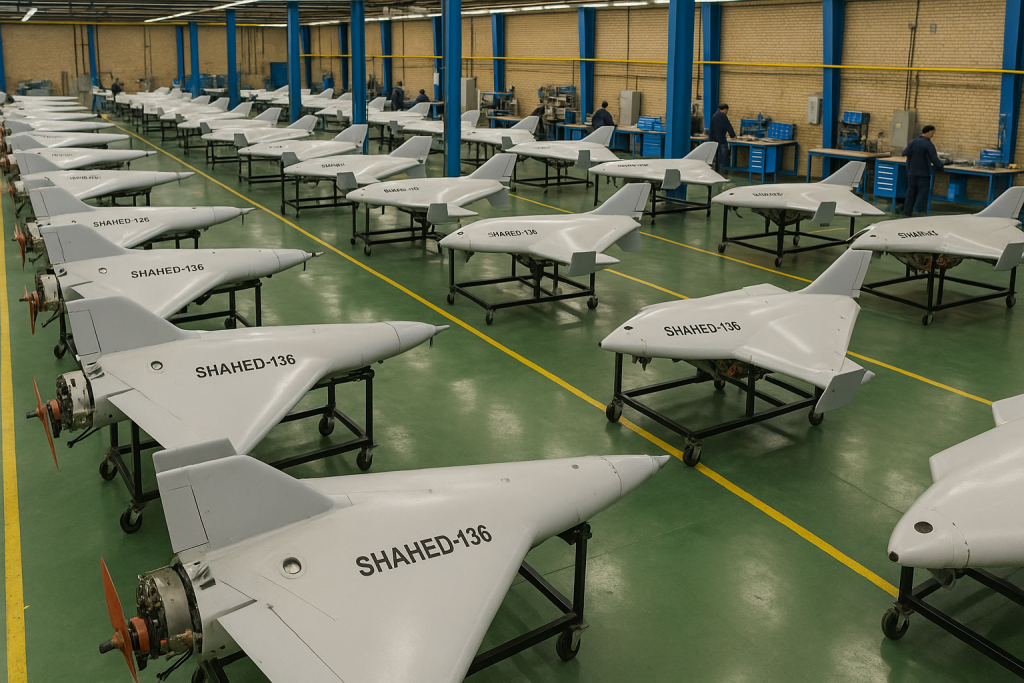
Image Credentials: Image Title: Russia Transfers Shahed Drone Tech to North Korea, Sparking Regional Security Fears Source: (sora.chatgpt) Date: May 2025 Attribution: Created by AI-generated imagery (sora.chatgpt), and it does not depict a real-world scene.
By Staff Writer International Desk with AGencies | June 9, 2025
Kyiv, Ukraine — Russia is actively transferring advanced military technology to North Korea, including the means to produce long-range Shahed-136 “kamikaze” drones, in a move that could drastically alter the military balance on the Korean Peninsula and further entrench Pyongyang’s capabilities, Ukraine’s top military intelligence official has revealed.
In an exclusive interview with The War Zone, Lt. Gen. Kyrylo Budanov, chief of Ukraine’s Defense Intelligence Directorate (GUR), said Moscow’s support extends beyond ammunition and logistics; it now includes cutting-edge drone and missile technologies once sourced from Iran and further refined on Russian soil.
“This isn’t just about tactical support. It’s about fundamentally changing North Korea’s military posture and reach,” Budanov said.
🧵 Officially disclosed allied intelligence has confirmed the transfer of advanced Russian weapons systems to North Korea in return for their troop deployment & arms transfers.
Among the Russian weapons is at least one Russian Pantsir short-range air defense (SHORAD) system. pic.twitter.com/9LDEsEM3Bp— Korea Defense Blog (@Korea_Defense) May 31, 2025
Shahed Drones on the Peninsula
According to Budanov, North Korea is now receiving technology and production support to domestically manufacture the Shahed-136 drone, an Iranian-designed loitering munition that has wreaked havoc in Ukraine’s skies. Russia, he noted, has significantly ramped up its Shahed production, now building approximately 2,000 units per month, with goals to more than double that.
“Having these drones gives Pyongyang a capacity to saturate South Korean airspace with long-range aerial threats,” Budanov warned. “It’s a strategic shift.”
Experts suggest this could overwhelm South Korean air defenses in a future conflict, allowing for secondary waves of more lethal munitions to follow. The technology may also be exported back to Russia, further fueling its invasion of Ukraine.
North Korea’s Missiles: From Failure to Precision
Budanov also disclosed that North Korea’s KN-23 short-range ballistic missiles (SRBMs), once highly unreliable, have seen a dramatic leap in accuracy and performance, all thanks to Russian intervention.
The KN-23, often dubbed a “North Korean Iskander,” initially performed poorly when supplied to Russia for use in Ukraine. “Half of them exploded midair or missed entirely,” Budanov said, citing a report from Ukrainian state prosecutors. But under Russian technical guidance, the missiles are now capable of pinpoint strikes, significantly enhancing their threat profile.
This mutual exchange — North Korean SRBMs for Russian battlefield use, and Russian tech for North Korea’s strategic development — marks a deepening military alliance that has drawn concern from Western analysts.
Submarine Nuclear Deterrence in the Making?
Perhaps even more alarming is Budanov’s assertion that Russia is helping North Korea advance its nascent submarine-based nuclear deterrent. Though details remain sparse, the collaboration could mark a milestone in Pyongyang’s longstanding ambition to field a credible second-strike nuclear capability.
“Russia is helping North Korea close the gap across all domains — aerial, missile, and naval,” Budanov said. “We’re watching a full-spectrum militarization with potentially global implications.”
An Alliance of Pariahs
The revelations underscore a broader geopolitical trend: the tightening of strategic ties between Russia and North Korea, two states largely isolated on the global stage. In return for military support, North Korea has sent Russia artillery shells, rockets, and now even troops, according to Ukrainian intelligence.
The alliance, forged out of mutual sanctions pressure and pariah status, is beginning to reshape regional security dynamics far beyond Eastern Europe.
In Washington, State Department officials have expressed growing alarm. “This is not just about Ukraine,” one senior defense analyst said. “This is about a new axis of military cooperation that threatens peace in the Indo-Pacific.”
A Broader Threat
Russia’s use of Shahed drones has devastated Ukrainian cities and infrastructure. If North Korea harnesses the same technology, South Korea — and potentially even U.S. bases in the region — could face a new class of fast, cheap, hard-to-intercept weapons deployed en masse.
Budanov’s warning arrives as NATO and regional allies reassess security postures in light of North Korea’s growing capabilities and Russia’s willingness to proliferate sensitive military technologies.
“This isn’t Cold War déjà vu,” Budanov concluded. “It’s a new and dangerous model of strategic cooperation, one that thrives in the vacuum left by fractured international norms.”