
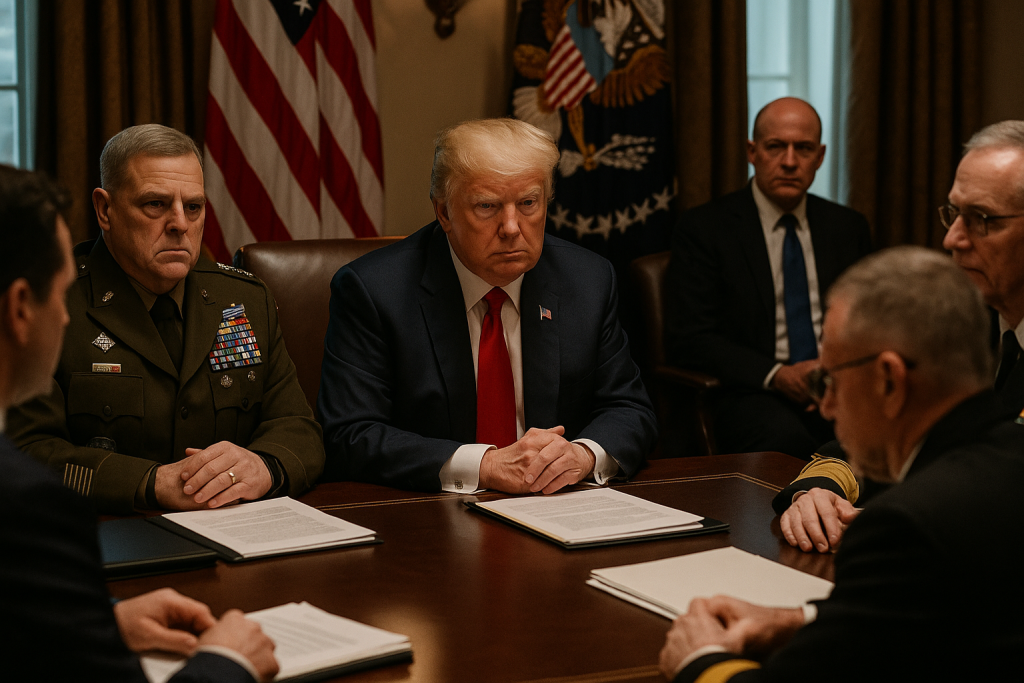
Image Credentials: Image Title: Trump Privately Endorses Iran Strike Plans But Pauses for Diplomatic Opening Source: (sora.chatgpt) Date: June 2025 Attribution: Created by AI-generated imagery (sora.chatgpt), it does not depict a real-world scene.
By Staff Writer with Agencies
June 18, 2025
Washington, D.C. — As tensions between Iran and Israel spiral and the Middle East inches closer to a broader conflict, former President Donald Trump has privately approved U.S. military plans to strike Iranian nuclear targets—but is holding off on issuing a final order, according to individuals familiar with high-level discussions.
During a closed-door meeting with senior national security advisers late Tuesday, Trump gave conditional approval to attack options targeting Iran’s nuclear infrastructure, signaling that his decision hinges on whether Tehran will retreat from its nuclear ambitions. “The next week is going to be very big, maybe less than a week,” Trump told reporters cryptically, when asked about a potential military strike.
One possible target identified by Pentagon planners is Iran’s Fordow enrichment facility, a heavily fortified site buried beneath a mountain. Military experts consider it virtually impervious to conventional airstrikes, requiring advanced “bunker buster” munitions should the U.S. choose to strike.
The deliberations come amid a growing military buildup in the region. A third U.S. Navy destroyer has moved into the eastern Mediterranean, and a second carrier strike group is steaming toward the Arabian Sea. While defense officials maintain these deployments are defensive, analysts say the move also serves to reinforce American options should Trump choose to back Israeli military operations directly.
“The presence of our forces ensures we’re ready for any outcome, diplomatic or otherwise,” said a senior Pentagon official, who spoke on condition of anonymity.
Meanwhile, the conflict continues to escalate on the ground. According to human rights monitors, the death toll in Iran has now exceeded 450 amid Israeli strikes, while Iranian rocket fire has killed at least 24 people in Israel. The Israeli military claimed responsibility for targeting eight Iranian helicopters and dozens of missile infrastructure sites in western Iran.
Iranian Supreme Leader Ayatollah Ali Khamenei remained defiant, rejecting U.S. demands and warning of “irreparable consequences” if American forces enter the conflict. “We will never surrender to coercion or aggression,” Khamenei said in a televised address.
U.S. lawmakers are already weighing in on the potential next steps. Sen. Ted Cruz (R-Texas), a vocal foreign policy hawk, suggested that a targeted “bunker buster” operation could be a viable option. “The United States can act decisively without putting troops on the ground,” Cruz said.
Prime Minister Benjamin Netanyahu, addressing the Israeli Knesset, emphasized Israel’s gradual but deliberate efforts to dismantle Iran’s nuclear program. “We are advancing step by step to ensure Iran’s capabilities are neutralized—both their uranium enrichment and their ballistic missiles,” Netanyahu said.
In response to growing security concerns, the U.S. Embassy in Israel has begun organizing evacuation flights for American citizens. Ambassador Mike Huckabee confirmed that logistical operations were underway: “We are working with Israeli authorities to ensure every U.S. citizen who wishes to leave can do so safely and swiftly.”
As diplomatic efforts hang in the balance, world leaders are urging restraint, but few hold illusions about the fragility of the situation. Whether President Trump opts for a military solution or continues to leverage U.S. power as a negotiating tool may determine the course of the region for years to come.