
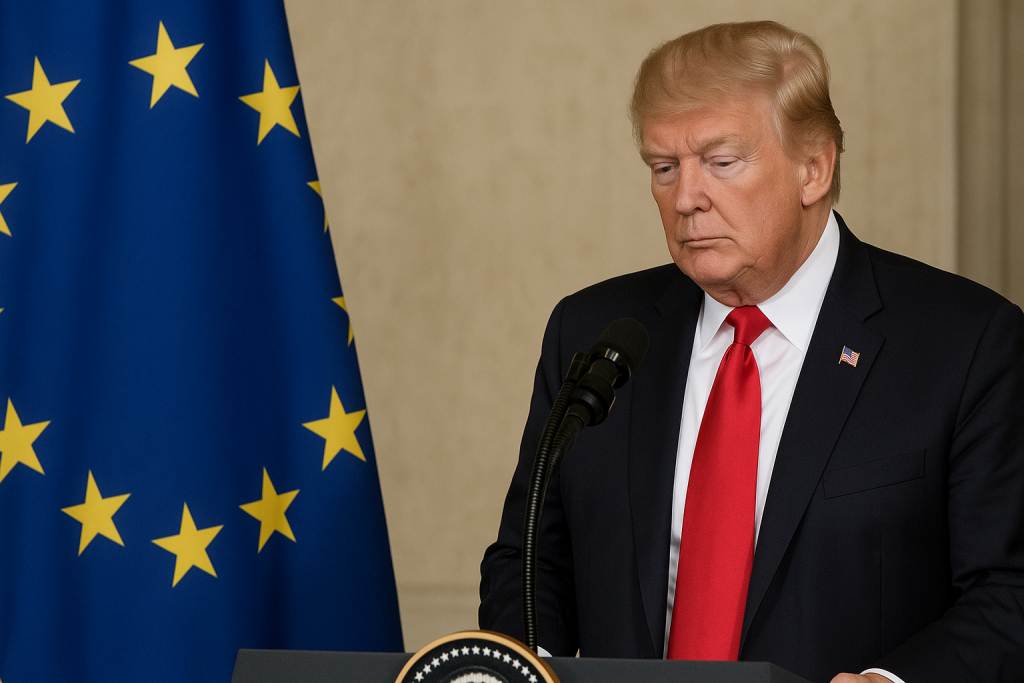
Image Credentials: Image Title: U.S. Tariffs on European Goods Could Disrupt Major Trade Alliance, Spark Price Hikes Source: (sora.chatgpt) Date: July 2025 Attribution: Created by AI-generated imagery (sora.chatgpt), it does not depict a real-world scene.
By Open Chronicle Staff with Agencies
FRANKFURT, Germany — The European Union is anxiously awaiting the outcome of a critical decision by President Donald Trump, who is expected to announce on Monday whether he will impose punitive tariffs on European goods, a move that could have profound effects on both sides of the Atlantic. Economists warn that these tariffs could disrupt trade and lead to higher prices for consumers and businesses alike.
In early April, Trump imposed a 20% import tax on all European-made products, as part of an effort to address the U.S. trade imbalance with the EU. However, just hours after the tariffs took effect, the White House chose to postpone them, reducing the rate to 10% until July 9. This was done to calm financial markets and allow for time to engage in negotiations.
Despite this reprieve, the U.S. President has threatened to escalate the tariff rate to a staggering 50%, which would significantly raise the cost of European exports to the United States. Products such as French cheese, Italian leather goods, German electronics, and Spanish pharmaceuticals could become much more expensive, straining U.S. consumers and businesses.
In response, the European Union’s executive commission has expressed a desire to strike a deal with the Trump administration but warned it is prepared to retaliate with tariffs on a wide range of American products, including beef, auto parts, beer, and even Boeing airplanes.
The trade relationship between the U.S. and the EU is one of the most significant commercial partnerships in the world. According to the EU’s statistics agency, Eurostat, the total value of trade in goods and services between the two regions was an astounding 1.7 trillion euros ($2 trillion) in 2024, or an average of 4.6 billion euros ($5 billion) per day.
The biggest U.S. exports to Europe include crude oil, pharmaceuticals, aircraft, automobiles, and medical equipment, while Europe’s main exports to the U.S. consist of pharmaceuticals, cars, aircraft, chemicals, and wine and spirits. Despite the overall trade imbalance, with Europe’s goods surplus reaching 198 billion euros, the U.S. benefits from a services surplus, balancing the scales to some extent.
While Trump has expressed frustration with the EU’s trade surplus in goods, the reality is that the U.S. outsells Europe in services such as cloud computing, travel bookings, and legal and financial services, narrowing the overall trade gap to just 50 billion euros ($59 billion), or less than 3% of total trade.
Before Trump’s return to office, the U.S. and the EU enjoyed a generally cooperative trade relationship, with low tariffs on both sides. The U.S. typically levied an average tariff of 1.47% on European goods, while the EU’s tariff on American imports averaged 1.35%.
However, since February, the Trump administration has taken a more confrontational approach. In addition to the fluctuating tariffs on European goods, the U.S. has imposed a 50% tariff on steel and aluminum imports from the EU, as well as a 25% tax on imported automobiles and parts.
Trump has also raised concerns over agricultural trade barriers, such as the EU’s ban on chlorine-washed chicken and hormone-treated beef, and criticized Europe’s value-added taxes (VAT), which range from 17% to 27%. However, many economists view the VAT as trade-neutral, applying to both domestic and imported products. The EU has indicated that these tax issues are non-negotiable, as they are decided by national governments.
Higher tariffs could lead to higher prices for American consumers, as companies would face increased costs for imported goods. Companies would have to decide whether to absorb the higher tariff costs through lower profits or pass the price hikes on to customers.
Some U.S. companies, such as Mercedes-Benz, have already warned of potential price increases due to the tariff impact. Despite producing 35% of their vehicles in the U.S., Mercedes expects “significant increases” in prices in the coming years. Similarly, Italian spirits and wine producer Campari Group might have to adjust prices for certain products depending on how competitors react.
Trump has argued that protecting American manufacturers from foreign competition will revive U.S. manufacturing jobs. However, many experts dismiss this idea, pointing out that the benefits of protectionism would take years to materialize, and even then, may not yield the desired results.
Some companies have already begun shifting production to the U.S. to avoid tariffs. LVMH, the French luxury group behind brands like Louis Vuitton and Tiffany, has expressed willingness to move some of its production to the U.S. to circumvent potential tariffs.
As the deadline approaches, the most likely outcome is a framework deal that would include a 10% base tariff on European imports, while leaving the existing auto, steel, and aluminum tariffs in place until further negotiations are completed.
However, economists suggest that the U.S. will likely agree to a deal that takes away its most severe threats while allowing for exemptions on some goods. The EU may offer to ease some regulations that are seen as trade barriers to reach a deal.
Holger Schmieding, chief economist at Germany’s Berenberg Bank, believes that a rocky road lies ahead: “The road to get there could be rocky, but ultimately the U.S. will likely seek an outcome that allows it to claim a victory while reducing the impact on consumers.”
A deal of this kind might help Trump to save face but at the cost of U.S. consumers, who would likely bear the brunt of the higher prices caused by tariffs.
Some experts warn that the U.S. economy is more vulnerable to the impact of failed trade talks than the EU. A recent analysis from the Brussels-based think tank Bruegel forecasts that U.S. GDP could fall by 0.7% if tariffs between the two economies are raised, while the EU would lose just 0.3% of its GDP.
As the situation develops, one thing is clear: the outcome of these trade negotiations will have far-reaching consequences for both the U.S. and Europe. If an agreement is not reached, it could escalate into a full-blown trade war, hurting both sides and affecting global trade dynamics for years to come.
The world is watching as these two economic giants prepare to either strike a deal or risk a collision.