
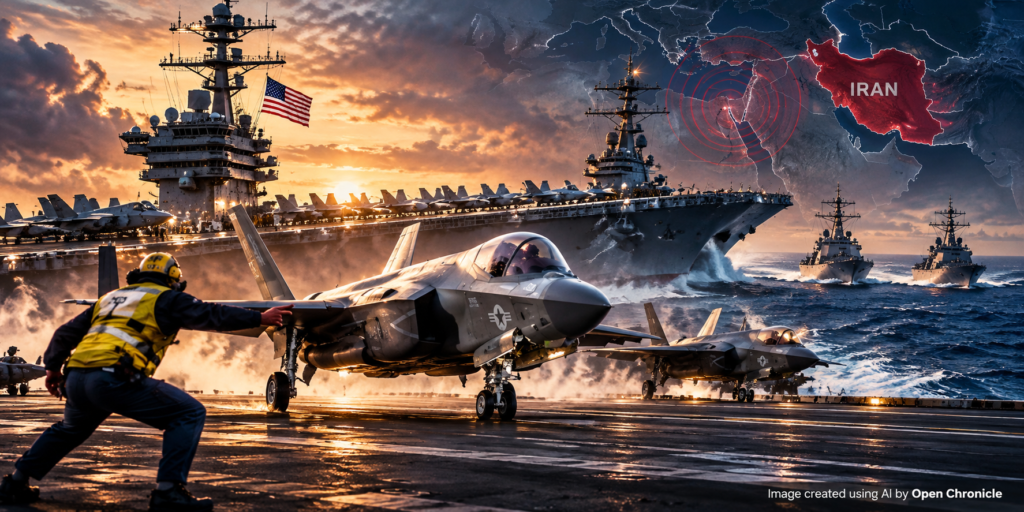
By the end of November, three US aircraft carriers and two amphibious landing groups are expected to be positioned near Iran, significantly expanding the military options available to President Donald Trump as Washington combines military pressure with stalled diplomatic efforts.
By Open Chronicle with agencies
The United States is deploying another aircraft carrier strike group and thousands of additional military personnel towards the Middle East as the war with Iran enters its eighth month, adding to an already substantial American military presence across the region.
The USS Theodore Roosevelt carrier strike group departed its San Diego base on Sunday bound for the region, according to a US official cited by Al Jazeera. It was followed a day later by the Makin Island Marine Expeditionary Unit, carrying more than 2,000 Marines.
The wider naval deployments could involve approximately 9,000 to 10,000 additional US personnel, including sailors and Marines assigned to the carrier strike group and accompanying vessels, according to reporting by The Wall Street Journal cited in the supplied material.
By the end of November, the United States is expected to have three aircraft carriers and two amphibious landing groups positioned near Iran.
The deployment represents a significant concentration of American military power at a moment when Washington and Tehran are simultaneously preparing for the possibility of further fighting and attempting to find a diplomatic route out of the conflict.
A Major New Concentration of US Forces
The Theodore Roosevelt deployment will add another carrier strike group to forces already operating in and around the Middle East.
The latest reinforcements also include F 35 fighter aircraft and will join roughly 50,000 US military personnel already stationed throughout the region, according to the supplied reporting.
Sources inside the Pentagon and White House cited by Al Jazeera said the objective is to ensure that military options remain available to Trump regardless of developments in negotiations with Tehran.
The Pentagon is reportedly not currently planning to withdraw military assets even if an agreement with Iran is reached.
Defense Secretary Pete Hegseth has said American forces are ready should Trump order further military action.
The expanding deployment does not by itself establish that Washington has decided to escalate the war. It does, however, substantially increase the military capabilities available to the president if the administration chooses to intensify operations.
An American Military Network Across the Middle East
The latest deployment is being added to a US military infrastructure that has developed across the Middle East over decades.
According to the Council on Foreign Relations figures cited in the supplied material, the United States operates from permanent and temporary military sites across at least 19 locations in the region.
Eight permanent bases are located in Bahrain, Egypt, Iraq, Jordan, Kuwait, Qatar, Saudi Arabia and the United Arab Emirates.
Between 40,000 and 50,000 American military personnel were stationed across the Middle East as of mid 2025, distributed between large bases and smaller forward operating locations.
Washington began strengthening that presence before the current war with Iran began.
The USS Abraham Lincoln aircraft carrier was among the warships sent towards the Arabian Sea as the military buildup accelerated earlier this year.
Airpower Had Already Been Increasing
The naval deployment follows a major expansion of American airpower in the region.
According to open source intelligence analysts and military flight tracking information cited in the supplied reporting, more than 120 US aircraft had been deployed to the region since early February.
The reported aircraft included E 3 Sentry Airborne Warning and Control System platforms, F 35 stealth fighters, F 22 air superiority fighters, and F 15 and F 16 combat aircraft.
Cargo aircraft and aerial refuelling tankers were also observed supporting those deployments.
Military analysts cited in the reporting interpreted the scale and supporting infrastructure as evidence of sustained operational preparations rather than ordinary force rotations.
Further ground and amphibious forces followed after the war began.
Thousands of Troops Have Already Arrived
In March, the Pentagon ordered three additional formations towards the Gulf.
The Tripoli Amphibious Ready Group, centred on the USS Tripoli and the 31st Marine Expeditionary Unit, was joined by the Boxer Amphibious Ready Group and its 11th Marine Expeditionary Unit.
Together, those formations added approximately 4,500 Marines and sailors.
Another roughly 2,000 soldiers came from the 82nd Airborne Division’s Immediate Response Force based at Fort Bragg, North Carolina.
In total, nearly 7,000 additional American military personnel had already been sent to the Middle East since the war with Iran began, before the latest announced deployment.
The Theodore Roosevelt strike group and Makin Island deployment will expand that presence further.
Does the Deployment Signal Escalation?
The central question is whether the movement of another carrier strike group represents preparation for a new phase of the conflict or an attempt to strengthen Washington’s negotiating position.
At present, the deployment alone cannot answer that question.
Trump indicated in an interview with Time published on Thursday that an intensification of the bombing campaign after the November midterm elections was possible.
Asked for further details about potential targets, the president declined to provide operational information.
At the same time, Washington and Tehran continue to exchange diplomatic proposals through intermediaries.
The military buildup could therefore serve several purposes simultaneously: preparing for possible operations, strengthening deterrence, protecting existing US forces and increasing pressure on Iran during negotiations.
Hormuz Remains at the Centre of Diplomacy
The Strait of Hormuz remains one of the principal obstacles in negotiations.
Iran recently presented a proposal under which it would reopen the strategic waterway within seven days if Washington met several conditions.
According to the supplied reporting, Tehran sought sanctions relief, the unfreezing of Iranian assets and guarantees concerning an end to strikes.
The Trump administration rejected the proposal.
Washington reportedly wants negotiations to address broader questions, including Iran’s nuclear programme, before agreeing to Tehran’s conditions.
Trump said in his Time interview that the Iranian ceasefire proposal contained provisions he would not accept.
The United States has meanwhile continued applying economic pressure.
Washington imposed sanctions on Iranian rail and automotive conglomerates this week, following broader sanctions announced the previous month against Iran and countries conducting trade with it.
Military reinforcement and economic pressure are therefore proceeding alongside diplomatic contacts rather than replacing them.
Negotiations Continue Without a Breakthrough
Indirect talks between Iran and the United States have continued through mediators, but no decisive breakthrough has emerged.
Discussions held around the United Nations General Assembly in New York last month, mediated by Qatar, again focused heavily on the Strait of Hormuz.
Iran proposed a seven day roadmap under which the strait would reopen and nuclear negotiations would resume in exchange for an end to the US naval blockade, sanctions relief and a regional ceasefire extending to Lebanon and Yemen.
Trump rejected the proposal.
US Ambassador to the United Nations Mike Waltz argued that demands involving frozen funds and sanctions could not be accepted on the terms proposed, while also referring to United Nations Security Council measures concerning Iran’s nuclear programme.
Iranian Foreign Minister Abbas Araghchi subsequently said Tehran remained prepared for renewed fighting while maintaining that Iran had gone to New York seeking peace.
The contrasting statements illustrate the dual track that increasingly defines the conflict: preparations for further military operations are continuing while diplomatic channels remain open.
Trump Issues Another Warning to Tehran
The rhetoric surrounding the negotiations has also intensified.
Speaking on Thursday at a Peterbilt Motors facility in Denton, Texas, Trump said the confrontation with Iran would end soon and warned of severe consequences if Tehran failed to reach an agreement with Washington.
He also publicly questioned whether Iran could be trusted to honour an eventual agreement.
Such statements come as additional US forces move towards the region, giving the warnings greater military significance even though Washington has not publicly announced a decision to begin a new phase of operations.
Military Pressure Meets Political Pressure at Home
The deployment is also occurring shortly before the November US midterm elections.
According to the supplied reporting, the war has become deeply unpopular in the United States, creating political pressure on Trump and the Republican Party.
That domestic context adds another dimension to decisions surrounding military escalation and diplomacy.
Trump’s suggestion that intensified bombing could occur after the elections will therefore be closely watched alongside the movement of the Theodore Roosevelt strike group.
Domestic political considerations do not establish what military decisions the administration will make, but the timing means the next stage of the war could unfold alongside a consequential electoral period in the United States.
Three Carriers, Multiple Options
Aircraft carriers are among the most powerful instruments available to Washington for projecting military force without depending entirely on land bases in allied countries.
Deploying three carrier groups near the same conflict theatre would give the United States substantial aviation, surveillance, command and strike capabilities.
Amphibious groups carrying Marines provide additional flexibility, including forces capable of operating from sea to land.
Combined with fighter aircraft, airborne surveillance systems, aerial refuelling capabilities, existing regional bases and tens of thousands of personnel, the buildup gives Washington a broad range of military options.
But capability is not the same as intent.
The presence of additional forces can support an attack, strengthen deterrence or increase leverage during negotiations. The same deployment can potentially serve all three purposes.
A Critical Period for the Iran War
The coming weeks may consequently become one of the most consequential periods since the conflict began.
Washington is moving significant additional military power towards Iran while simultaneously maintaining indirect negotiations.
Tehran is offering terms for reopening the Strait of Hormuz while signalling that it remains prepared to continue fighting.
The Trump administration is increasing sanctions while keeping further military action available.
By the end of November, if the deployments proceed as described, the United States will have assembled three aircraft carriers, two amphibious landing groups and a substantial concentration of air and ground forces around the region.
Whether that force is ultimately used to expand the war or becomes leverage for an eventual agreement remains unresolved.
For now, the military buildup ensures that both possibilities remain open.