
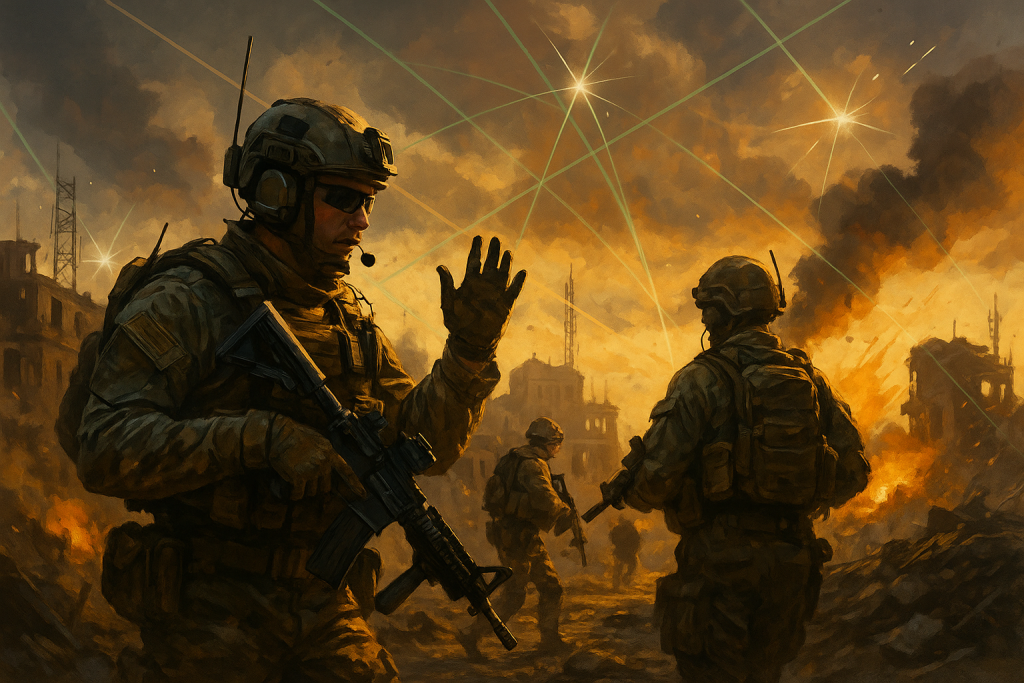
Image Credentials: Image Title: Advanced Communication Systems: Unleashing a Tactical Advantage in Modern Combat Source: (sora.chatgpt) Date: August 2025 Attribution: Created by AI-generated imagery (sora.chatgpt), it does not depict a real-world scene.
By Staff Writer | Open Chronicle
Today’s battlefields demand more from warfighters than ever before. In Ukraine, we have seen how contested communications and GPS jamming can cripple even the most technologically advanced forces. Soldiers must maneuver while maintaining situational awareness and communicating seamlessly across diverse networks, often in chaotic, degraded environments.
To achieve decisive overmatch, communication systems must be as enduring as the Soldiers who rely on them. Interoperable, survivable, and capable of leveraging full-spectrum bandwidth for ultra-high-throughput data transfer, these systems enable real-time connectivity that modern warfare demands. Multi-mode products, commercial off-the-shelf solutions, and agile software updates allow forces to field advanced capabilities faster, at lower cost, and with minimal disruption.
Most critically, we must learn from current conflicts while applying the hard-earned lessons of history.
In On War, Carl von Clausewitz described the “fog of war” and “friction of war”, the chaos and unpredictability that can disrupt even the most carefully planned operations. He warned that ambiguity can cloud decision-making, making simple tasks exceedingly difficult in combat. His remedy, keep communications clear and direct at every level of command.
Nearly two centuries later, the fog of war remains, but its sources have multiplied. Clausewitz could never have imagined today’s contested electromagnetic spectrum, hypersonic weapons, autonomous threats, or joint theater-wide operations. Communication gear, once considered a support function, is now a primary determinant of combat effectiveness.
In modern warfare, resilient networks are the gravitational force that enables rapid, informed decision-making. Systems must operate under pressure, adapt in real time, and withstand both electronic and kinetic attacks, while avoiding unnecessary complexity that breeds confusion.
The Army’s Transform in Contact strategy demands solutions that are battle-tested and operationally ready. Industry must deliver unmatched capability, agility, and adaptability—ensuring warfighters remain connected in even the most contested environments.
Commercial Speed: By adopting commercial technology, data-layer management, and rapid test-and-field cycles, the Department of Defense accelerates innovation, reduces costs, and brings capabilities to the field at operational speed. This commercial model shortens development timelines, reduces lifecycle burdens, and enables large-scale deployment without compromising resilience.
Next-Generation Communication Software: Modern systems must be secure, scalable, and interoperable across allied forces, avoiding extra gateways or hardware. Multipurpose hardware with self-forming, self-healing waveforms, rapid frequency agility, and API-based interfaces delivers reliable connectivity across joint operations. Software updates further enhance bandwidth and throughput without replacing hardware.
Enhanced Night Vision Capability: The Enhanced Night Vision Goggle–Binocular (ENVG-B), integrated with AI-driven situational awareness, accelerates decision-making in any environment. Within CJADC2, Next Generation Command and Control (NGC2), or Soldier-Borne Mission Command (SBMC) ecosystems, these devices transform individual Soldiers into data-sharing, real-time decision nodes.
Open Systems Architecture: Modular, scalable systems integrate easily into existing infrastructure, protecting investments while enabling rapid upgrades as threats evolve. This approach simplifies operations, speeds deployment, and ensures long-term adaptability.
Today’s battlefields cross domains and continents, presenting challenges like cyber warfare, electronic jamming, and GPS spoofing. Rigid systems fail in such conditionssurvivability depends on versatility.
Secure, interoperable communications are essential across platforms, units, and domains. The Army’s Handheld, Manpack, and Small Form Fit (HMS) radios and ENVG-B systems exemplify this, with software upgrades that enhance resilience and adaptability. With hundreds of thousands deployed, these systems double as tactical data routers for next-generation command and control.
We have entered an era where communications serve as both offensive and defensive assets. As the DoD modernizes through CJADC2, NGC2, SBMC, and related initiatives, industry must deliver survivable, agile solutions.
Battle-tested systems with spectrum agility, high throughput, and advanced gateway capabilities give forces the clarity and resilience needed to “burn through” the fog of war. These capabilities must be validated under the harshest conditions to ensure they hold up in real combat.
The Army needs partners who can innovate fearlessly while delivering proven, mission-ready solutions. In modern combat, communication systems are no longer background tools—they are the backbone of operational dominance.
By combining adaptability, interoperability, and relentless testing, advanced communication systems will continue to be the decisive tactical advantage that keeps our forces connected, informed, and in control, no matter how chaotic the battlefield becomes.
References
-
Clausewitz, Carl von. 1984. On War. Edited and translated by Michael Howard and Peter Paret. Princeton, NJ: Princeton University Press.
-
Defense Advanced Research Projects Agency (DARPA). 2023. “Adaptive and Resilient Electromagnetic Spectrum Operations.” DARPA Programs Overview.
-
Headquarters, Department of the Army. 2022. FM 3-0: Operations. Washington, DC: Department of the Army.
-
National Defense Industrial Association (NDIA). 2023. “Leveraging Commercial Technology for Military Communications.” NDIA Emerging Technologies Report.
-
Office of the Director, Operational Test & Evaluation (DOT&E). 2024. Annual Report 2023. Washington, DC: U.S. Department of Defense.
-
Program Executive Office – Command, Control and Communications-Tactical (PEO C3T). 2024. “Handheld, Manpack and Small Form Fit (HMS) Radios.” Program Overview.
-
U.S. Army Futures Command. 2022. Army Network Modernization Strategy: 2022–2030. Washington, DC: U.S. Army.
-
U.S. Department of Defense. 2021. Joint All-Domain Command and Control (JADC2) Strategy. Washington, DC: Office of the Secretary of Defense.
-
Center for Strategic and International Studies (CSIS). 2023. Electronic Warfare in the Russia-Ukraine War: Lessons for the U.S. Military. Washington, DC: CSIS Brief.
-
Congressional Research Service (CRS). 2023. Emerging Military Technologies: Background and Issues for Congress. CRS Report R46458. Washington, DC: CRS.