
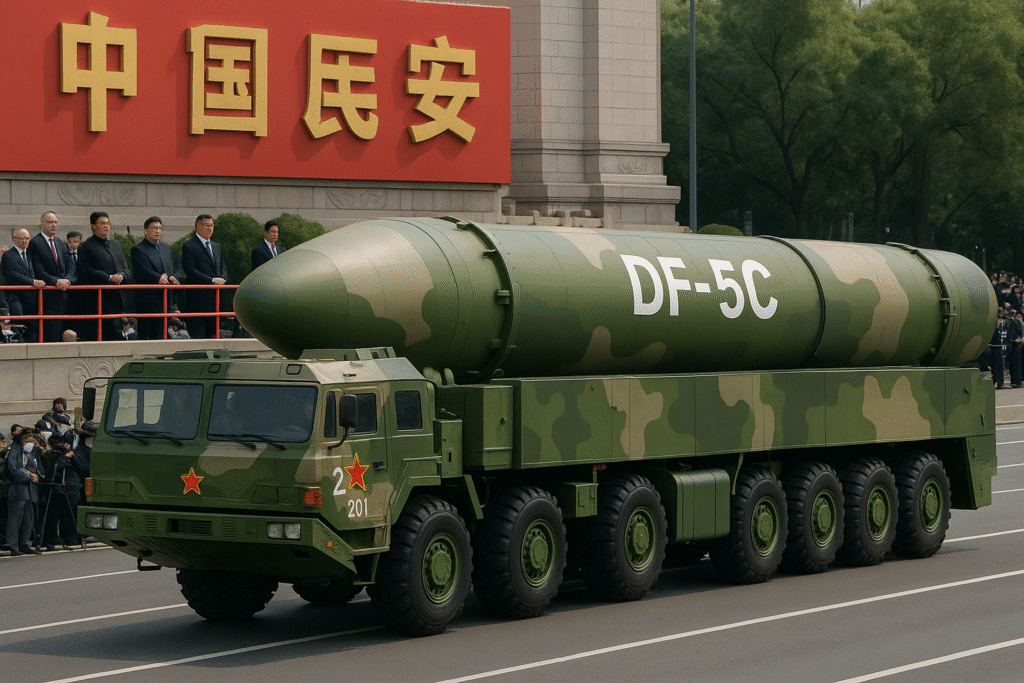
Image Credentials: Image Title: DF-5C missile Source: (sora.chatgpt) Date: September 2025 Attribution: Created by AI-generated imagery (sora.chatgpt), it does not depict a real-world scene.
By Staff Writer | Open Chronicle
The DF-5C (Dongfeng-5C) is a Chinese liquid-fueled intercontinental ballistic missile (ICBM) publicly revealed during a military parade in Beijing. The missile, along with the DF-61, was showcased as part of China’s demonstration of expanding nuclear capabilities, an event attended by Russian President Vladimir Putin and North Korean leader Kim Jong Un.
China’s display of the DF-5C and DF-61 was interpreted by analysts as a direct signal to the United States, amid estimates that the Chinese nuclear arsenal could reach 1,000 warheads by 2030.
Design and capabilities
The DF-5C is a two-stage, liquid-fueled ICBM and is regarded as one of the most powerful of its kind. During the Beijing parade, it was transported in three sections: two propulsion stages mounted on vehicles, and a separate oversized warhead unit.
-
Dimensions: The missile measures more than 3 meters (10 ft) in diameter and over 20 meters in length.
-
Propulsion: It is powered by four liquid-fuel engines, offering significant thrust but requiring complex handling due to volatility and storage issues.
-
Payload: Capable of carrying up to 10 independently targetable nuclear warheads (MIRVs), or a single large warhead. Analysts noted that the warhead appeared large enough to contain a multimegaton payload, exceeding the 750-kiloton to 1-megaton warheads typically deployed by the United States and Russia.
-
Range: Estimated at more than 20,000 kilometres, enabling global strike capability.
Chinese media have described the DF-5C as maintaining constant readiness, with roles in deterrence, precision strikes, and nuclear force survivability.
DF-61 missile
Unveiled alongside the DF-5C, the DF-61 is a road-mobile ICBM, transported by a 16-wheeled transporter-erector-launcher (TEL) truck.
-
Mobility: Unlike the silo-launched DF-5 series, the DF-61 is designed for mobility, allowing deployment across China to increase survivability.
-
Size: With an estimated length of more than 20 metres, its payload is comparable to or heavier than that of the DF-41 missile, which is capable of striking targets throughout North America.
-
Development: The DF-61 is believed to be a successor to the DF-41 and may have roots in missile systems China reportedly tested in 2021.
Strategic implications
Analysts view the DF-5C and DF-61 as evidence of China’s nuclear modernization and ambition to expand its deterrence capabilities. According to Jeffrey Lewis of the James Martin Center for Nonproliferation Studies, the DF-5C’s large payload options highlight China’s growing ability to field multimegaton-class warheads.
Professor Yang Chengjun, a Chinese missile expert, argued that the DF-5C combines global range with improved penetration capabilities, representing a leap in China’s strategic arsenal.
The unveiling of both missiles has sparked renewed debate on nuclear arms control and strategic stability, as previous U.S. and Soviet experiments with similar technologies during the Cold War were deemed too destabilizing.
References
-
Bloomberg News (2025). China showcases DF-5C and DF-61 missiles in Beijing military parade.
-
Global Times (2025). Expert commentary on DF-5C missile range and capabilities.
-
James Martin Center for Nonproliferation Studies. Jeffrey Lewis, Analysis of DF-5C warhead capacity.
-
SIPRI Yearbook. Chinese nuclear arsenal projections.
Missiles of the People’s Republic of China | Intercontinental ballistic missiles of the People’s Republic of China
Explore this subject
Continue exploring related Open Chronicle Encyclopedia entries through the categories associated with this article.

Staff Writers at Open Chronicle produce trusted journalism, strategic analysis and authoritative reference content across global affairs, geopolitics, defense, science, history, technology, business, culture and sport. Their work combines accurate reporting with historical perspective and analytical depth, helping readers understand not only what is happening, but why it matters. Beyond daily news coverage, Staff Writers contribute to the Open Chronicle Encyclopedia, investigative features, original research projects and long-form reports, building a comprehensive knowledge platform designed to inform, educate and preserve reliable information for a global audience.