
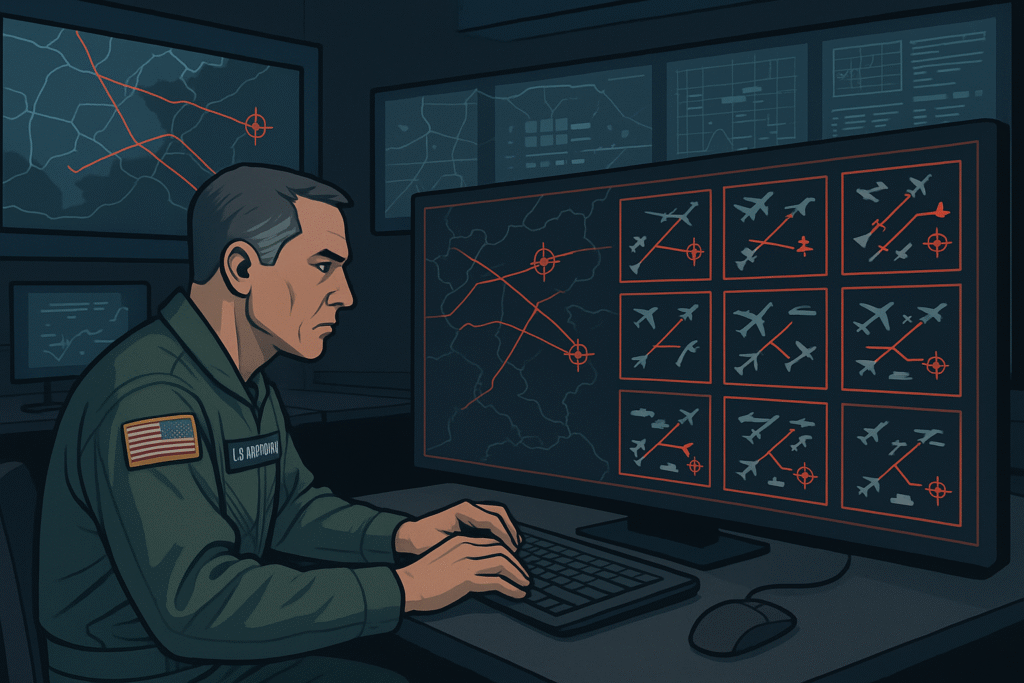
Image Credentials: Image Title: AI Outpaces Humans in Generating Battle Plans, But Still Needs Human Oversight Source: (Sora.ChatGpt) Date: September 2025. Attribution: Created using AI-generated imagery (Sora.ChatGpt), this does not depict a real-world scene.
By Liam Scott | Staff Writer with Agencies
In a recent U.S. Air Force experiment, artificial intelligence (AI) algorithms demonstrated their capability to generate battle plans at a remarkable speed, producing options approximately 400 times faster than human counterparts. However, despite the impressive speed, not all of the plans were viable, showcasing the complexities and limitations of AI in military planning.
The exercise, known as DASH-2, aimed to create detailed courses of action for a series of military targets, utilizing a mix of aircraft and weaponry. According to Maj. Gen. Robert Claude, who spoke at the Air Force Association’s Air, Space, and Cybersecurity Conference, said the traditional human approach took around 16 minutes to develop three options. In contrast, the AI tools managed to generate 10 potential attack plans in just eight seconds, a stark difference in processing time.
While the speed at which AI generated these plans was impressive, the quality of the results did not always meet operational standards. Maj. Gen. Claude revealed that the AI’s errors were often subtle, such as selecting incorrect sensors for weather conditions, rather than obvious mistakes like suggesting the use of tanks in air missions. These errors highlighted the importance of human oversight, as AI alone may not yet be trusted to fully handle military planning.
“What is going to be important going forward is, while we’re getting faster results and we’re getting more results [from AI], there’s still going to have to be a human in the loop for the foreseeable future to make sure that they’re all viable and to make the decision,” said Maj. Gen. Claude.
The experiment underscores the ongoing challenge in AI’s integration into military decision-making. The AI systems used in DASH-2 were developed in just two weeks, a rapid timeline that left little room to fine-tune the algorithms and ensure that all the necessary factors were accounted for. Claude emphasized that future iterations of AI planning tools would likely see a reduction in error rates, improving the accuracy of AI-generated strategies.
While AI’s role in military planning is still evolving, the Air Force’s DASH-2 experiment is just one example of the broader experimentation with AI within the U.S. military. The Army is also exploring the use of AI to enhance maintenance and repair capabilities. In late August, reports revealed that the Army was training large language models to assist engineers and technicians in repairing the Infantry Squad Vehicle, a heavily modified version of the Chevy Colorado pickup.
The Army uploaded about 1,000 hours of repair videos to train a visual AI model, which can then be integrated with technologies like smart glasses or HoloLens to guide soldiers through repairs step by step. This AI tool aims to simplify complex repair processes, improving the efficiency and capability of military personnel in the field.
In both the Air Force and Army experiments, AI’s role is seen as a complement to human decision-making rather than a replacement. While AI can generate faster results and manage vast amounts of data, human expertise is still essential to ensure that those results are viable, practical, and aligned with operational realities.
The future of AI in military operations is still in its infancy, but these early experiments suggest a growing reliance on artificial intelligence to support, rather than replace, human decision-making in complex and high-stakes environments.
As the technology continues to evolve, military planners and developers will need to refine the algorithms, enhance data quality, and incorporate safeguards to minimize errors. For now, it is clear that while AI can dramatically speed up the process of military planning, human oversight remains crucial in making sure the plans are not only fast but also effective.