
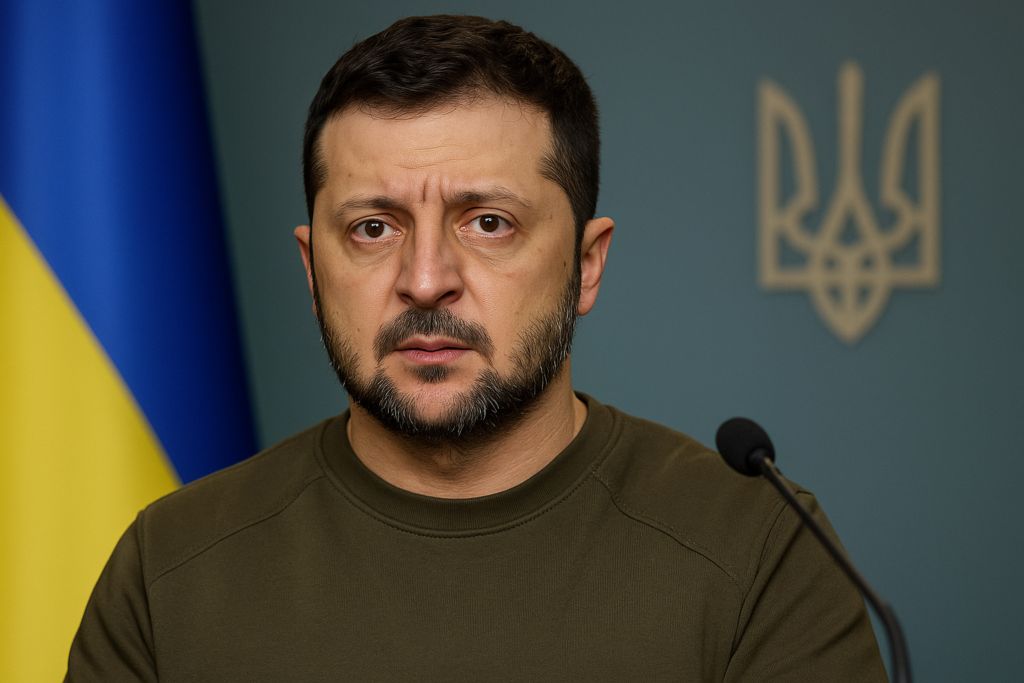
Image Credentials: Image Title: Zelenskyy on Elections: Security and Law Must Precede Vote in Wartime Ukraine Source: (sora.openai) Date: December 2025. Attribution: This image was created using AI-generated imagery (sora.openai) and does not depict a real-world scene.
By Open Chronicle Staff with Agencies
KYIV, Ukraine – Ukrainian President Volodymyr Zelenskyy has pushed back against claims that he is using the war as an excuse to avoid holding elections, stating he is ready for a poll if critical security and legal challenges can be overcome. Zelenskyy’s five-year term formally expired in May 2024, but elections were legally suspended due to Russia’s full-scale invasion.
This delay has become a point of international debate, notably with criticism coming from President Donald Trump, who suggested Ukraine’s lack of elections undermines its democracy.
Zelenskyy, who has previously maintained that an election could only occur after a ceasefire, outlined the fundamental obstacles preventing a vote:
- Martial Law: Ukraine has been under martial law since February 2022. The country’s constitution and separate laws explicitly bar elections from being held while martial law is in force.
- Security Risks: Any nationwide vote would face extreme security risks due to ongoing missile and drone attacks by Russia across Ukrainian cities.
- Logistical Impossibility: With roughly one-fifth of the country under Russian occupation and millions of citizens displaced abroad, organizing a fair, nationwide ballot is logistically impossible. This includes finding a secure and viable way for Ukrainian soldiers on the front lines to cast their votes.
Responding directly to critics, Zelenskyy told reporters on Tuesday that the suggestion he is “clinging to power” is “a completely absurd story.” He then laid out a conditional proposal for holding a vote within the next 60–90 days:
“Moreover, I am now asking, and I am stating this openly, for the United States, possibly together with our European colleagues, to help me ensure security for holding elections.”
He added that if allies could guarantee security, he would then ask lawmakers to propose the necessary legal changes to allow elections to proceed under martial law.
The ongoing delay has been weaponized by Moscow, which has used Zelenskyy’s continuation in power after his term’s expiry to cast him as an illegitimate leader.
However, the Constitution allows the President to legitimately remain in office until a newly elected president is sworn in. Furthermore, the decision to postpone elections under martial law has been largely supported by the Ukrainian populace, who prioritize national unity against the invasion.
Despite this unity, potential political rivals exist. Former army chief Valerii Zaluzhnyi, the current Ukrainian ambassador to Britain, remains popular in public surveys, though he has denied plans to enter politics. Former President Petro Poroshenko also leads the largest opposition party, and his backing of any candidate would hold significant weight.
The President reiterated that the decision on when to hold elections belongs to the Ukrainian people, not international allies, but stressed that safety and legality must come first.