
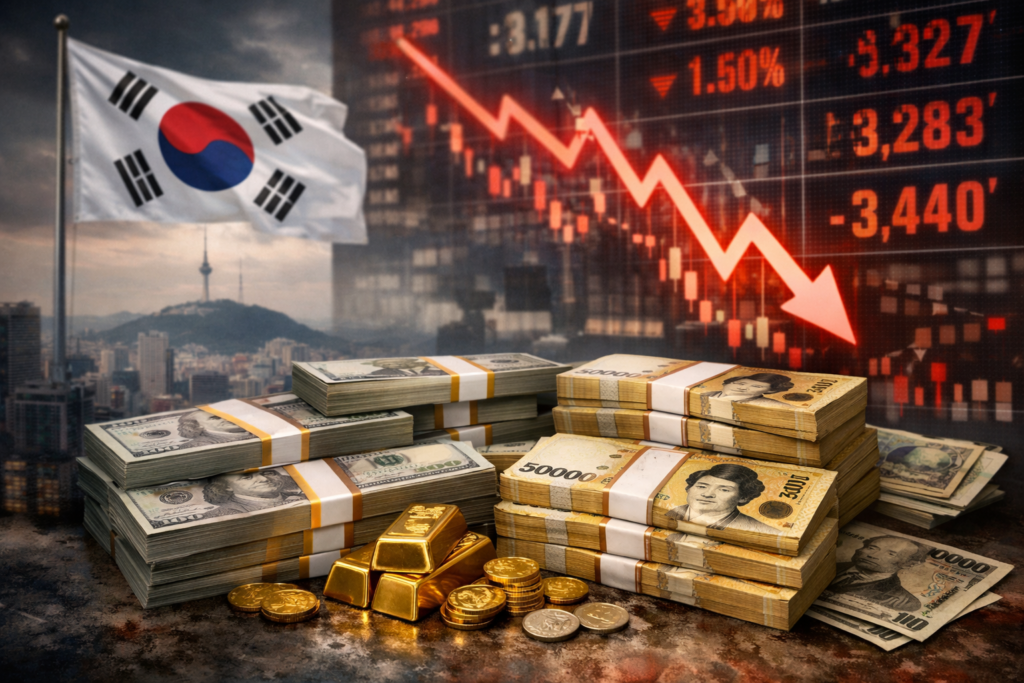
Image Credentials: Image Title: Trump Warns Republicans a Midterm Loss Could Trigger Impeachment Push Source: (sora.openai) Date: January 2026. Attribution: This image was created using AI-generated imagery (sora.openai) and does not depict a real-world scene.
By Open Chronicle News Desk with Agencies | January 7, 2026
South Korea’s foreign exchange reserves edged lower at the end of December as authorities stepped in to stabilize the won during a period of heightened currency volatility, underscoring the pressures facing Asia’s fourth-largest economy in a turbulent global financial environment.
According to figures released by the Bank of Korea on January 6, the country’s FX reserves stood at 428.05 billion dollars at the close of 2025, down about 2.6 billion dollars from November’s 430.66 billion. The decline marked the first monthly drop in seven months, ending a steady recovery that had lifted reserves from a low near 404.6 billion dollars in May.
The central bank said the fall was driven primarily by its efforts to smooth sharp movements in the foreign exchange market as the won weakened toward the psychologically important 1,500 per dollar level. Although financial institutions increased their foreign currency deposits at the end of the quarter and the dollar value of non-dollar assets rose, these gains were outweighed by official intervention aimed at easing volatility.
A closer look at the composition of reserves shows where the pressure was most visible. Holdings of foreign securities, including government and corporate bonds, fell sharply by 8.22 billion dollars to 371.12 billion, reflecting sales or valuation changes linked to currency defense. By contrast, deposits rose by 5.44 billion to 31.87 billion, while Special Drawing Rights at the International Monetary Fund increased modestly to 15.89 billion. Gold reserves remained unchanged at 4.79 billion, as they are recorded at historical purchase prices rather than current market value.
Despite the December decline, South Korea remains one of the world’s largest holders of foreign exchange reserves. As of the end of November, it ranked ninth globally, behind China, Japan, Switzerland, Russia, India, Taiwan, Germany, and Saudi Arabia. This sizeable buffer provides Seoul with significant capacity to respond to external shocks, capital outflows, or further pressure on the won.
Economists note that the recent drawdown highlights the delicate balance policymakers face. Defending the currency can help prevent disorderly market moves and imported inflation, but sustained intervention also depletes reserves and can invite scrutiny from global markets. With geopolitical tensions, shifting U.S. monetary policy, and uneven global growth all influencing capital flows, South Korea’s ability to manage its currency while preserving its financial firepower will remain a key test in the months ahead.