
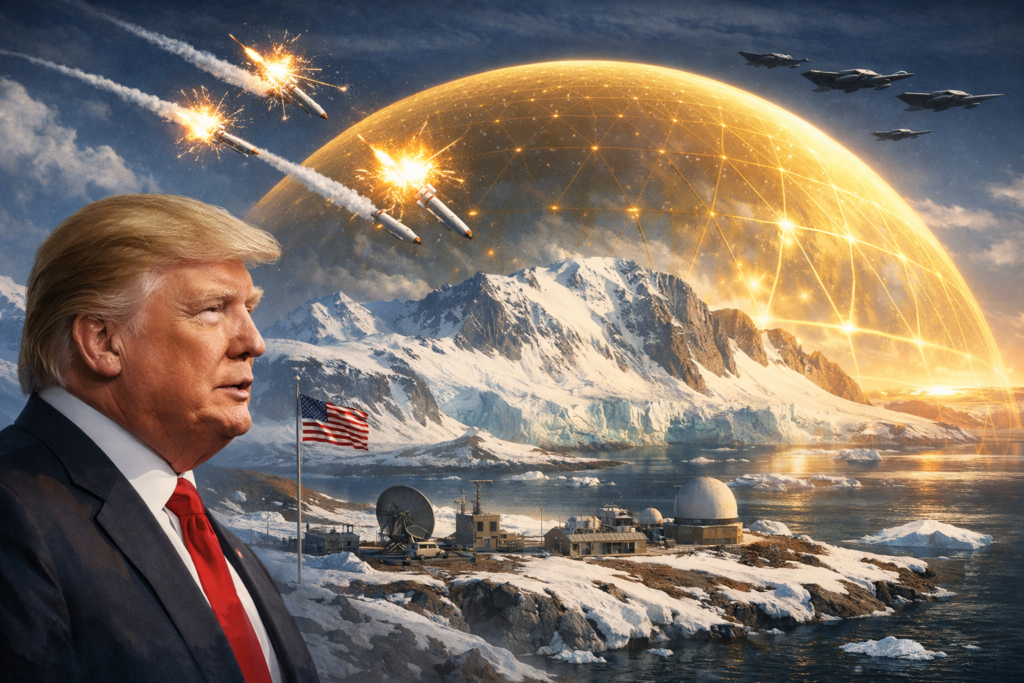
Image Credentials: Image Title: Greenland Standoff: Trump Doubles Down on “Golden Dome” StrategySource: (sora.openai) Date: January 2026. Attribution: This image was created using AI-generated imagery (sora.openai) and does not depict a real-world scene.
By Open Chronicle Finance & Geopolitics Desk with Agencies
WASHINGTON — Wednesday, January 14, 2026 — President Donald Trump has intensified his push to acquire Greenland, describing the Arctic territory as a non-negotiable component of his administration’s premier defense project, the “Golden Dome.” In a series of provocative statements, the President linked the island’s strategic location directly to the success of a new missile defense shield designed to protect the Western Hemisphere.
Despite the President’s rhetoric, the diplomatic reality in Washington remains starkly different, with major European allies and the American public showing significant resistance to the proposal.
The “Golden Dome” vs. Geopolitical Reality
The Golden Dome, a sophisticated multi-layered defense system modeled after Israel’s Iron Dome, is intended to intercept threats from the moment of launch until they reach their descent phase. President Trump insists that without Greenland, the system would have a “fatal gap” that Russia or China would inevitably exploit.
“IF WE DON’T [take over Greenland], RUSSIA AND CHINA WILL, AND THAT IS NOT GOING TO HAPPEN!” Trump posted on Truth Social today. He further argued that the acquisition would make NATO “far more formidable,” despite the alliance’s leadership expressing deep concern over the threat to Danish sovereignty.
High-Stakes Meeting at the White House
As the President posted his ultimatums, Vice President JD Vance and Secretary of State Marco Rubio met behind closed doors with the foreign ministers of Denmark and Greenland. While official details of the meeting are being closely guarded, the Greenlandic government made a preemptive move by announcing an expansion of Danish military presence and NATO exercises on the island.
This expansion is seen as a direct signal to Washington that Greenland and Denmark intend to maintain their current security framework rather than entertain a transfer of ownership.
A Public Divided: Poll Results
A new Reuters/Ipsos poll released today highlights a massive gap between the administration’s goals and public sentiment. The data suggests that most Americans are wary of another major territorial entanglement:
-
Overall Support: Only 17% of Americans favor the acquisition of Greenland.
-
Opposed to Force: A staggering 71% of respondents, including a majority of Republicans (60%), oppose taking the island “the hard way” or through military pressure.
-
Uncertainty: 35% of those polled remain unsure, reflecting the complexity of the Arctic’s role in modern defense.
The “Hard Way” Warning
Trump’s mention of taking the territory “the easy way or the hard way” has caused alarm in European capitals. French President Emmanuel Macron warned of “unprecedented knock-on effects” if the sovereignty of a NATO ally is compromised. This follows the recent U.S. military intervention in Venezuela, where the administration removed Nicolás Maduro and took control of the nation’s oil assets, setting a precedent that has many European leaders on high alert.
Greenland Acquisition Status: January 2026
| Stakeholder | Current Position | Key Concern |
| White House | Acquisition is a “National Security” necessity. | Missiles from Russia/China; Golden Dome integrity. |
| Denmark / Greenland | Not for sale; Sovereignty is non-negotiable. | Violation of international law and territorial unity. |
| U.S. Public | 71% oppose annexation by force. | Potential for another costly military conflict. |
| NATO / EU | Strong support for Denmark. | Stability of the alliance and precedent for allies. |
The standoff over Greenland has reached a critical juncture. While Trump views the island as a strategic necessity for the Golden Dome, the combination of diplomatic resistance and domestic disapproval suggests that the “hard way” would come with immense political and international costs.