
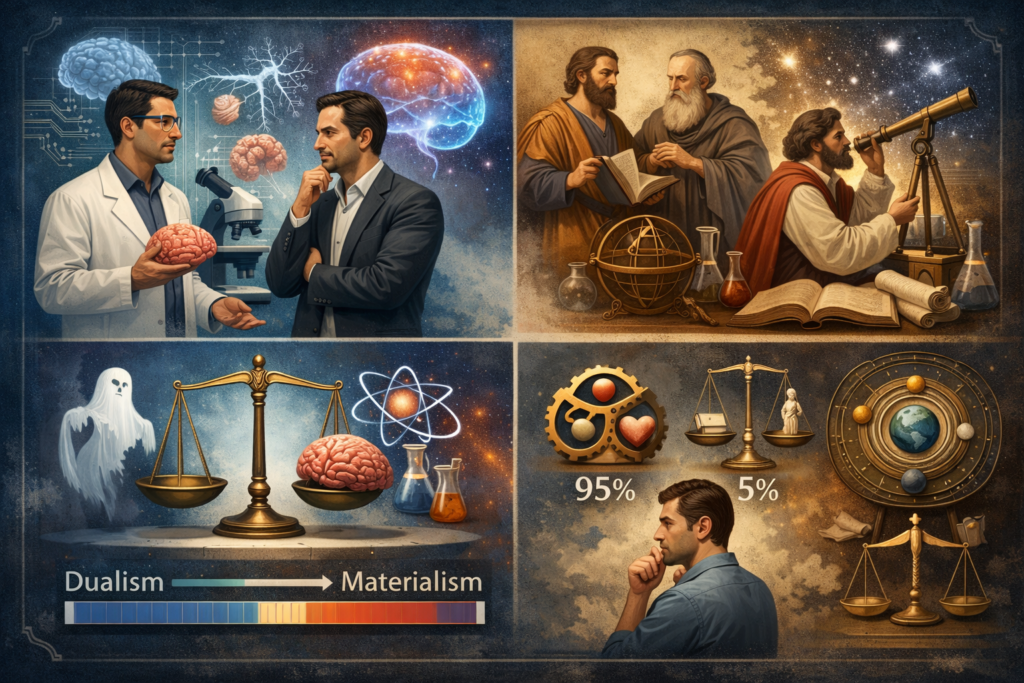
Image Credentials: Image Title: What’s the Point of Philosophy? Source: (sora.openai) Date: January 2026. Attribution: This image was created using AI-generated imagery (sora.openai) and does not depict a real-world scene.
The article “What’s the Point of Philosophy?” by Walter Veit, Ph.D. (published January 16, 2026, in Psychology Today), explores the ongoing debate regarding the nature of philosophy and its relationship with science.
By Open Chronicle Philosophy Desk | January 21, 2026
The core of the essay is a response to fellow philosopher Richard Yetter Chappell. Here is a summary of the key points:
The Relationship Between Science and Philosophy
-
The Disagreement: Chappell argues that science and philosophy are distinct realms. He suggests that science is neutral regarding theories of consciousness (e.g., whether it is a fundamental property of matter or identical to brain processes), as these are “empirically indistinguishable” philosophical interpretations.
-
Veit’s Naturalist Stance: Veit disagrees, advocating for naturalism, the idea that philosophy and science are continuous. He argues that scientific progress (like the study of the brain) provides evidence that should shift our “credence” away from views like dualism and toward materialism/physicalism.
Challenging the “Sharp Boundary.”
-
Veit argues that the idea of philosophy as an intellectually distinct activity is a relatively recent historical development. Historically, “natural philosophy” was a shared endeavor between scientists and philosophers to understand the world.
-
He asserts that science is not just about making predictions but also about “clarifying the comparative costs and benefits of rival views,” a task that overlaps with philosophy.
The Goal of Philosophy
-
According to Veit, philosophy should be defined by its goal (to understand the world and reflect on how to act) rather than a rigid method or a priori commitments.
-
He argues that philosophical methods have always been pluralistic and change over time.
Epistemic Humility and Progress
-
Veit suggests that philosophers should emulate “effective altruists” by hedging their bets and assigning degrees of belief to different theories (e.g., being 95% utilitarian and 5% Kantian) rather than dogmatically defending a single “pet theory.”
-
He concludes that accumulated scientific evidence has made materialist views of the mind the default, comparing outdated metaphysical models (like dualism or panpsychism) to the geocentric model of the universe—theories that have simply become less plausible over time due to empirical discoveries.