
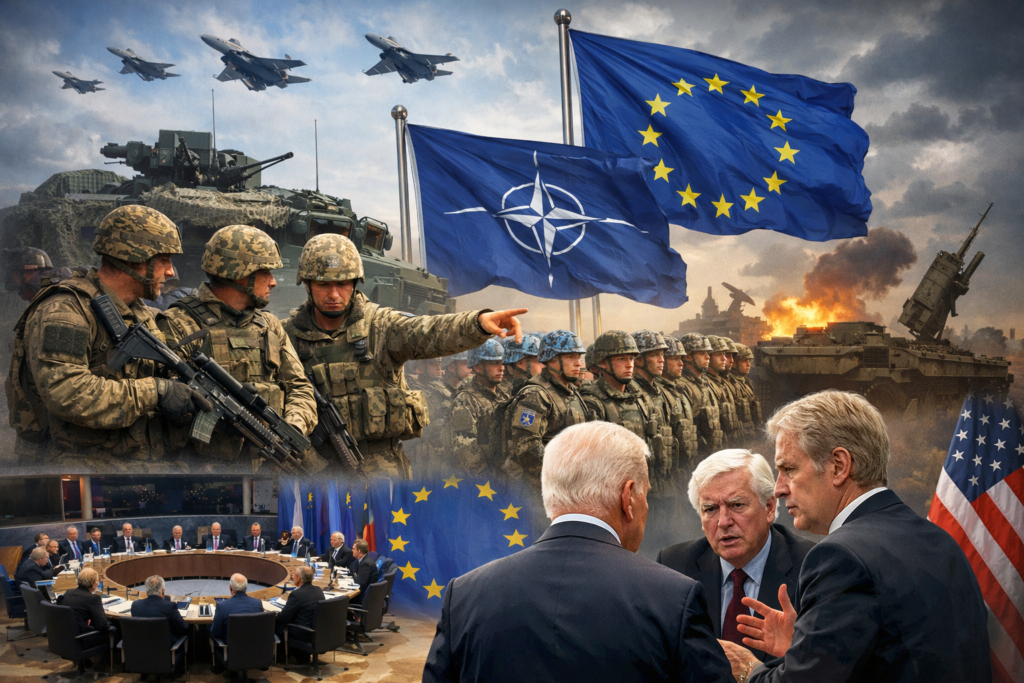
Image Credentials: Image Title: Europe’s Army Debate Intensifies Source: (sora.openai) Date: January 2026. Attribution: This image was created using AI-generated imagery (sora.openai) and does not depict a real-world scene.
By José Carlos Palma*
As geopolitical tensions rise, discussions about Europe creating its own military force have moved from academic debate to strategic urgency. Recent commentary suggests that European leaders are re-evaluating long-held assumptions about collective defence amid shifting commitments by traditional allies and evolving threats.
Recently, an article highlighted that European policymakers are seriously contemplating establishing a permanent European force amid heightened pressure from unpredictable shifts in US foreign policy. These include repeated threats from the current US administration that have unsettled European capitals and prompted questions about reliance on Washington for regional security. The article notes that changes in thinking have taken place not only within the EU institutions but also among NATO members and other European allies.
At the heart of the discussion is a belief that Europe cannot continue to depend entirely on external actors for its defence, particularly if transatlantic strategic priorities diverge. Leaders are considering how a more autonomous European security architecture might operate alongside, not in place of, NATO, with some proposals involving a permanent rapid reaction force of up to 100,000 troops drawn from willing states.
This development comes as part of a broader strategic reassessment following Russia’s invasion of Ukraine, rising global competition, and calls from some quarters for European self-reliance in defence.
The notion of a European Army or unified defence force is not new. It has been debated since the post-World War Two era, and periodically resurfaced during key security moments. Today, multiple leaders and commentators are renewing calls for deeper European defence integration:
• Spanish Foreign Minister José Manuel Albares recently argued that the EU must “advance toward creating a European army” to control its own security in the face of geopolitical uncertainty and coercive behaviour by other powers.
• Ukrainian President Volodymyr Zelenskyy has publicly urged the EU to build its own joint armed force of at least three million personnel, framing it as a necessary response to Russia’s growing military capabilities and to reduce over-reliance on NATO’s US-led security umbrella. He emphasized that such a force would reinforce, not replace, NATO commitments.
• Members of the European Parliament have also pushed for strengthening EU security structures, advocating for more efficient defence decision-making, closer cooperation on procurement, and capabilities that could allow the EU to act autonomously if required.
These calls reflect a broader reassessment of Europe’s strategic environment, particularly with questions over future US engagement and the ongoing conflict in Ukraine.
Despite political momentum, realizing a European Army faces deep structural challenges:
• NATO vs. EU Roles: The existence of NATO complicates EU defence ambitions. Many policymakers stress that any European force must complement NATO rather than compete with it, given existing security guarantees and integrated command structures.
• Member State Sovereignty: Defence remains a core national competency within the EU. Efforts to centralize military decision-making require member states to cede elements of sovereignty, a difficult political proposition for many capitals.
• Capability and Command: Building a unified force requires harmonised equipment, interoperable systems, and a unified command structure. This contrasts with the current reality of 27 diverse national militaries. Historical proposals have treated integration more like coordinated cooperation than a fully supranational army.
• Funding and Policy Agreement: Sustained investment and strategic consensus among member states are prerequisites for any credible European defence force.
Several factors are now accelerating the discussion. European Commission President Ursula von der Leyen has emphasised that the EU is at a crossroads and must build credible defence capacities to safeguard itself amid global instability. She has highlighted the importance of stronger economic and security levers and reiterated the need for cohesive defence capabilities.
Spain’s recent public call for a joint EU army, coming in the context of Arctic geopolitics and pressures like the Greenland controversy, underscores how external events are influencing European thinking.
Europe’s defence evolution now blends long-standing strategic ambitions with urgent contemporary realities. Whether this translates into a permanent, operational European armed force remains uncertain, but the debate has undeniably shifted toward tangible strategic planning rather than theoretical discussions.
The idea of a European army, once confined to academic debates and occasional political rhetoric, is gaining real momentum in 2026. This is driven by shifting transatlantic dynamics, Russia’s assertiveness, and calls from leaders within and outside the EU for greater strategic autonomy. Significant obstacles remain, from institutional complexities to national sovereignty concerns. However, the renewed push for a unified defence capability reflects broader concerns about Europe’s capacity to protect its interests independently in an unstable global environment.
The Grand Strategy Institute
Continue Exploring Strategic Analysis
Return to The Grand Strategy Institute for strategic assessments, long-form analysis and research examining geopolitics, military affairs, international security, emerging technologies and the changing international order.
← Back to The Grand Strategy Institute