
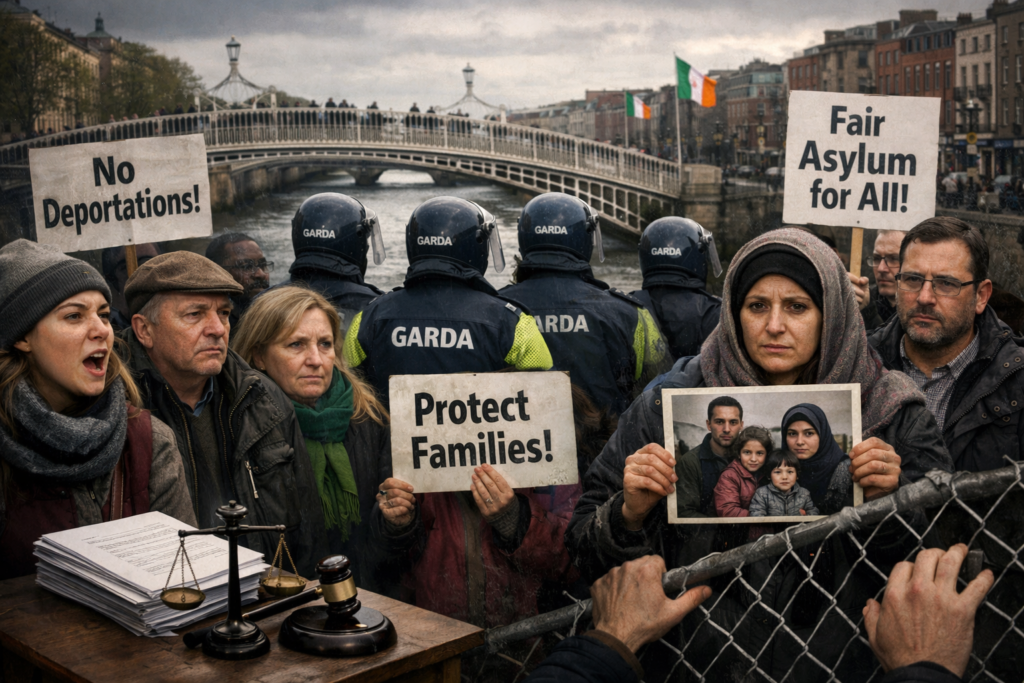
Image Credentials: Image Title: Ireland Faces Criticism Over Proposed Immigration Reforms Limiting Asylum Appeals and Family Reunification Source: (sora.openai) Date: January 2026. Attribution: This image was created using AI-generated imagery (sora.openai) and does not depict a real-world scene.
By Open Chronicle News Desk
Ireland faces growing criticism over proposed changes to its immigration and asylum laws, which could make the country one of Europe’s most restrictive destinations for people fleeing war and persecution. Activists and legal experts have raised alarms about the potential impact on refugees’ access to justice and family reunification.
Under the Civil Reform Bill, judicial reviews of immigration decisions would be transferred from the High Court to the Circuit Court for the first time in Irish history. Immigration lawyer Cathal Malone warned that such a move would severely limit the ability of asylum seekers to challenge decisions denying them protection. He said that judicial reviews in immigration law are highly complex, involving EU law, constitutional law, administrative law, and international human rights law, and that errors could have life-or-death consequences for applicants. “Rights are completely useless unless you can enforce them. The changes to judicial review are draconian,” Malone said.
The proposed legislation would also significantly tighten rules on family reunification. Refugees granted status would have to wait three years before bringing family members — including children and partners — to Ireland. Fiona Hurley of NASC, a migrant and refugee rights centre, described this as “deeply regressive” and “needlessly cruel,” warning that families could remain separated for at least four years, leaving relatives exposed to danger in conflict zones. She emphasised that family reunification is a critical pathway for refugees to rebuild their lives and integrate into society.
These proposals coincide with the publication of the International Protection Bill, which seeks to transpose the EU Pact on Migration and Asylum into Irish legislation. The bill also introduces detention provisions within Ireland’s asylum system, including for children, drawing strong condemnation from human rights advocates. John Lannon, CEO of Doras, argued that detaining children violates basic human rights and damages Ireland’s international reputation.
Justice Minister Jim O’Callaghan has defended the bill as an effort to balance the rights of asylum seekers with the country’s broader social and economic interests. However, civil society groups, including the Coalition on the EU Migration Pact, have raised serious concerns, particularly regarding the restrictions on judicial review and family reunification.
Experts warn that the proposed changes would place Ireland among the most restrictive EU countries regarding refugee protections and family reunification. In 2025, 13,160 people applied for asylum in Ireland, highlighting the potential human impact of these new policies. NASC has called for any changes to be clearly defined in legislation and subjected to rigorous parliamentary scrutiny to ensure compliance with constitutional and international human rights standards.
The debate underscores the tension between national immigration control and the obligation to provide humane protection for those fleeing persecution, with legal experts and advocacy groups urging policymakers to reconsider measures that could undermine fundamental rights.