
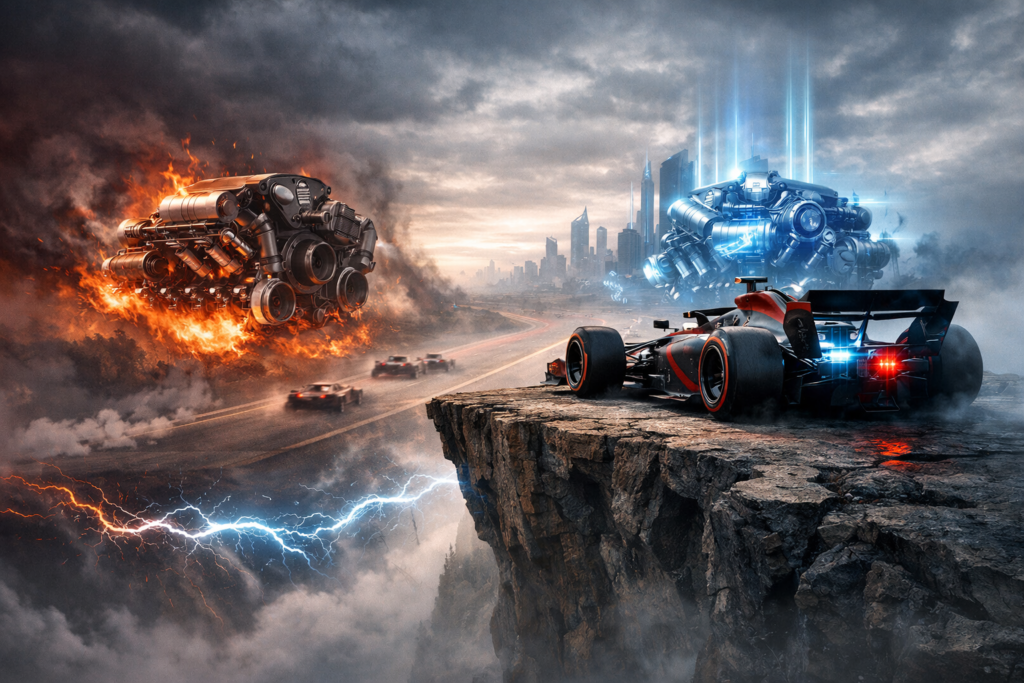
Image Credentials: Image Title: F1 2026: The High-Stakes Revolution of the 50/50 Power Dynamic Source: (sora.openai) Date: January 2026. Attribution: This image was created using AI-generated imagery (sora.openai) and does not depict a real-world scene.
By Open Chronicle News Desk
MONTE CARLO – Formula 1 is standing on the precipice of its most radical transformation in decades. As the sport prepares to usher in the 2026 season, a new era of power unit regulations is set to redefine the very essence of Grand Prix racing, shifting the balance of power from the traditional internal combustion engine to a sophisticated, high-output electrical hybrid system.
The core of this revolution lies in a “50/50” power split. Currently, the V6 turbo hybrid engines derive only about 18% of their power from electrical systems. In 2026, this will jump to nearly 50%, with the battery system (MGU-K) expected to deliver approximately 470 horsepower—a massive leap from the current 160 horsepower. Consequently, the internal combustion engine’s output will drop from over 800 to just 540 horsepower.
Had a strong feeling for a while (as did many others) that the removal of the MGU-H would make the engine noise louder/more appealing and its seems like that was correct
Almost as if this was how these engines were thought to have sounded in 2014 before that season began https://t.co/qM75g1UawD
— matt (@FM1_3316) January 22, 2026
Driver Concerns and Simulator Alarms
this year we gonna get 50-50 fuel & electric engine. Interesting to watch https://t.co/Aloc1XXx57
— 𝐉𝐚𝐬𝐦𝐢𝐧𝐞 <(´⌯ ̫⌯`)> (@jackcibo) February 1, 2026
The transition hasn’t been without its critics. World Champion Max Verstappen raised eyebrows after testing the 2026 configuration in a simulator, particularly at high-speed tracks like Monza. Verstappen reported that the battery drained so rapidly on long straights that he found himself forced to downshift at full throttle just to maintain speed and keep the engine in its power band.
“If the battery system fails in 2026, you’re finished,” the report notes. Unlike current cars, where a hybrid failure results in a manageable loss of performance, the 2026 cars will lose half their total power instantly, turning a competitive racer into a “sitting duck.”
Tactical Chess at 330 km/h
To manage this new energy reality, F1 is replacing the Drag Reduction System (DRS) with a “Manual Override” mode. This system functions as a high-speed chess match: while the leading car’s electrical boost begins to fade at 290 km/h, the chasing car can maintain full electrical power up to 337 km/h. This tactical boost can be used anywhere on the track, forcing drivers to decide whether to attack early or save energy for a defensive counter-move.
Sustainability and the Future
The shift is driven by F1’s commitment to being carbon neutral by 2030. The 2026 season will also introduce 100% sustainable synthetic fuels, created in labs from bio-waste or carbon capture. This technological push has already attracted major automotive giants, with Ford, Audi, and Cadillac signing up to join the grid.
However, history suggests the transition will be rocky. When the hybrid era began in 2014, mechanical failures doubled compared to the previous year. Fans should expect a “war of attrition” in the early races of 2026 as teams struggle with cooling, software integration, and the sheer complexity of the new power units.
As the electrical battle begins, the team that strikes the perfect balance between watts and horsepower will likely dominate the next decade of racing.