
Image: Momen Zellmi X@momenzellmii
By Open Chronicle News Desk
TEHRAN – In a dramatic escalation of diplomatic hostilities, the Iranian parliament on Sunday formally designated the armed forces of European Union member states as “terrorist organizations.” The move comes as a direct retaliatory strike against the EU’s decision last Thursday to apply the same label to Iran’s Islamic Revolutionary Guard Corps (IRGC).
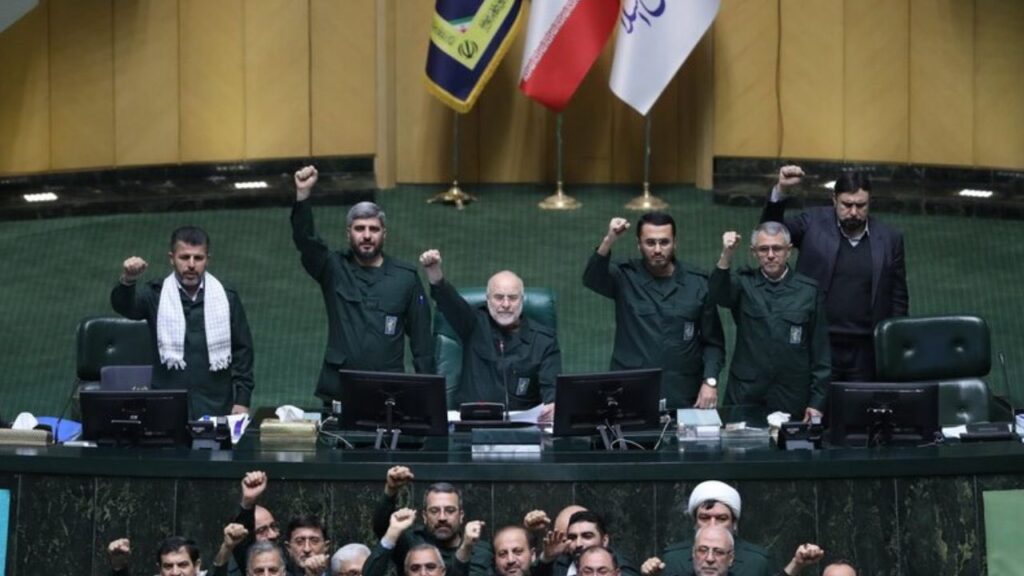
The legislative session in Tehran was marked by high-octane symbolism and defiance. Lawmakers arrived at the chamber dressed in the signature green uniforms of the IRGC, chanting “Death to America,” “Death to Israel,” and “Shame on you, Europe,” according to state television footage.
Today the regime parliament declared all European armies terrorist groups, dressed up in IRGC uniforms, and chanted Death to America.
Imagine negotiating or doing diplomacy with these demonic clowns. pic.twitter.com/e8Zh5g7bis
— 𝐍𝐢𝐨𝐡 𝐁𝐞𝐫𝐠 ♛ ✡︎ (@NiohBerg) February 1, 2026
A Legislative Rebuff
Parliament Speaker Mohammad Bagher Ghalibaf announced the decision, citing Article 7 of the Law on Countermeasures, a piece of legislation originally passed in 2019 after the United States first classified the Guards as a terrorist entity.
“Under this law, the armies of European countries are now considered terrorist groups,” Ghalibaf stated. He further warned that the European Union would bear full responsibility for the “consequences” of its actions, which he described as an irresponsible move carried out “in compliance with the orders of the American president and the leaders of the Zionist regime.”
The speaker added that the EU’s decision has only served to “accelerate Europe’s path to becoming irrelevant in the future world order” and has significantly bolstered domestic support for the IRGC within Iran.
Iran’s Parliament Speaker Ghalibaf:
I hereby declare that, according to Article 7 of the Intervention Law, in the face of the declaration of the IRGC as a terrorist organization, the armies of European countries will be classified as a terrorist group … pic.twitter.com/RN053jW1O2
— NΞMICO (@NemicoNetwork) February 1, 2026
Context of the Conflict
The EU’s designation of the IRGC follows months of intense pressure from Western governments and human rights organizations, who accuse the elite force of orchestrating a brutal crackdown on domestic protests that has left thousands dead. EU Foreign Policy Chief Kaja Kallas stated on Thursday that “those who operate through terror must be treated as terrorists,” placing the IRGC on the same legal footing as groups like Al-Qaeda and ISIS.
The timing of Tehran’s response is also symbolic, falling on the 47th anniversary of the return from exile of Ayatollah Ruhollah Khomeini, the founder of the Islamic Republic.
Escalating Regional Tensions
This legal tit-for-tat unfolds against a backdrop of increasing military posturing. In recent weeks, U.S. President Donald Trump has dispatched a “massive armada” to the region, including the aircraft carrier USS Abraham Lincoln, while calling on Tehran to negotiate a new deal on its nuclear and missile programs.
While both sides have recently signaled a cautious willingness to engage in “structural arrangements for negotiations,” the atmosphere remains volatile. Iranian lawmakers are already pressing for further action, including the immediate expulsion of European military attachés from embassies in Tehran, arguing that their presence now violates Iranian anti-terrorism laws.
As diplomatic channels continue to narrow, the international community remains on high alert for potential confrontations in the Strait of Hormuz, where Iran has recently announced plans for live-fire naval drills.