
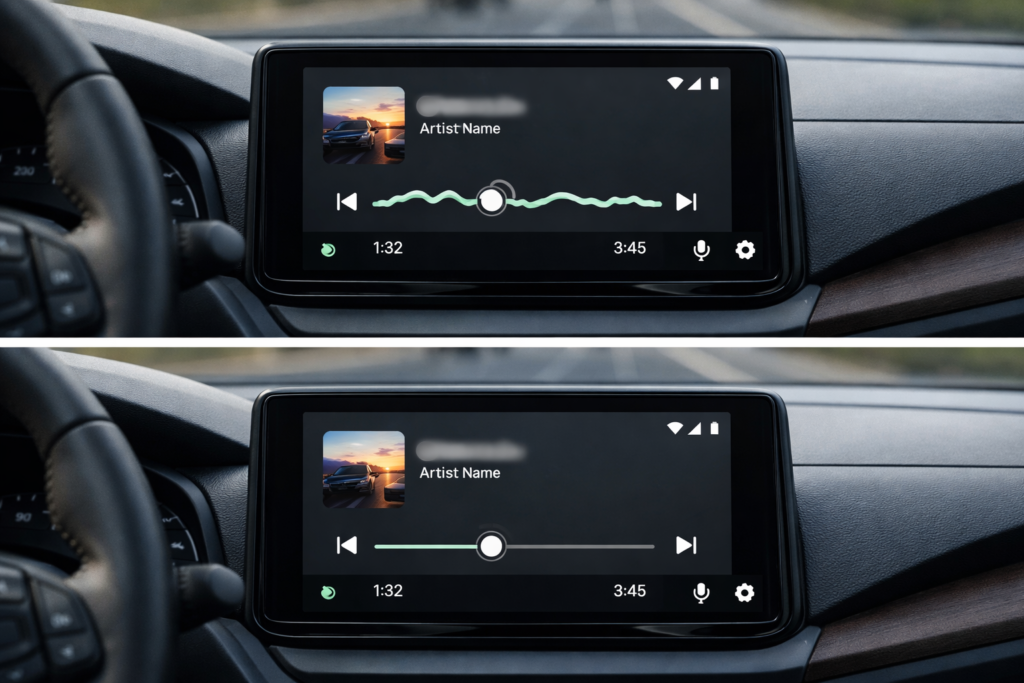
Image Credentials: Image Title: Google Rolls Back Android Auto Visual Update Following Steering Wheel Control Failures Source: (sora.openai) Date: January 2026. Attribution: This image was created using AI-generated imagery (sora.openai) and does not depict a real-world scene.
By Open Chronicle with Agencies
MOUNTAIN VIEW — Google has initiated an emergency software rollback for Android Auto after a recent aesthetic update inadvertently disabled essential steering wheel controls for a significant number of drivers.
The issue surfaced following the release of Android Auto 16, which introduced a stylized “squiggly line” progress bar for media playback. The design choice, intended to align the car interface with the visual language of Google Pixel smartphones, replaced the traditional flat progress bar in popular apps such as Spotify and YouTube Music.
However, the visual flair came with a technical cost. Shortly after the deployment, motorists globally began reporting that their physical steering wheel buttons—used for skipping tracks and adjusting volume; had ceased to function. Technical forums were quickly flooded with complaints, with users discovering that the only immediate remedy was to manually downgrade to an older version of the software.
Google tried to make music look cooler and your car said absolutely not.https://t.co/rCtecTt3P3 pic.twitter.com/O5aJU6XLHR
— Android Police (@AndroidPolice) February 2, 2026
In response, Google has fast-tracked the release of Android Auto 16.1. The latest update appears to perform a surgical strike on the problematic feature, removing the “squiggly” animations and reverting to the standard progress bar. While the tech giant has not officially confirmed the direct link between the animation and the hardware failure, the removal of the feature in version 16.1 has reportedly restored functionality for affected users.
Industry analysts suggest that the bug highlights the delicate balance between software aesthetics and hardware integration in the automotive sector. “When you’re dealing with vehicle interfaces, a ‘minor’ visual bug can quickly become a safety or usability concern if it interferes with physical tactile controls,” noted one software engineer.
The 16.1 update is currently rolling out via the Google Play Store. For users who have not yet received the over-the-air update and are struggling with unresponsive controls, experts suggest checking for updates manually. While some tech-savvy users have turned to installing APK files (Android Package Kits) to bypass the rollout queue, security professionals warn that downloading software from unverified third-party sources carries inherent risks to device security.
For now, Android Auto users can expect a return to the “boring” flat progress bar, a small price to pay for the return of functional steering wheel controls.