
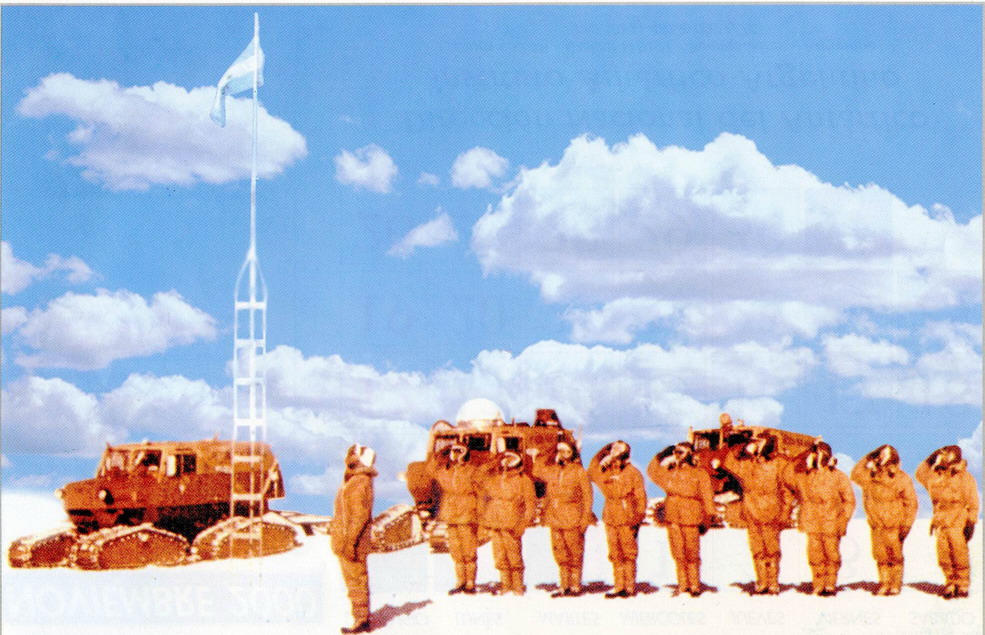
Image: Soldiers saluting the Argentine flag at the South Pole. Tucker Sno-Cats are behind them. By Argentine Army. , Public Domain, (Wikipedia)
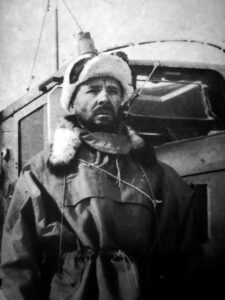
Operación 90 (Operation Ninety) was the first Argentine ground expedition to the South Pole, carried out in 1965 by ten soldiers of the Argentine Army under then-Colonel Jorge Edgar Leal. It was also the first Latin-American expedition to the South Pole. It was named after the target: 90 degree South latitude point (the geographic South Pole)
The operation had been originally conceived by General Hernán Pujato in the early 1950s but could not be carried out due a lack of forward bases and icebreakers The plan was revived in 1961, and finally approved in July 1962 Preparations began in 1963 and suffered multiple mishaps, including the loss of a Douglas C-47 plane, which crashed while scouting possible routes; the crew was rescued a few days later. Colonel Jorge Edgar Leal, chief of the General Staff’s Antarctic Division, was chosen to lead the expedition.
One of the goals of the expedition was to perform scientific measurements and observations. To accomplish this, the soldiers were trained on how to use various meteorological, glaciological, gravimetric, magnetic, and topographic equipment. There was also a political goal: to show that Argentina could exert sovereignty on a portion of Antarctica that the country claims as its own.
¡Qué importante que una funcionaria pública del Estado nacional recuerde estos hechos! Oficialmente el punto extremo sur de nuestro país es el Polo Sur (paralelo 90° sur y de ahí el nombre de la expedición "Operación 90") gracias también al patriotismo de estos 10 argentinos. https://t.co/n1ezEv1li2 pic.twitter.com/U47aDiGOZ2
— ElAuxiliar 🇦🇷 (@elauximalvinero) December 10, 2025
Leal’s team departed on six snowcat vehicles (believed to be Tucker Sno-Cats based on the spelling used) from General Belgrano Army Base on October 26, 1965. The main group was preceded by a scouting four-man patrol on a sled drawn by 18 dogs. While the scouts remained at 83° 2″ S, Leal and his men reached the geographic South Pole on December 10. Shortly after, they were met by a radar operator from the US Amundsen–Scott South Pole Station, who asked them who they were and what they were doing there. After Leal explained that they were not Soviets, base commander William R. Griffin congratulated them and invited them to share a meal: the first decent food, said Leal, that the group had in some weeks. He also offered the Argentines spare parts to repair their snowcat vehicles, tools, and access to the base’s workshop. Leal hesitated, fearing that foreign assistance could diminish the value of the expedition, but ultimately accepted. They then returned to Base Belgrano, which they reached on December 31. Overall, the mission lasted 66 days.
The group received a hero’s welcome upon their return to Buenos Aires and were congratulated personally by President Arturo Umberto Illia. Leal was promoted to General a few years later. Despite his success, he was pushed out of the military by General Alejandro Agustín Lanusse and spent some time in prison due to his opposition to Operation Soberanía and the Malvinas War.
Trivia
Before leaving the Amundsen base, Leal and his men were given diplomas recognizing them as members for life of the “Penguin Emperor’s Court”, a long-running inside joke among Antarctic explorers.
References
- Jurío, Mirta Luisa (1984). Argentina antártica. Universidad Nacional de La Plata. p. 43.
- Sánchez, Rodolfo A. (2007). Antártida: introducción a un continente remoto. Editorial Albatros. p. 124. ISBN 978-950-24-1211-5.
- San Martin, C (1969). Argentinos en la Antartida. Editorial Libreria Mitre. pp. 97, 106, 111, 115, 121.
- Leal, Jorge E. (2021). Memorias de un Antartico. Museo Maritimo de Usuahia. pp. 120, 132, 169, 155, 174, 177. ISBN 978-987-23160-5-1.
- “Operación 90: La llegada al Polo Sur por vía terrestre” by Jorge Edgard Leal (in Spanish)
(Click on Llegada al Polo (terrestre) on the column at the left) - Negrete, Claudio R. (2022). “Leal, las memorias y las increíbles fotos del hombre que conquistó el Polo Sur”. Infobae.
Explore this subject
Continue exploring related Open Chronicle Encyclopedia entries through the categories associated with this article.

Staff Writers at Open Chronicle produce trusted journalism, strategic analysis and authoritative reference content across global affairs, geopolitics, defense, science, history, technology, business, culture and sport. Their work combines accurate reporting with historical perspective and analytical depth, helping readers understand not only what is happening, but why it matters. Beyond daily news coverage, Staff Writers contribute to the Open Chronicle Encyclopedia, investigative features, original research projects and long-form reports, building a comprehensive knowledge platform designed to inform, educate and preserve reliable information for a global audience.