
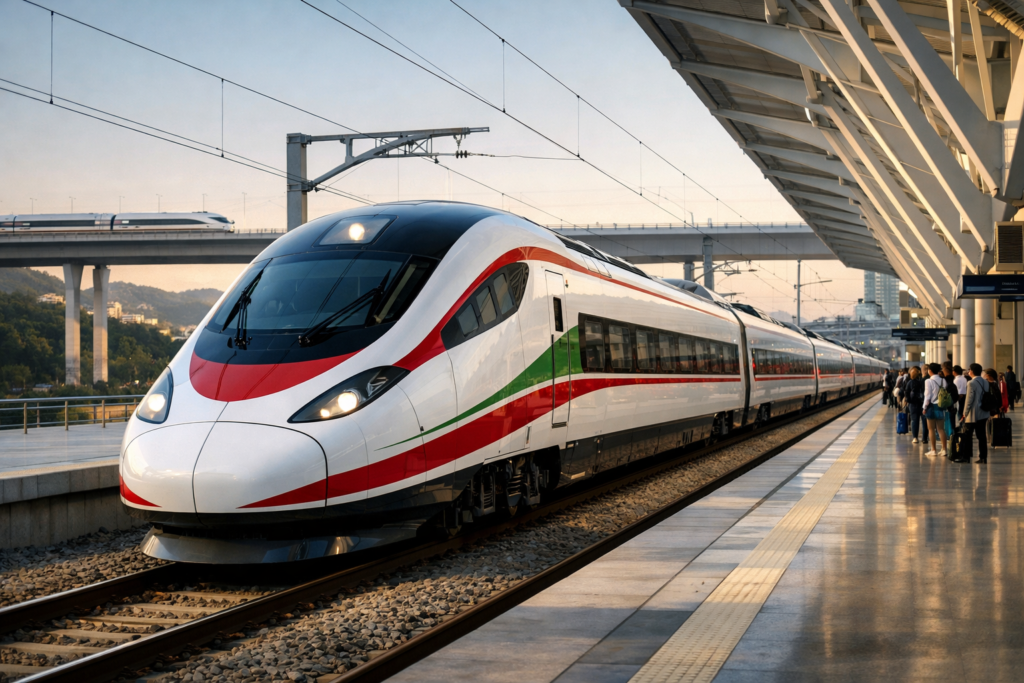
Image Credentials: Image Title: Portugal Greenlights High-Speed Future with Massive Rolling Stock Procurement Source: (sora.openai) Date: February 2026. Attribution: This image was created using AI-generated imagery (sora.openai) and does not depict a real-world scene.
By Open Chronicle Feb. 3, 2026
LISBON — In a move set to redefine the Iberian Peninsula’s transport architecture, the Portuguese government has officially launched the procurement process for a new generation of high-speed trains. This ambitious fleet acquisition marks the first concrete step in the nation’s multi-billion-euro plan to link its major cities via a dedicated high-speed rail network.
CP (Comboios de Portugal), the state-owned operator, has been authorized to initiate a tender for the purchase of 22 high-speed trainsets. The investment, estimated to exceed €800 million, represents the cornerstone of the “Atlantic Axis” modernization project, which aims to slash travel times between Lisbon and Porto to just one hour and 15 minutes.
A Modern Fleet for a Shifting Climate
The technical specifications for the new fleet are rigorous. The trains must be capable of reaching speeds of at least 300km/h (186mph) and will be required to operate on both the Iberian broad-gauge and the international standard-gauge tracks. This “bi-gauge” capability is essential for ensuring that the new service can integrate seamlessly with existing infrastructure while remaining compatible with future connections to Spain and the wider European high-speed network.
Government officials emphasized that this procurement is not merely about speed, but about environmental necessity. By offering a viable, rapid alternative to short-haul domestic flights and heavy car traffic on the A1 motorway, the high-speed line is expected to be a primary driver in Portugal’s goal to achieve carbon neutrality.
Economic and Industrial Impact
The tender is expected to attract the world’s leading rail manufacturers, including industry giants such as Alstom, Siemens, Talgo, and CAF. Beyond the purchase of the trains, the contract includes long-term maintenance provisions and, crucially, requirements for local industrial involvement.
“This is a generational project,” stated a spokesperson for the Ministry of Infrastructure. “We are not just buying trains; we are revitalizing the Portuguese railway industry and creating high-tech jobs in maintenance and engineering.”
The Road Ahead
The first phase of the high-speed line, connecting Porto and Soure, is slated for completion by 2028, with the new fleet expected to enter service shortly thereafter. The procurement process will also include the construction of a new maintenance depot specifically designed for high-speed technology.
While the project has faced scrutiny regarding its total cost and the complexity of its construction, the official launch of the rolling stock tender signals a point of no return. For travelers and businesses alike, the dream of a high-speed Portugal is finally pulling out of the station.