
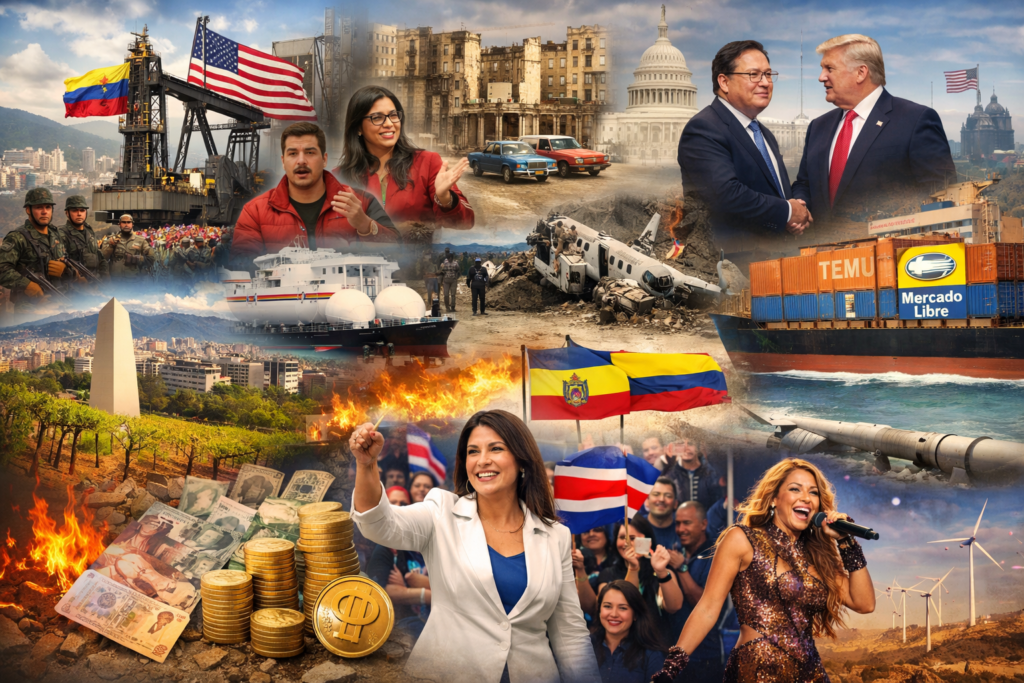
Image Credentials: Image Title: Latin America News Brief Source: (sora.openai) Date: February 2026. Attribution: This image was created using AI-generated imagery (sora.openai) and does not depict a real-world scene. Source: (sora.openai) Date: February 2026. Attribution: This image was created using AI-generated imagery (sora.openai) and does not depict a real-world scene.
By Open Chronicle Staff
Latin America is experiencing an intense period of political, economic, and diplomatic change, with developments reverberating both within the region and internationally.
In Venezuela, Chavismo has begun an internal reshuffle one month after the capture of Nicolás Maduro, amid a conditional and evolving relationship with the United States. The country has also moved to open its oil industry to foreign investment and announced the gradual release of assets frozen abroad. Interim President Delcy Rodríguez reiterated that Venezuela does not take orders from external actors.
Cuba continues to face a deepening economic crisis, exacerbated by a historic collapse in tourism. Tensions with Washington escalated after the United States declared Cuba a national security threat. In response, Mexico announced plans to send humanitarian aid to Havana.
Argentina is grappling with significant economic headwinds. Its wine industry is suffering the deepest crisis in two decades, while the government has privatized natural gas imports, effectively ending the state’s role in those operations. In the digital economy, Chinese platform Temu entered a legal dispute with local e-commerce giant Mercado Libre over alleged unfair competition.
In Colombia, President Gustavo Petro arrived in Washington for an official visit that includes talks with President Donald Trump. The country was also shaken by a fatal crash involving a state-operated Satena aircraft in the northeast, with no survivors reported. Regionally, Ecuador raised tariffs by 900 percent on the transport of Colombian crude oil and lodged a diplomatic protest following an incident involving U.S. immigration agents at its consulate in Minneapolis.
In Costa Rica, political scientist Laura Fernández won the presidency outright in the first round of elections, marking a decisive political transition. Uruguay issued economic warnings after its peso became the world’s strongest-performing currency against the U.S. dollar, raising concerns over competitiveness.
In Chile, AES Andes, a subsidiary of U.S.-based AES Corp., canceled a controversial mega energy project in the Atacama Desert amid environmental opposition. In Mexico, proposed Royal Caribbean tourism developments along the Caribbean coast have drawn mounting criticism.
Beyond politics and economics, Latin American culture made global headlines as Shakira set a Guinness World Record for the highest-grossing Latin tour in history.
Overall, the region’s latest developments reflect a complex landscape of political realignments, economic strain, rising geopolitical tensions, and enduring cultural influence on the world stage