
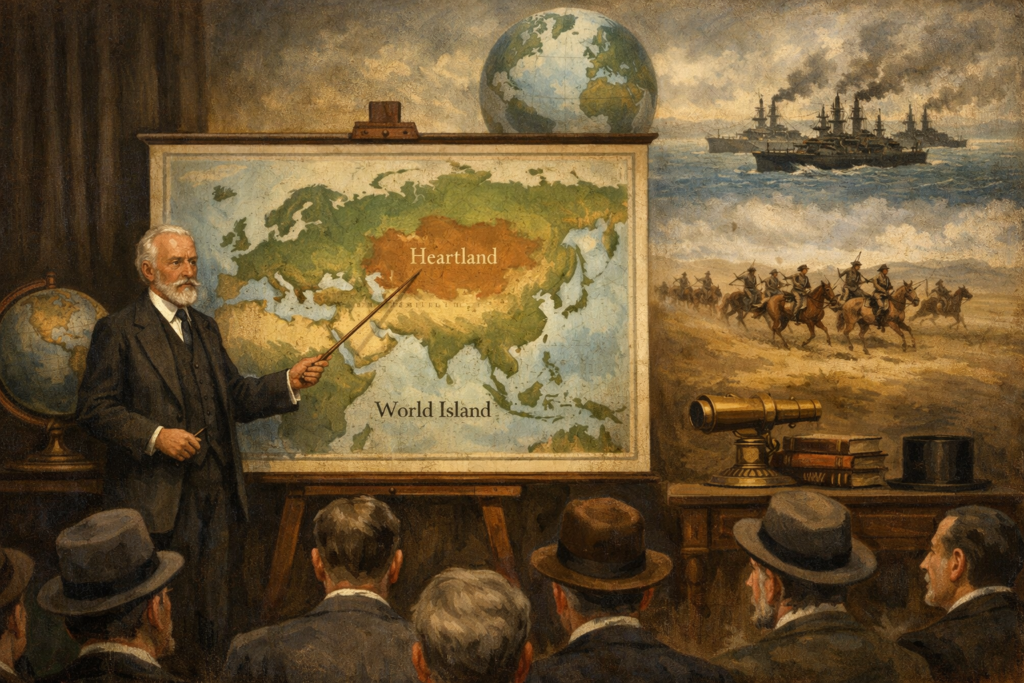
Image Credentials: Image Title: From Heartland to Data Land: Does Mackinder’s Logic Survive in a Digital World? Source: (sora.openai) Date: February 2026. Attribution: This image was created using AI-generated imagery (sora.openai) and does not depict a real-world scene.
By José Carlos Palma for The Grand Strategy Institute | February 5, 2026
When Halford Mackinder presented The Geographical Pivot of History in 1904, he offered a deceptively simple proposition. Control the Heartland of Eurasia, and one could command the World Island. Command the World Island, and global dominance would follow. Geography, in Mackinder’s view, was destiny.
More than a century later, power no longer moves primarily by railways across the steppe or by armies across land bridges. It moves through fiber-optic cables, satellite constellations, cloud servers, and algorithmic systems. Yet the core question remains unresolved: has the logic of the Heartland truly expired, or has it merely migrated from territory to infrastructure?
Mackinder was not arguing that land itself was magical. His deeper insight was structural. He believed that the actor able to dominate the largest, most secure, and most internally connected space would gain decisive advantages in mobility, resource access, and resilience against maritime blockade.
The Heartland mattered because it was hard to invade, rich in resources, and increasingly integrated by rail. Sea power, once dominant, could be neutralized by continental depth and internal lines of communication. Mackinder’s theory was less about maps and more about systems.
That distinction is crucial for understanding its relevance today.
In the twenty-first century, strategic depth no longer depends solely on territory. It depends on control over data flows, computation, and networks. Undersea cables carry over 95 percent of global internet traffic. Data centers concentrate economic and military power. Satellites synchronize finance, navigation, and warfare. Artificial intelligence processes information faster than any human command structure ever could.
This emerging domain can be described as “Data Land”, a nonphysical but highly structured space where power accrues to those who control access, standards, and infrastructure. Like the Heartland, Data Land is unevenly distributed. It has hubs, chokepoints, and peripheries. And like the Heartland, it rewards scale, integration, and insulation from external disruption.
Seen through this lens, Mackinder’s logic does not disappear. It mutates.
States that dominate data infrastructure gain strategic depth without territorial expansion. The United States benefits from its control over core internet architecture, cloud computing giants, and satellite networks. China has pursued digital sovereignty through firewalls, domestic platforms, and alternative technology standards. Both are attempting to secure internal coherence while limiting external dependence, a digital echo of continental consolidation.
Even competition over semiconductors reflects Mackinderian logic. Advanced chips function as the railways of the digital age. Whoever controls their production and supply chains gains leverage over economic and military systems far beyond their borders.
Classical geopolitics emphasized chokepoints like straits and canals. Digital geopolitics has its own equivalents. Submarine cable landing points, rare earth supply chains, server farms, and orbital pathways have become critical vulnerabilities.
However, digital space also introduces a challenge to Mackinder’s determinism. Data flows are harder to contain than armies. Cyber operations bypass borders. Influence travels through platforms rather than frontiers. Power is exercised less through occupation than through standards, protocols, and narratives.
This weakens the idea of a single, conquerable pivot of history. There is no digital Heartland that can be physically seized and held. Instead, there are layered systems requiring constant maintenance, trust, and legitimacy.
Critical geopolitics urges caution against treating digital dominance as fate. Mackinder’s original theory carried an aura of inevitability that later policymakers used to justify expansion and confrontation. Similar risks exist today when data power is framed as an unavoidable zero-sum struggle.
Maps of undersea cables or semiconductor hubs can obscure the political choices that created them. Control over Data Land is not merely technical. It reflects labor practices, regulation, corporate power, and ideology. Unlike the Heartland, Data Land is as much socially constructed as it is engineered.
Mackinder’s logic survives not as a territorial blueprint, but as a systemic intuition. Power still flows to actors who control the deepest, most resilient, and most internally integrated domains. What has changed is the substance of that domain.
In a digital world, geography has not vanished. It has been encoded.
The struggle for influence no longer runs only across plains and seas, but through servers, cables, and code. Mackinder’s warning endures, stripped of its determinism but sharpened by technology. The pivot of history still exists, but it no longer lies on a map. It lies in the architecture of connection itself.
The Grand Strategy Institute
Continue Exploring Strategic Analysis
Return to The Grand Strategy Institute for strategic assessments, long-form analysis and research examining geopolitics, military affairs, international security, emerging technologies and the changing international order.
← Back to The Grand Strategy Institute