
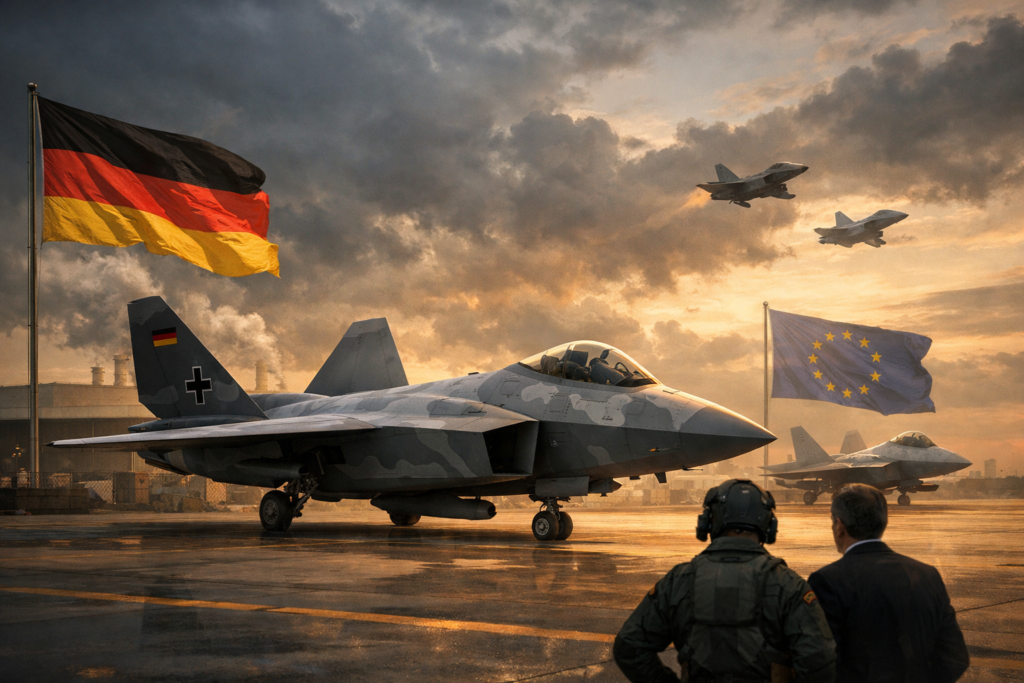
Image Credentials: Image Title: JET RIFT: German Union Calls for Homegrown Fighter as European Project Teeters. Source: (sora.openai) Date: February 2026. Attribution: This image was created using AI-generated imagery (sora.openai) and does not depict a real-world scene.
By Open Chronicle Staff with Agencies
BERLIN — The ambitious dream of a unified European sixth-generation fighter jet has suffered a severe blow as Germany’s largest industrial union, IG Metall, officially urged Berlin to abandon the joint project in favor of a homegrown alternative.
The move, announced on February 9, 2026, marks a potential “point of no return” for the Future Combat Air System (FCAS), a tri-national program between France, Germany, and Spain intended to replace the Rafale and Eurofighter fleets by 2040.
European disunity and subsequent dependence on the US has created this mess.
Only a pan-European movement can fix it.
Currently, France and Germany are STILL bickering over how to divide the workload for Europe's next generation fighter jet. A member of the CDU even said that… pic.twitter.com/8NcxOhnMhf
— Ave Europa (@AveEuropae) January 7, 2026
Accusations of “Dictated Terms”
In an opinion piece published in the Handelsblatt newspaper, Jürgen Kerner, deputy head of IG Metall, and Marie-Christine von Hahn, head of the German Aerospace Industries Association (BDLI), accused French planemaker Dassault Aviation of attempting to unilaterally dominate the project.
“FCAS was originally planned as a joint project between equal partners,” they wrote. “Those who now demand absolute control should not be suppressed if there are consequences.”
The union is now advocating for a “two-aircraft” solution within the project framework—effectively splitting the manned fighter element into two distinct national jets while maintaining cooperation only on shared “Combat Cloud” digital infrastructure and sensors.
A Stalled Vision
Launched in 2017 by President Emmanuel Macron and then-Chancellor Angela Merkel, FCAS was hailed as the “lighthouse project” of European defense sovereignty. However, it has been paralyzed for over a year by toxic industrial disputes between Dassault and Airbus.
While President Macron recently urged progress, framing the jet as a “test of credibility” for the continent, German officials have been more pessimistic. A government spokesperson admitted in December that attempts to break the industrial deadlock had failed, and reports suggest Chancellor Friedrich Merz is privately exploring a total withdrawal or a shift toward the rival British-Italian-Japanese Global Combat Air Programme (GCAP).
Economic and Security Stakes
The push for a domestic German jet is rooted in fears that French dominance would “wipe out” German aerospace engineering expertise. Union leaders warned that without a sovereign stake in the aircraft’s development, thousands of high-skilled jobs and critical intellectual property in Germany would be at risk.
“Developing two jets would represent the ‘maturation’ of the project,” the union leaders argued. “It would allow for different national priorities and reduce tensions because cooperation would then take place where it makes economic sense, not where it is dictated by political symbolism.”
The “Dead” Project?
The timing of the union’s intervention is critical. Sources in Brussels and Paris have begun to speak of the project in the past tense. Four European officials recently told Politico that “FCAS is dead; everyone knows it, but no one wants to say it.”
If Germany proceeds with a homegrown or separate fighter, it would follow the historical pattern of the 1980s, when France withdrew from the joint European program that eventually produced the Eurofighter to build its own Rafale.
Comparison of the Rival Paths:
-
The Unified FCAS: A single €100 billion “system of systems” including a 6th-gen jet, drones, and a combat cloud.
-
The “Two-Jet” Proposal: Shared software and networking, but separate airframes built by Dassault (France) and Airbus (Germany/Spain).
-
The GCAP Alternative: Germany potentially joining the UK, Italy, and Japan’s “Tempest” program, which is currently seen as being years ahead in development.