
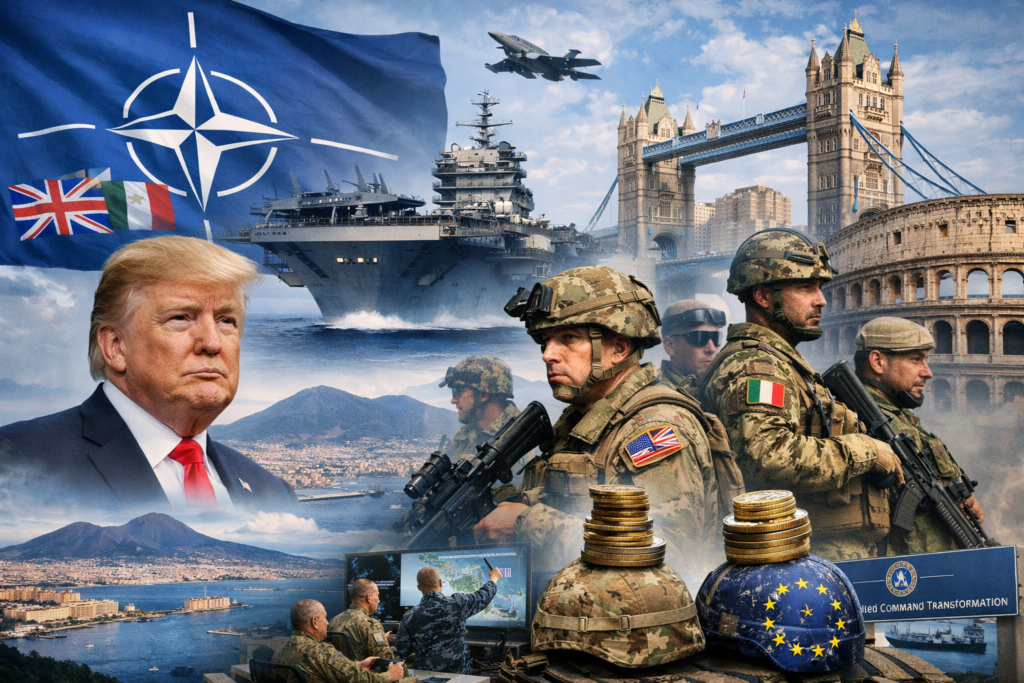
Image Credentials: Image Title: NATO COMMAND SHIFT: US Relinquishes Control of Major Strategic Hubs Source: (sora.openai) Date: February 2026. Attribution: This image was created using AI-generated imagery (sora.openai) and does not depict a real-world scene.
By Open Chronicle Staff with Agencies
BRUSSELS — In a historic restructuring of the North Atlantic Treaty Organization, the United States has officially begun handing over control of three critical command posts to European allies. The decision, confirmed on February 10, 2026, marks the most tangible step yet in President Donald Trump’s long-standing demand for “burden-shifting” within the alliance.
A New European Leadership
Under the new agreement, Washington is relinquishing its leadership of key regional hubs that have historically been under American stewardship. The realignment includes:
-
Naples Command (Italy): Oversight of NATO’s southern flank and Mediterranean operations will pass to Italian leadership.
-
Norfolk Command (Virginia): Leadership of the North Atlantic command, primarily focused on protecting sea lanes between North America and Europe, will be transferred to the United Kingdom.
-
Land Command (Izmir): Sources indicate that the administrative and operational control of the alliance’s land forces hub in Turkey is also part of the broader redistribution of senior officer responsibilities.
While the US is ceding these regional command posts, it will retain control of NATO’s core air, land, and sea structures, as well as the pivotal role of Supreme Allied Commander Europe (SACEUR).
Strategic “Burden Shifting”
The move comes as the Trump administration intensifies its focus on the Indo-Pacific region. US Ambassador to NATO Matthew Whitaker defended the shift, stating that the goal is not to “dismantle” the alliance but to make it work as originally intended—as a partnership of “strong and capable allies” who handle their own conventional defense.
“This is a good sign of burden-shifting in practice,” one NATO diplomat said. “It allows European allies, including the newest members, to play a more prominent role in military leadership.”
Geopolitical Friction
The handover occurs against a backdrop of significant transatlantic tension. European leaders have expressed growing anxiety over the reliability of the US security guarantee, particularly following recent diplomatic crises involving trade tariffs and territorial disputes.
In response to the perceived American drawdown, European nations have significantly increased military spending, with many members now aiming for a 5% GDP target. This restructuring of the command hierarchy is seen by many in Brussels as an essential “Plan B” for a Europe that can no longer blindly rely on American protection.
Key Takeaways of the Restructuring:
-
Shift to Italy: Naples becomes the primary hub for Mediterranean security under European control.
-
British North Atlantic: The UK takes the lead in Norfolk, ensuring the security of the “High North.”
-
US Core Control: Washington maintains the “Golden Dome” missile defense priority and the top-tier SACEUR position.
-
Regional Independence: European allies will now lead the planning for their own regional exercises and conventional defense strategies.