
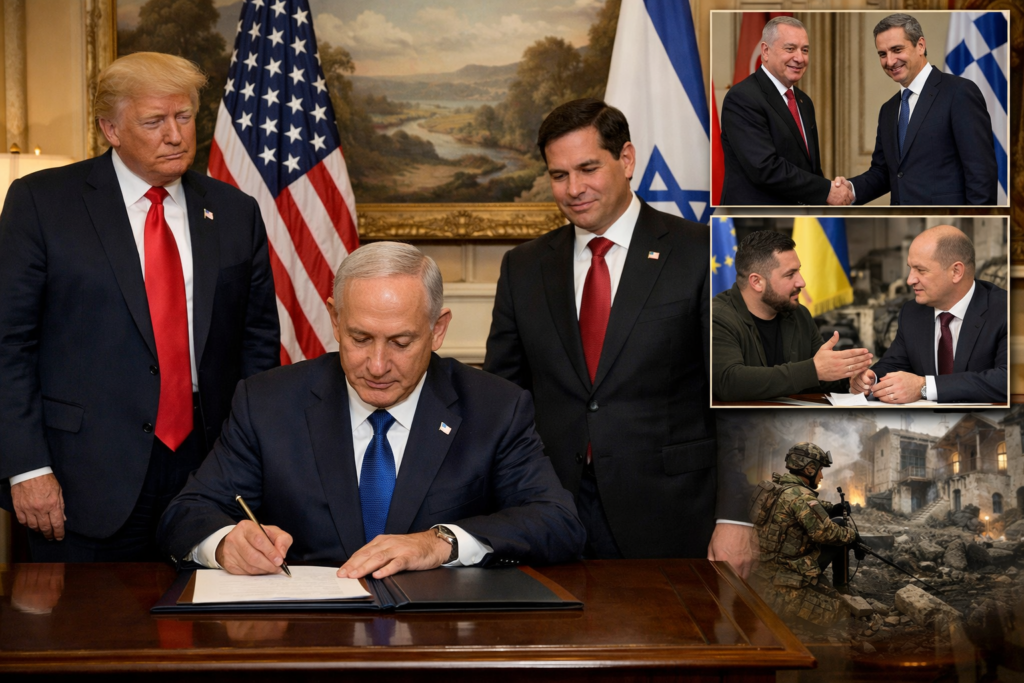
Image Credentials: Image Title: Global News Brief: Key Events and Developments for February 12, 2026 Source: (sora.openai) Date: January 2026. Attribution: This image was created using AI-generated imagery (sora.openai) and does not depict a real-world scene.
By Open Chronicle Staff with Agencies
Netanyahu Joins Board of Peace as Regional Diplomacy Intensifies Across Europe and the Middle East
A new diplomatic chapter unfolded Thursday as Israeli Prime Minister Benjamin Netanyahu formally joined the Board of Peace in Washington, while regional leaders across Europe and the Middle East signaled renewed efforts to manage tensions through dialogue. From Ankara to Kyiv, political momentum appears to be shifting toward negotiation, even as disputes over territory, trade, and security remain deeply entrenched.
Netanyahu Signs On Ahead of Trump Talks
Israeli Prime Minister Benjamin Netanyahu officially joined the Board of Peace during a meeting at Blair House in Washington, DC, just ahead of talks with US President Donald Trump. The signing took place in the presence of Secretary of State Marco Rubio at the presidential guest residence.
The move carries symbolic and political weight. While the Kremlin confirmed Russian officials will not attend the Board’s inaugural meeting on February 19, Washington appears determined to frame the initiative as a new diplomatic mechanism aimed at conflict management and strategic coordination.
Trump later said his closed-door meeting with Netanyahu yielded no concrete results, though he emphasized the need for continued discussions with Iran. The Board’s formation comes amid heightened tensions in the Middle East, particularly over Israeli measures in the occupied West Bank, which have drawn criticism from the European Union, Germany, and the Arab League. Berlin described Israel’s actions as a step toward de facto annexation, while EU officials labeled them incompatible with international law.
Erdogan Calls for Dialogue with Greece
In Ankara, Turkish President Recep Tayyip Erdogan stressed the importance of maintaining open communication channels with Greece, describing the two countries as both neighbors and allies. Speaking alongside Greek Prime Minister Kyriakos Mitsotakis, Erdogan reaffirmed Ankara’s commitment to cooperation despite long-standing disputes in the Aegean and Eastern Mediterranean.
The leaders discussed trade expansion, aiming to increase bilateral commerce to 10 billion dollars, up from nearly 7 billion dollars last year. Erdogan stated that maritime and regional disputes were addressed openly and sincerely, suggesting a willingness to manage disagreements through structured diplomacy rather than confrontation.
The renewed engagement between Ankara and Athens comes as Türkiye also calls for stability and reconciliation in Syria, urging all actors to prioritize unity to prevent further fragmentation.
Zelenskyy Eyes New Round of Peace Talks
Ukrainian President Volodymyr Zelenskyy said a third round of Russia-Ukraine peace talks is expected next week, potentially on Tuesday or Wednesday. However, uncertainty remains over Russia’s participation, particularly if the talks are hosted in the United States.
A proposed US plan to establish a free economic zone in the Donbas region as a buffer between Russia and Ukraine is reportedly on the agenda. Both Kyiv and Moscow have expressed skepticism toward the idea, underscoring the fragile state of negotiations.
Meanwhile, Russian Foreign Minister Sergey Lavrov sharply criticized Europe and Ukraine, claiming they undermined a US peace proposal previously presented in Anchorage. The rhetoric highlights the persistent diplomatic mistrust surrounding any negotiated settlement.
Mounting Pressure Over the West Bank
Tensions in the occupied West Bank continued to escalate. The head of the UN agency for Palestinian refugees described new Israeli measures as another blow to international law. Illegal Israeli settlers reportedly displaced 15 Palestinian families, adding to growing international concern.
An emergency meeting of the Arab League convened to address the developments, while Germany and the EU reiterated their opposition to actions that consolidate Israeli control over the territory.
Global Security and Economic Shifts
Elsewhere, security incidents underscored ongoing instability. A drone strike on a religious school in Sudan’s North Kordofan state killed one student and wounded 18 others. In southern Thailand, a gunman injured three people at a school before being arrested. In Russia’s Krasnodar region, a shooting at an educational institution left one person dead and three injured.
China conducted a spacecraft safety test involving a low-altitude flight of its Long March 10 rocket, as strategic competition between Beijing and Washington intensified. China accused the US of attempting to resume nuclear tests, following US allegations that Beijing conducted nuclear explosive tests in 2020.
In Europe, Britain announced plans to double troop deployments to Norway over the next three years, reinforcing NATO’s northern posture.
Germany’s Drone Acquisition Signals Military Shift
In a notable defense development, Germany’s Defense Ministry plans to spend approximately 639 million dollars on thousands of AI-powered strike drones. According to local reporting, the procurement involves startups Helsing and Stark Defense. The drones would equip Germany’s 45th Armored Brigade stationed in Lithuania, marking the country’s first planned deployment of explosive armed unmanned systems.
The move reflects Europe’s accelerating investment in autonomous warfare capabilities, particularly along NATO’s eastern flank.
Trade, Energy, and Economic Realignment
On the economic front, World Trade Organization Director General Ngozi Okonjo Iweala warned that the global trading system risks descending into chaos without reform. She stressed that multilateral institutions remain essential amid geopolitical tensions and technological disruption.
In Washington, President Trump signed an executive order directing the Department of Defense to purchase energy from coal-burning plants, seeking to support the struggling domestic coal industry. He also argued that the US should maintain the lowest interest rates globally after January’s nonfarm payroll figures exceeded expectations.
Meanwhile, US Energy Secretary Chris Wright arrived in Caracas to finalize an energy partnership with Venezuela’s interim government, following a general license authorizing American firms to resume oil and gas production there. The visit marks the highest level of US diplomatic engagement with Venezuela in nearly three decades.
Germany’s Chancellor Friedrich Merz warned that the European Union would retaliate if faced with new US tariffs, while French President Emmanuel Macron urged Europe to pursue balanced trade relationships and reduce strategic dependencies.
A Moment of Diplomatic Flux
From Washington’s Board of Peace initiative to renewed regional dialogue in Ankara and tentative negotiations over Ukraine, global diplomacy appears to be in motion. Yet the parallel rise in territorial disputes, military modernization, and strategic rivalry underscores a persistent reality: negotiation efforts are unfolding in an increasingly fragmented international order.
Whether these overlapping initiatives produce durable outcomes remains uncertain, but the convergence of diplomatic activity across multiple theaters suggests that 2026 may prove decisive for both regional stability and the broader architecture of global governance.