
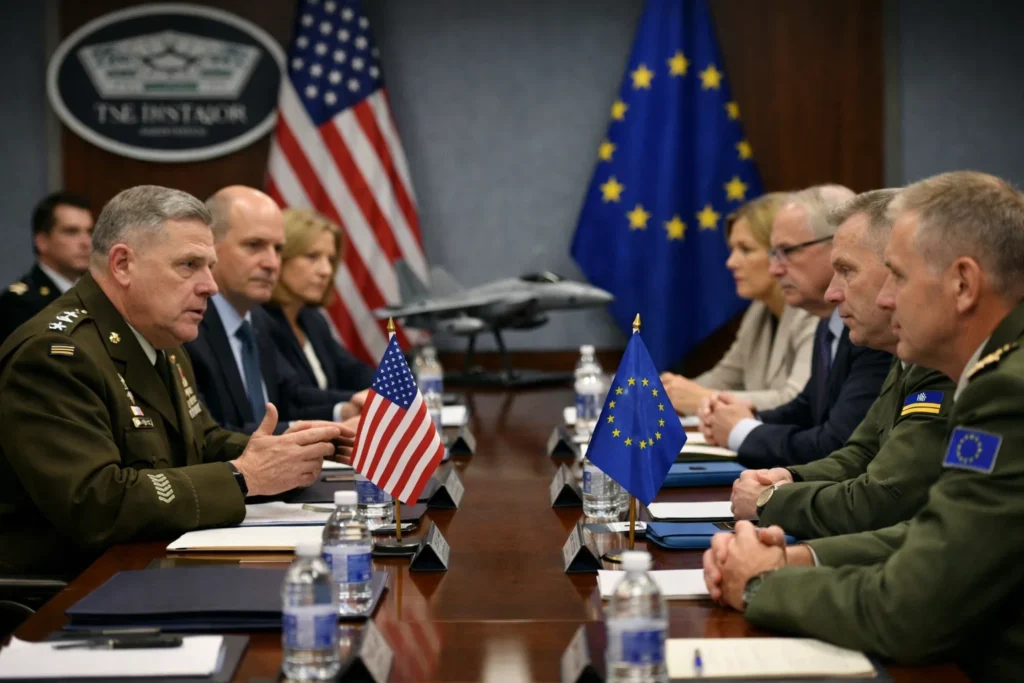
Image Credentials: Image Title: Pentagon Escalates Pressure on Brussels Over “Buy European” Defense Push Source: (sora.openai) Date: Feb 2026. Attribution: This image was created using AI-generated imagery (sora.openai) and does not depict a real-world scene.
By The Grand Strategy Institute staff
The administration of President Donald Trump has intensified transatlantic tensions by warning the European Union that it could face retaliation if Brussels moves forward with rules favoring European arms manufacturers over American firms. The message was formally conveyed by the U.S. Department of Defense in response to a public consultation launched by the European Commission on revising EU defense procurement regulations.
In its submission, Washington strongly opposed any amendment to the directive that would restrict U.S. industry participation in national defense contracts across EU member states. The administration characterized potential restrictions as protectionist and warned that reciprocal measures could follow. Specifically, the Pentagon indicated it may reconsider waivers and exceptions granted to European firms under existing Reciprocal Defense Procurement Agreements if European capitals adopt binding preference clauses.
The dispute emerges at a pivotal moment for Europe’s defense posture. The EU has sought to bolster its strategic autonomy, driven by Russia’s war in Ukraine and concerns over political unpredictability in Washington. For decades, European militaries have relied heavily on American systems such as the F-35 Lightning II fighter jet, the M142 HIMARS rocket system, and the MIM-104 Patriot air defense platform. Today, roughly two-thirds of EU arms imports originate from the United States.
Brussels has attempted to rebalance this dependency through initiatives designed to strengthen the European defense industrial base. Programs such as the SAFE €150 billion loans for weapons mechanism include minimum European content requirements. Similar provisions apply to EU-funded arms purchases linked to financial support for Ukraine.
From Washington’s perspective, however, embedding a strong “Buy European” clause into national procurement laws would mark a turning point. The Pentagon warned that it could review existing blanket exemptions under U.S. “Buy American” legislation, potentially limiting European firms’ access to Pentagon contracts and assessing future exceptions only on a case-by-case basis tied to NATO interoperability needs.
The confrontation highlights a strategic paradox. The Trump administration has consistently urged European allies to assume greater responsibility for the continent’s conventional defense spending and capabilities. At the same time, it has resisted policies that might reduce the market share of American defense companies in Europe.
U.S. officials argue that restrictive procurement measures could fragment supply chains, raise costs for joint programs, and complicate NATO capability targets agreed by allies. European advocates of industrial preference counter that strengthening domestic production is essential to ensure supply security during prolonged crises and to reduce vulnerability to external political shifts.
The European Commission is expected to present an updated version of the 2009 defense procurement directive in the third quarter. It remains unclear whether the proposal will introduce binding obligations favoring European suppliers or preserve substantial flexibility for member states.
The outcome of this debate carries implications far beyond defense contracting. At stake is the balance between European strategic autonomy and transatlantic interdependence, as well as the future architecture of industrial cooperation within NATO. In a geopolitical environment shaped by confrontation with Russia and renewed questions about U.S. reliability, procurement policy has become a litmus test for Western cohesion.
The Grand Strategy Institute
Continue Exploring Strategic Analysis
Return to The Grand Strategy Institute for strategic assessments, long-form analysis and research examining geopolitics, military affairs, international security, emerging technologies and the changing international order.
← Back to The Grand Strategy Institute