
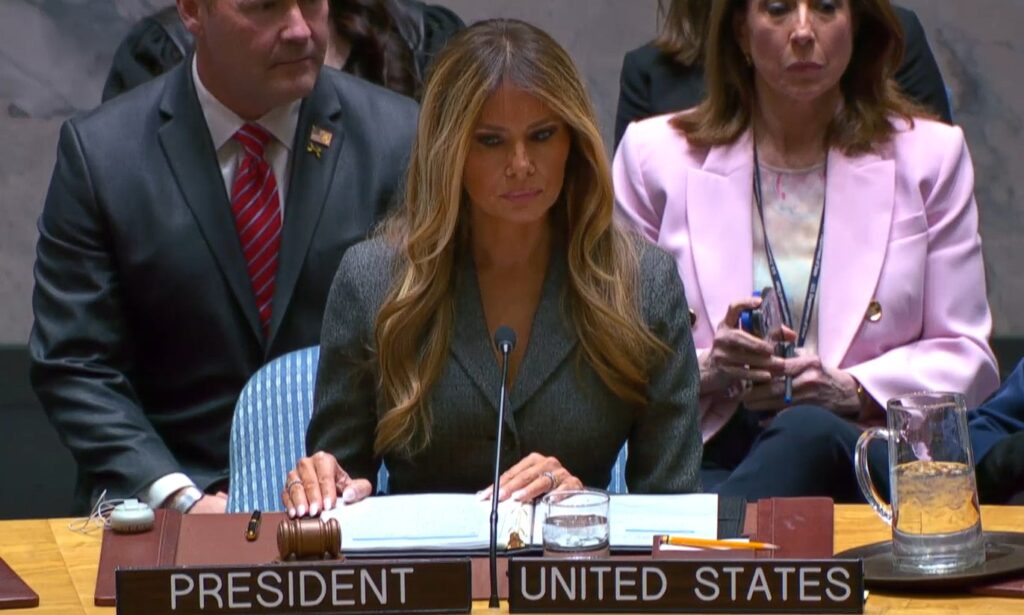
Image: from UN News X @UN_News_Centre
OPEN CHRONICLE | “The Truth in Every Detail.”
By Open Chronicle Staff with Agencies
UNITED NATIONS — In an unprecedented diplomatic maneuver, First Lady Melania Trump took the president’s seat at the United Nations Security Council on Monday, gaveling in a session focused on the protection of children in armed conflict. The symbolic appearance comes at a moment of profound global instability, as the United States and Israel continue a series of coordinated military strikes against Iran.
Mrs. Trump is the first spouse of a world leader to preside over the Council, the U.N.’s most powerful body. Her appearance was facilitated by the United States’ rotating presidency of the Council for the month of March. While the First Lady sought to center the conversation on her signature platform of child welfare, the proceedings were overshadowed by the grim realities of the widening war.
“The U.S. stands with all of the children throughout the world,” Mrs. Trump said during her address, maintaining a tone of general humanitarian concern rather than addressing the specific tactical developments of the Middle East offensive. “I hope soon peace will be yours.”
A Backdrop of Bloodshed: The session opened under the heavy shadow of reported mass casualties in Iran. According to Iranian state media, a recent airstrike struck a girls’ school in southern Iran, resulting in the deaths of at least 165 people. While the Israeli military stated it was unaware of strikes in that specific area and the U.S. military is currently reviewing the reports, the incident fueled a firestorm of criticism within the chamber.
Shortly before the session convened, Iran’s U.N. Ambassador, Amir Saeid Iravani, lashed out at the proceedings. Speaking to reporters, Iravani labeled the meeting “deeply shameful and hypocritical,” accusing the United States of posturing as a protector of children while simultaneously “launching airstrikes on Iranian cities.”
Policy Contradictions: The First Lady’s call to “safeguard learning” and ensure tech education for children in war zones met with skepticism from some international observers, who pointed to the Trump administration’s recent fiscal policies. In January, the administration withdrew support for the U.N. Office of the Special Representative for Children in Armed Conflict and has significantly slashed funding for UNICEF.
U.N. political chief Rosemary DiCarlo provided a sobering context to the day’s discussion, noting that the world is currently facing the highest number of armed conflicts since World War II. She highlighted that schools across the Middle East—including in the UAE, Qatar, and Bahrain, have been forced to close and move to remote learning as a direct result of the ongoing military operations.
A History of High-Stakes Diplomacy: This is not Mrs. Trump’s first foray into sensitive international relations. Last summer, she made headlines by writing directly to Russian President Vladimir Putin, an effort she later claimed led to the reunification of Ukrainian children with their families following their displacement during the 2022 invasion.
As the First Lady concluded her remarks on Monday by stating that “peace does not have to be fragile,” the sounds of diplomacy were once again drowned out by the drums of war. While the U.S. signals a potential openness to talks with “new leadership” in Tehran, the reality on the ground remains one of escalating violence, leaving the children Mrs. Trump championed caught in the crossfire.