
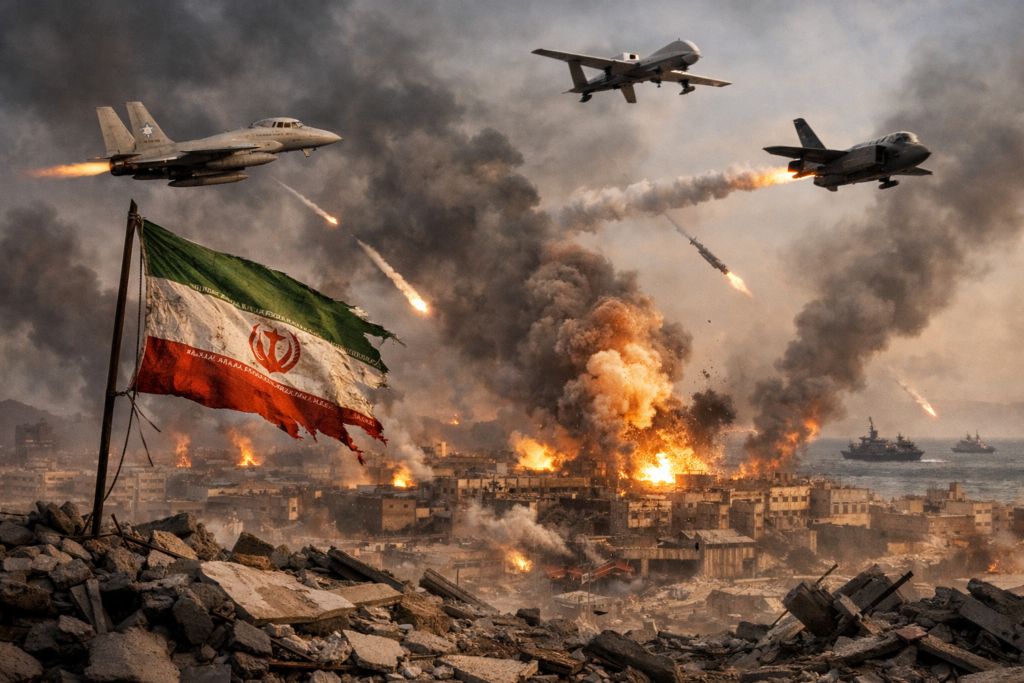
Image Credentials: Image Title: Global News Brief: Key Events and Developments for March 13, 2026. Source: (sora.openai) Date: March 2026. Attribution: This image was created using AI-generated imagery
By Open Chronicle with Agencies
The geopolitical landscape remains dominated by the escalating confrontation between the United States, Israel, and Iran, now entering its second week. Diplomatic activity across Europe and the Middle East, alongside high-level briefings in Washington and the United Nations, reflects growing international concern over the widening conflict and its economic repercussions.
US-Israeli war on Iran enters day 14
The war between the United States, Israel, and Iran enters its fourteenth day as hostilities continue across the region. Iranian Supreme Leader Mojtaba Khamenei has declared that the Strait of Hormuz must remain closed after Iran blocked the critical maritime route in retaliation for US-Israeli strikes that began on February 28.
The closure threatens one of the world’s most important energy corridors, raising fears of global supply disruptions. Tehran has framed the blockade as a defensive response to continued military pressure, while Washington and its allies have warned that attempts to restrict international shipping could trigger broader escalation.
UN Secretary-General visits Lebanon
Amid rising regional tensions, António Guterres is traveling to Lebanon to meet President Joseph Aoun, Prime Minister Nawaf Salam, and Parliament Speaker Nabih Berri.
The visit comes as Israeli attacks on Lebanese territory intensify, increasing fears that the conflict with Iran could expand into a broader regional war. Discussions are expected to focus on de-escalation efforts, humanitarian concerns, and the fragile security environment along the Israeli-Lebanese frontier.
European reactions to strikes on Iran
European leaders are closely monitoring developments following the joint US-Israeli strikes on Iranian targets and Tehran’s retaliatory attacks. The escalation occurred despite ongoing nuclear negotiations mediated by Oman, which had raised hopes of easing tensions.
European governments have expressed concern about the risks of a wider war in the Middle East, emphasizing the need to preserve diplomatic channels and prevent disruptions to global energy markets.
Zelenskyy and Macron meet in Paris
Ukrainian President Volodymyr Zelenskyy will meet French President Emmanuel Macron at the Élysée Palace in Paris. Their talks are expected to address the ongoing Russia-Ukraine war, continued European support for Kyiv, and measures to increase pressure on Moscow.
Among the topics under discussion are efforts to target Russia’s so-called shadow fleet of oil tankers, which Western governments believe are being used to circumvent sanctions.
Merz holds talks in Norway
German Chancellor Friedrich Merz meets Norwegian Prime Minister Jonas Gahr Støre on the second and final day of his visit to Norway.
The talks are expected to focus on European foreign policy coordination, NATO cooperation, and joint initiatives in space exploration, reflecting growing strategic collaboration among European partners.
UN briefing in Geneva
The United Nations Information Service will hold its biweekly press briefing in Geneva, with the agenda to be released shortly before the session. The discussion is expected to address several global issues, including ongoing conflicts, humanitarian crises, and international health concerns.
White House and Pentagon briefings
US President Donald Trump is expected to sign a series of executive orders before greeting National Finals Rodeo winners at the White House. While the event is currently listed as closed to the press, officials are monitoring for any remarks regarding the war with Iran.
At the Pentagon, Defense Secretary Pete Hegseth and Joint Chiefs Chairman Dan Caine will brief reporters on the conflict, providing updates on military operations and strategic objectives.
Meanwhile, Vice President JD Vance will travel to Rocky Mount, North Carolina, where he is expected to deliver remarks that may touch on the expanding crisis in the Middle East.
UN General Assembly president addresses reporters
Annalena Baerbock will brief journalists at the United Nations. Her comments are expected to address diplomatic efforts and international reactions to the widening Middle East conflict.
Eurasian reactions to regional escalation
Governments across Eurasia are also responding to the escalating confrontation between Iran, Israel, and the United States. Countries such as Azerbaijan are watching developments closely as retaliatory strikes ripple across the region.
Officials in several capitals have expressed concern about security risks and economic disruptions tied to the crisis.
Energy disruptions affect Asian markets
The war is increasingly affecting energy supplies to Asian economies as shipping routes through the Strait of Hormuz face uncertainty. Governments across the region are monitoring the situation closely due to their heavy reliance on Middle Eastern oil and gas exports.
In addition to energy concerns, the crisis has complicated the safety and movement of Asian nationals living or working in the region.
Nepal moves toward forming a new government
In South Asia, Nepal’s political landscape is undergoing a major shift after the Rastriya Swatantra Party secured a decisive victory in the general elections.
The party won 182 seats in the 275-member parliament and is expected to announce the formation of a new government, marking a dramatic change in Nepal’s political dynamics following the collapse of the previous administration last year.
The Economy
US GDP
The United States will release the second estimate of the fourth quarter gross domestic product. The initial reading showed the economy expanding at an annualized rate of 3.3 percent, reflecting stronger-than-expected resilience despite high interest rates and global uncertainty.
German wholesale prices
Germany’s statistical office Destatis will publish the February wholesale price index data. Wholesale prices fell 2.7 percent year on year in January, suggesting that inflationary pressures earlier in the supply chain may be easing.
UK GDP
The United Kingdom’s Office for National Statistics will release January GDP figures. The British economy expanded by 0.1 percent in December, a modest increase that nonetheless highlighted the ongoing impact of high borrowing costs.
Asian powers tread carefully as the Iran war raises energy risks
A detailed analysis explores how Asian governments are navigating the escalating war between the United States, Israel, and Iran while attempting to safeguard energy supplies and trade routes.
Experts, including Nancy Snow, Andrea Ghiselli, and Kazuto Suzuki, suggest many governments are adopting cautious diplomatic language while quietly preparing contingency plans for potential disruptions to oil and gas flows.
Qatar LNG outage raises global gas market concerns
Another report examines how disruptions to liquefied natural gas production in Qatar are tightening global energy markets. Shipping difficulties in the Strait of Hormuz and operational shutdowns at key facilities have raised concerns about the stability of LNG supply.
Analysts say the situation could increase competition among European and Asian buyers for alternative cargoes, potentially benefiting producers in the United States and Australia.
Ghana’s cocoa sector faces mounting pressure
A separate report highlights the growing strain on Ghana’s cocoa sector amid falling global prices and financial difficulties. A sharp decline in cocoa prices and reductions in payments to farmers have triggered protests in rural communities.
The downturn has intensified debate over the future of Ghana’s cocoa economy and the role of the Ghana Cocoa Board in managing the country’s vital export industry.
As the war with Iran reverberates through global politics and markets, the events of March 13 reflect a world grappling simultaneously with escalating conflict, economic uncertainty, and shifting political landscapes.