
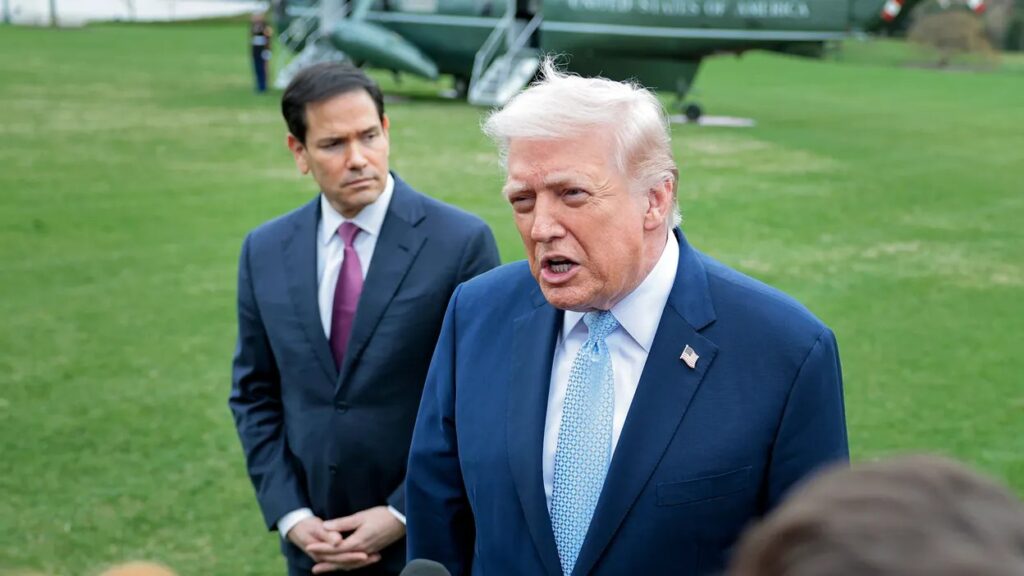
Image: from News News News X @NewsNew97351204
WASHINGTON D.C. — President Donald Trump announced Friday that the United States is considering a significant “winding down” of military operations against Iran, suggesting a pivot in strategy that would shift the burden of regional maritime security onto international shoulders.
In a series of statements posted to his Truth Social platform, the President indicated that the U.S. is nearing its strategic goals following weeks of intense kinetic engagement in the Middle East.
“We are getting very close to meeting our objectives as we consider winding down our great Military efforts in the Middle East with respect to the Terrorist Regime of Iran,” Trump stated.
The Burden of the Strait
A central pillar of the President’s announcement involves the Strait of Hormuz, the world’s most crucial chokepoint for oil transit. Trump explicitly called for the nations that rely on the waterway for their energy needs to take over the responsibility of patrolling it, signaling an end to the decades-long era of the U.S. Navy acting as the primary guarantor of passage in the Persian Gulf.
“The Hormuz Strait will have to be guarded and policed, as necessary, by other Nations who use it. The United States does not!” he wrote, echoing his long-standing “America First” stance on foreign military expenditures.
A Region in Turmoil
This potential de-escalation comes at a moment of extreme volatility. Tensions reached a breaking point following joint U.S.-Israeli strikes on Iranian soil on February 28. Local reports indicate a heavy human toll from the campaign, with estimates of 1,300 fatalities. Among the casualties were more than 150 children following a strike near a girls’ elementary school, an incident that has drawn international scrutiny.
In the weeks since, Tehran has launched a series of retaliatory missile and drone swarms. These strikes have targeted Israeli territory and assets that Iran identifies as being linked to the United States throughout the region.
Strategic Pivot or Power Vacuum?
Analysts are divided on the implications of a sudden U.S. withdrawal. While the administration views this as “mission accomplished,” critics argue that a departure without a formal multinational maritime force in place could leave the Strait of Hormuz vulnerable to further disruption, potentially destabilizing global energy markets.
For now, the White House has not provided a specific timeline for the “winding down,” but the President’s rhetoric suggests the U.S. is looking for the nearest exit ramp in a conflict that has rapidly redefined Middle Eastern geopolitics in early 2026.