
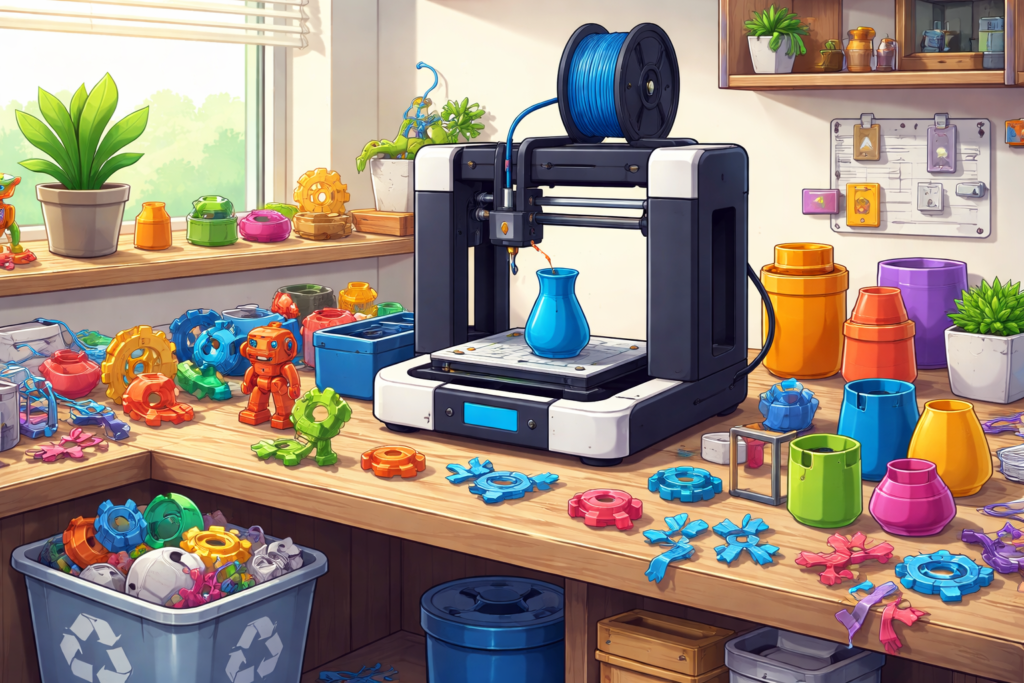
Image Credentials: Image Title: AI Wargames: The Plastic Paradox: Why Your Home 3D Printer Shouldn’t Make Everything Source: (sora.openai) Date: Feb 2026. Attribution: This image was created using AI-generated imagery (sora.openai) and does not depict a real-world scene.
By Julian Thorne | Open Chronicle Technology Columnist
SILICON VALLEY — The rise of affordable desktop 3D printing has turned thousands of spare bedrooms into miniature factories. With a spool of plastic filament and a downloaded file, hobbyists can now manufacture everything from replacement dishwasher knobs to intricate tabletop miniatures. However, as the technology matures, experts are issuing a stern warning to the “maker” community: just because you can print it, doesn’t mean you should.
While the “Star Trek” replicator remains the dream, the reality of fused deposition modeling (FDM) and resin printing involves chemical complexities and structural vulnerabilities that make certain items outright dangerous to produce at home.
The Bacteria Trap
Perhaps the most common mistake made by enthusiasts is printing kitchenware. While a 3D-printed cookie cutter or coffee mug might look functional, the microscopic anatomy of a 3D print is a breeding ground for pathogens.
“The layering process creates tiny ridges and pores,” explains a materials safety specialist. “These crevices are nearly impossible to fully sanitize. Food particles get trapped, and within days, your ‘cool’ custom mug becomes a high-density colony for bacteria.” Furthermore, most standard filaments like PLA and ABS are not food-safe and can leach toxic chemicals when they come into contact with hot liquids or acidic foods.
Structural Failures: Helmets and Hardware
Another area of concern involves safety equipment. The 3D-printing community is filled with files for “tactical” gear, bicycle helmets, and climbing equipment. However, the way a home printer builds an object, layer by layer, creates inherent “shear planes.”
Unlike injection-molded plastic, which is uniform and solid, a 3D-printed part is only as strong as the bond between its layers. Under sudden impact, these layers can delaminate, causing the object to shatter. Using a 3D-printed helmet is, in many cases, more dangerous than wearing no helmet at all, as the shards of plastic can cause secondary injuries.
The Toxic Air We Breathe
Beyond the objects themselves, the act of printing certain materials poses a respiratory risk. Many users are unaware that common filaments like ABS and Nylon release Volatile Organic Compounds (VOCs) and Ultra-Fine Particles (UFPs) during the melting process. Without industrial-grade ventilation or specialized enclosures, hobbyists are effectively “hot-boxing” their living spaces with microplastics and chemical fumes, which have been linked to long-term respiratory issues.
High-Heat Hazards
Finally, items intended for use near engines or electrical components are a frequent source of “print failure” disasters. Standard filaments have a low “glass transition temperature,” meaning they begin to soften and deform long before they actually melt. A 3D-printed car phone mount left in a sunny dashboard, or a custom light fixture, can quickly warp into a gooey mess, or worse, become a fire hazard.
As 3D printing continues to evolve, the message from industry veterans is clear: use the technology for prototyping and art, but leave the high-stakes manufacturing to the professionals.