
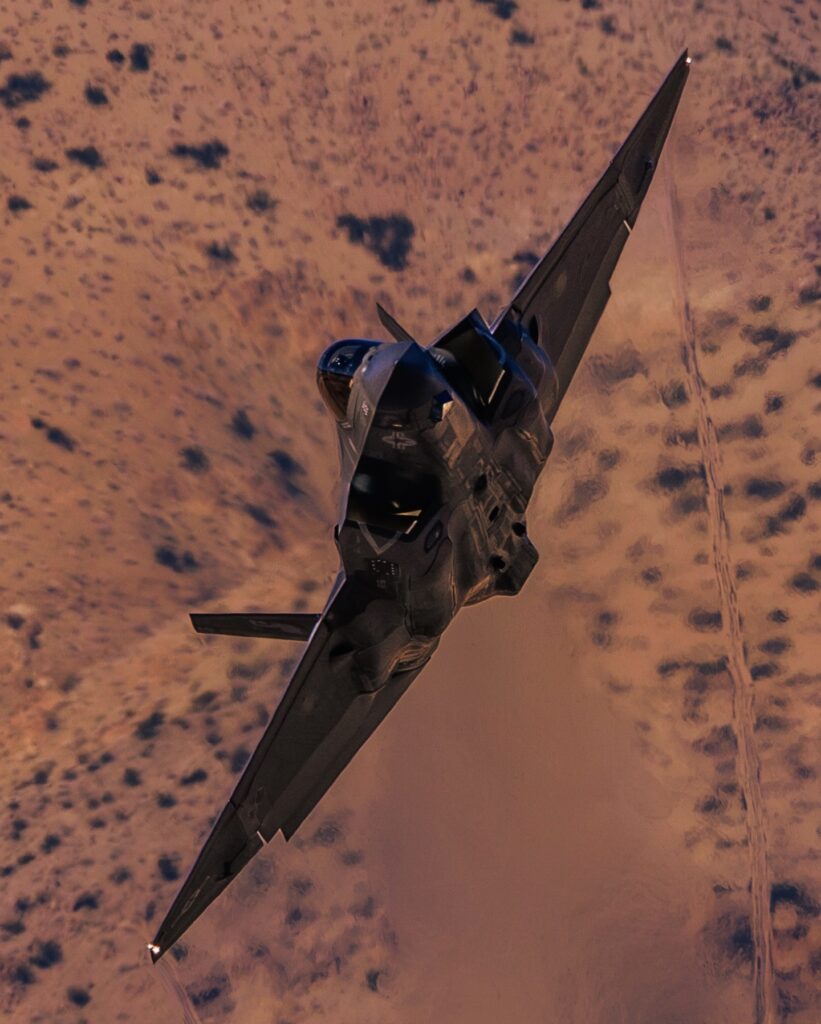
Image: from Midobecker X @midobecker_1
By Harrison Vane | Open Chronicle Defense Correspondent
ARLINGTON, VA — For years, the F-22 Raptor has been the undisputed, if somewhat reclusive, king of the skies. But as the geopolitical focus shifts toward the vast, contested expanses of the Indo-Pacific, the world’s premier air-superiority fighter is undergoing a mid-life transformation. This week, at the Air & Space Forces Association’s annual Warfare Symposium, Lockheed Martin pulled back the curtain on this evolution, displaying a production-representative scale model of what is being internally dubbed “Raptor 2.0.”
The model provides the most detailed look yet at the physical upgrades intended to keep the 20-year-old platform lethal against modernizing adversaries like China’s J-20.
BREAKING THE SKY — The F-22 Raptor is still untouchable.
No other fighter on Earth can do what the F-22 does:
• 70,000+ lbs of thrust
• Supercruise at Mach 1.8 (without afterburner)
• Stealth so advanced, it's invisible to radar
• Can outturn, outrun & outfight anything in… pic.twitter.com/10RTZt51cg— Defence Index (@Defence_Index) July 19, 2025
Going the Distance
The most striking features on the new model are the sleek, faceted external fuel tanks. Historically, the F-22’s greatest weakness has been its “short legs”, a range limitation that is particularly problematic in Pacific theater scenarios where bases are thousands of miles apart.
🚨 ALERTE INFO : 🇺🇸 F-22 Raptor en vol, démontrant sa puissance et sa vitesse supersonique. (F) pic.twitter.com/zxiACzrOt2
— Trump Fact News 🇺🇸 (@Trump_Fact_News) March 16, 2026
While the Raptor has long used 600-gallon drop tanks to ferry between bases, those tanks are bulky and radar-reflective, effectively stripping the jet of its “invisible” edge. The new 2.0 tanks are designed with low-observable (stealth) characteristics, allowing the Raptor to maintain a reduced radar cross-section even while carrying the extra fuel needed for long-range sorties. Like their predecessors, these tanks can be jettisoned before a dogfight, but Lockheed Martin suggests the jet could now enter contested airspace without immediately having to “go clean.”
The Return of the Infrared Eye
Just outboard of the new fuel tanks, the model reveals another critical addition: underwing infrared search and track (IRST) sensor pods.
An IRST system was originally intended for the F-22 during its development in the 1990s, but was famously axed to save costs. Its return marks a shift in aerial philosophy. While the Raptor’s AN/APG-77 radar is peerless, using it “paints” the sky with radio energy, potentially giving away the jet’s position. An IRST sensor is passive; it scans for the heat signatures of enemy engines and leading edges without emitting a single beep. This allows a “Raptor 2.0” to hunt other stealth aircraft—which are designed to evade radar but cannot hide their heat—while remaining electronically silent.
EL AVIÓN DE COMBATE QUE EE.UU. SE NIEGA A VENDERLE AL MUNDO
Un video aficionado captura el poderío del F-22 Raptor, considerado todavía por muchos expertos como el mejor caza de superioridad aérea del planeta. Este avión es tan avanzado que el Congreso estadounidense prohibió… pic.twitter.com/w4qWbh3Hej
— John P. Acquaviva (@JPAFS) November 29, 2025
Bridging the Gap to the Sixth Gen
The “Raptor 2.0” designation isn’t just about external hardware. Under the skin, the Air Force is pouring billions into “Open Systems Architecture” and upgraded processing power. These digital “brains” will allow the F-22 to communicate more seamlessly with F-35s and upcoming “loyal wingman” drones.
While the Air Force eventually looks toward the Next Generation Air Dominance (NGAD) fighter, rumored to be the F-47, the Raptor 2.0 program ensures that the existing fleet remains the “apex predator” of the transition era. With flight testing of these new external stores already underway and deliveries expected to hit squadrons by late 2026, the Raptor is proving that even a veteran can learn new, deadlier tricks.