
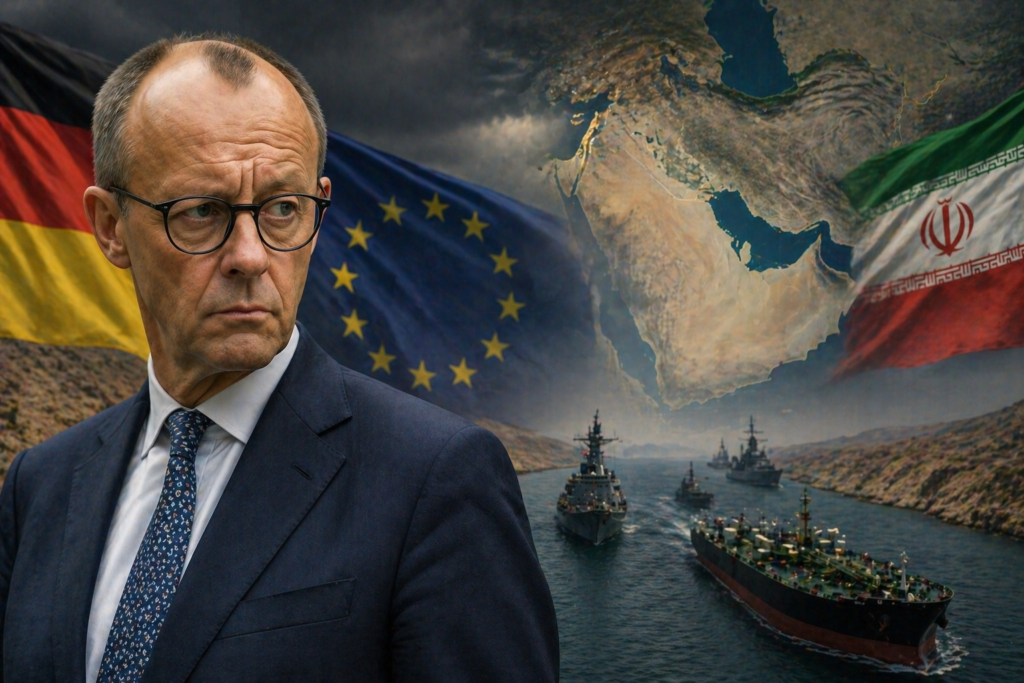
Image Credentials: Image Title: Merz Criticizes Iran and Questions U.S. Strategy as Transatlantic Divisions Deepen Source: (chatgpt.com) Date: April 2026. Attribution: This image was created using AI-generated imagery (chatgpt.com) by Open Chronicle and does not depict a real-world scene.
By Open Chronicle with Agencies
German Chancellor Friedrich Merz has delivered a sharp and unusually direct critique of Iran’s leadership and raised fresh doubts about the United States’ strategy in the ongoing conflict, highlighting growing tensions between Washington and its European allies.
Speaking to students in the western German town of Marsberg, Merz accused Tehran of outmaneuvering the United States diplomatically, suggesting that Iranian officials were deliberately stalling negotiations. He pointed to recent failed talks in Pakistan, where U.S. representatives reportedly traveled without achieving any concrete outcome.
Merz described the situation as damaging to American credibility, arguing that Iran’s negotiating approach had effectively placed Washington in a difficult position. His remarks singled out the influence of Iran’s Revolutionary Guards, which he suggested were playing a central role in shaping the country’s strategy.
Beyond criticism of Iran, the German leader also questioned the broader direction of U.S. policy. He said it was unclear what endgame Donald Trump was pursuing in the conflict, underscoring uncertainty among European partners about Washington’s long-term objectives.
The comments reflect deeper fractures within the NATO alliance, which have been widening over several issues, including the war in Ukraine and burden-sharing in global security operations. The current crisis has further exposed these divisions, particularly as the conflict impacts global energy markets.
A key point of contention has been the Strait of Hormuz, a critical maritime route for global oil shipments. The waterway has remained largely disrupted due to the conflict, contributing to volatility in energy prices and supply chains. President Trump has criticized NATO allies for not deploying naval forces to help secure the route, a demand that has met with hesitation in Europe.
Merz’s remarks suggest that European leaders are increasingly concerned not only about the consequences of the conflict but also about the coherence of the Western response. His call for a swift resolution reflects fears that prolonged instability could deepen economic and political strains on both sides of the Atlantic.
As diplomatic efforts continue to falter, the gap between the United States and its European allies appears to be widening, raising questions about coordination within NATO at a time of escalating global tensions.