
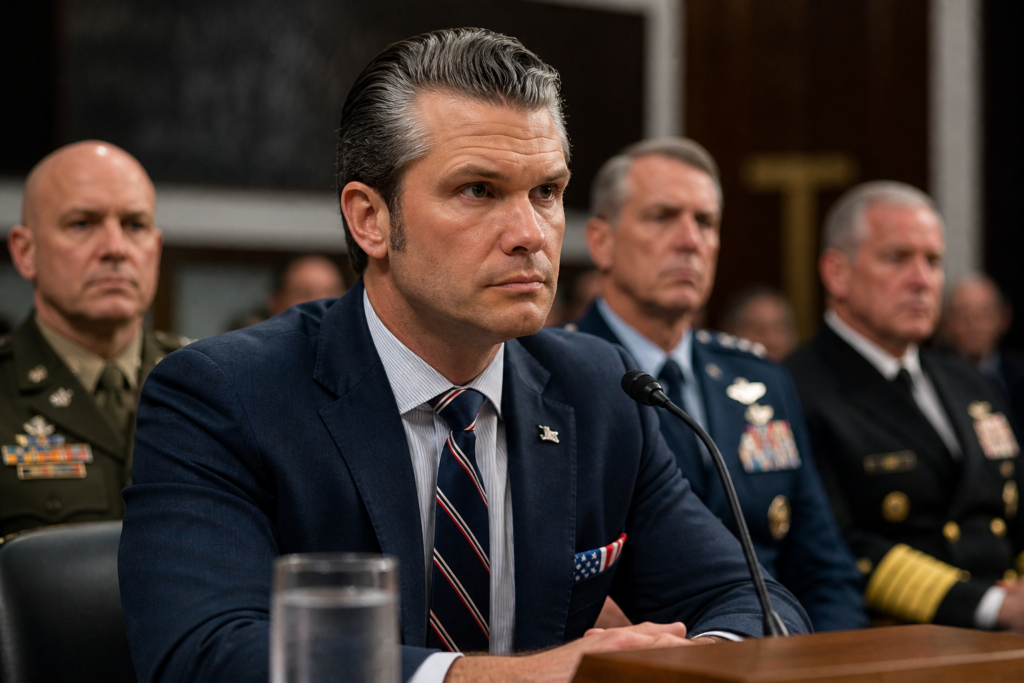
Image Credentials: Image Title: Republican Concerns Grow Over Pentagon Shake-Up Under Defense Secretary Hegseth Source: (chatgpt.com) Date: May 2026. Attribution: This image was created using AI-generated imagery (chatgpt.com) by Open Chronicle and does not depict a real-world scene.
By Open Chronicle with Agencies
Concerns are mounting among Republican lawmakers over the leadership approach of U.S. Defense Secretary Pete Hegseth, following a series of high-profile dismissals within the military during a period of heightened global tensions.
Hegseth, who has overseen the Pentagon since last year, has presided over a wave of leadership changes that include dismissals, retirements, and reassignments affecting senior military officials. Critics within his own party say the scale and timing of these moves are unusual, particularly amid the ongoing conflict involving Iran.
The dismissal of Randy George, the Army Chief of Staff, has emerged as a key flashpoint. Lawmakers, including Mike Rogers and Rich McCormick, questioned the decision, noting George’s role in improving recruitment and advancing modernization efforts within the Army.
George, a veteran with decades of service, had also pushed for the integration of emerging technologies such as drones. His removal, replaced by Christopher LaNeve, has raised questions about the criteria used in leadership changes.
Further unease followed the firing of John Phelan, which some senators described as lacking clear justification. One Republican senator, speaking anonymously, warned that the ongoing shake-up risks weakening experienced leadership within the Department of Defense.
Thom Tillis echoed those concerns, describing the removals as “less than ideal” and praising the dismissed officials as highly capable.
Analysts have also weighed in. Justin Logan of the Cato Institute argued that the changes appear more destructive than constructive, while Barry Posen suggested that ideological alignment may be playing a role in personnel decisions.
Hegseth has been vocal about reshaping the military’s priorities, emphasizing what he calls “lethality” and rejecting policies he associates with diversity and inclusion initiatives. His critics argue that this approach risks sidelining experienced leaders in favor of those who align more closely with his views.
The Defense Secretary’s tenure has also included the removal of senior figures such as Charles Q. Brown Jr. and Lisa Franchetti, both of whom were seen as historic appointments in their respective roles.
While leadership changes during wartime are not unprecedented, experts note that the pace and scale of recent dismissals are notable. Jennifer Kavanagh said the lack of transparency surrounding these decisions is a key concern, particularly at a time when stability is often critical.
Despite the criticism, President Donald Trump has continued to back Hegseth, calling him “a great choice” and dismissing concerns raised in Congress.
With hearings ongoing and tensions persisting within both the Pentagon and Capitol Hill, questions remain about the long-term impact of the leadership overhaul on U.S. military readiness and strategic direction.
The Grand Strategy Institute
Continue Exploring Strategic Analysis
Return to The Grand Strategy Institute for strategic assessments, long-form analysis and research examining geopolitics, military affairs, international security, emerging technologies and the changing international order.
← Back to The Grand Strategy Institute