
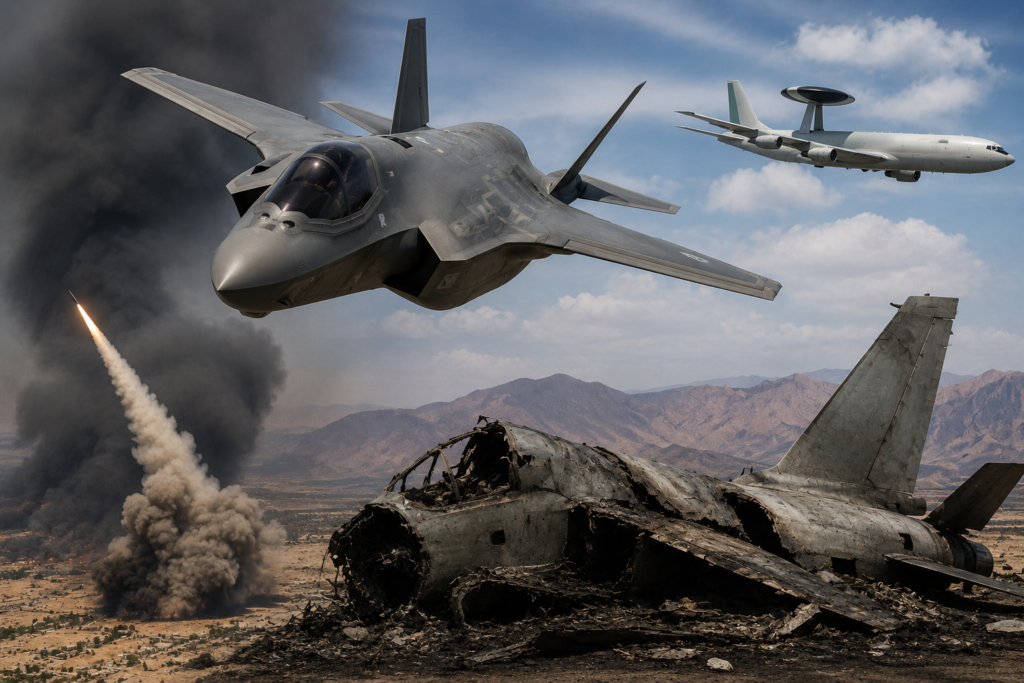
Image Credits: Image Title: US Lawmaker Says Washington Lost 39 Aircraft During Iran War. Source: (chatgpt.com) Date: May 2026. Attribution: This image was created using AI-generated imagery (chatgpt.com) by Open Chronicle and does not depict a real-world scene.
By Open Chronicle with agencies
A congressman has claimed that the United States lost 39 aircraft during the recent conflict involving Iran, citing a defense industry report during a Senate hearing on Tuesday.
The remarks introduced fresh questions about the scale of American military losses during the war, although Pentagon officials declined to publicly confirm the figures.
Republican Ed Case explicitly confirms the Pentagon has lost a staggering 39 aircraft in the war against Iran, exposing the unprecedented destruction of American military assets.
Pentagon CFO Jay Hurst desperately dodges the huge replacement costs.
Will TRUMP start counting❓🤡 pic.twitter.com/Q07okeuCV1
— Bhakt Prahlad🚩 (@RakeshKishore_l) May 13, 2026
Congressman Raises Aircraft Loss Claims
Ed Case made the comments while questioning Pentagon Chief Financial Officer Jay Hurst about the financial cost of the conflict.
“We’ve lost about 39 aircraft, according to a report in The War Zone,” Case said during the hearing, adding that the report was already nearly a month old.
He asked whether the Pentagon had calculated the long-term replacement and repair costs connected to the alleged losses.
Hurst acknowledged that costs existed but avoided confirming the numbers publicly.
“There are costs there, sir, but I want to get back to you in writing,” Hurst responded.
He added that calculating aircraft repair expenses was extremely complex and required full technical evaluations before final estimates could be produced.
Report Details Extensive Air Operations
The figures cited by Case reportedly originated from a report published by The War Zone.
According to the report, the US Air Force conducted nearly 13,000 flights during the conflict with Iran.
The publication claimed 39 aircraft were destroyed while another 10 suffered varying levels of damage.
Among the alleged losses were an F-35A Lightning II reportedly hit inside Iranian airspace and a Boeing E-3 Sentry aircraft allegedly destroyed during operations.
The claims have not been independently verified, and Pentagon officials stopped short of publicly validating the reported losses during the hearing.
War With Iran Reshaped Regional Security
Regional tensions escalated dramatically after the United States and Israel launched strikes against Iran on Feb. 28.
Iran responded with missile and drone attacks targeting Israel as well as American allies in the Gulf region hosting US military assets.
The conflict also disrupted global shipping after Tehran moved to close the Strait of Hormuz, triggering major economic and energy market consequences worldwide.
A ceasefire brokered through Pakistani mediation took effect on April 8, although negotiations in Islamabad failed to secure a permanent agreement.
The truce was later extended by President Donald Trump without a formal deadline.
Questions Grow Over Financial Cost of Conflict
The latest discussion comes as lawmakers increasingly scrutinize the financial and military toll of the conflict.
Earlier this week, Pentagon officials estimated the war had already cost Washington nearly $29 billion in operational expenses, equipment replacement and military deployments.
Analysts say aircraft losses, if confirmed, would represent one of the most serious American aviation setbacks in a modern regional conflict.
Military experts also note that advanced aircraft such as the F-35 carry exceptionally high replacement and maintenance costs, potentially pushing long-term expenses even higher.
Pentagon Maintains Cautious Position
Despite mounting speculation, the Pentagon continues to avoid publicly discussing detailed operational losses tied to the war.
Defense officials have repeatedly emphasized the complexity of assessing damage during ongoing military operations and post-conflict evaluations.
The hearing nevertheless reflected growing concern in Washington over the broader consequences of the Iran conflict, including military readiness, regional stability and rising economic pressure linked to energy market disruptions.