
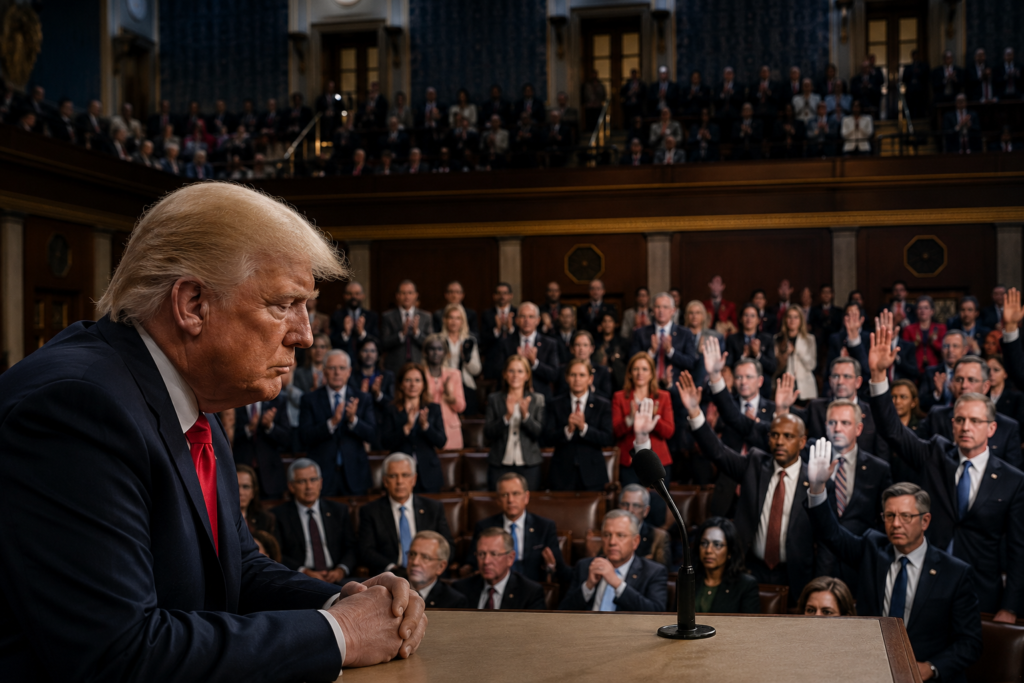
Image Credentials: Image Title: House Approves War Powers Resolution as Trump Faces Growing Pressure Over Iran Conflict. Source: (chatgpt.com) Date: May 2026. Attribution: This image was created using AI-generated imagery (chatgpt.com) by Open Chronicle and does not depict a real-world scene.
By Open Chronicle with agencies
President Donald Trump suffered a significant political setback on Wednesday after the U.S. House of Representatives approved a war powers resolution aimed at halting American military operations against Iran, marking the first major congressional challenge to the administration’s handling of the conflict.
The resolution passed by a narrow 215 to 208 margin, with several Republican lawmakers joining Democrats in supporting the measure. The vote reflects growing concern in Congress over the legality, costs, and strategic consequences of the military campaign that began after the United States joined Israel in strikes against Iran on February 28.
The decision represents a rare act of defiance by members of his own party against Trump and highlights growing divisions in Washington over the direction of U.S. foreign policy in the Middle East.
🚨 BREAKING: The US House has just PASSED an anti-Trump Iran War Powers Resolution to rein in military action, 215-208
RINO's Massie, Fitzpatrick, Barrett, & Davidson voted with Dems.
President Trump does NOT view War Powers Act as constitutional, even if it passed all the way. pic.twitter.com/zmsPCbl7vb
— vanhoa (@vanhoa2272) June 3, 2026
Growing Opposition in Congress
House Speaker Mike Johnson had previously attempted to prevent the measure from advancing, successfully delaying debate by two weeks. However, efforts to stop the vote ultimately failed as lawmakers pushed forward amid mounting public and political pressure.
Representative Gregory Meeks of New York, the leading Democrat on the House Foreign Affairs Committee, argued that the conflict has imposed high costs on American families.
“Enough is enough,” Meeks said during the debate. He urged the administration to pursue a different course, citing rising fuel prices and broader economic pressures linked to the conflict.
The House vote follows similar developments in the Senate, where a small group of Republican senators previously supported legislation seeking to reassert congressional authority over military action.
Economic Impact and Strategic Concerns
The conflict has contributed to instability in global energy markets, particularly following disruptions to shipping routes through the Strait of Hormuz, one of the world’s most critical energy transit corridors.
Since the outbreak of hostilities, fuel prices in the United States have risen sharply, adding to inflationary pressures already affecting consumers and businesses. Economists have warned that prolonged instability in the Gulf region could have far-reaching consequences for the global economy.
Although a ceasefire was announced in April, it has remained fragile, with periodic military exchanges continuing between American and Iranian forces. Regional tensions have been further complicated by Israel’s ongoing military operations against Hezbollah in Lebanon.
🚨 PRESIDENT TRUMP BLASTS HOUSE REPUBLICAN HOLDOUTS AND DEMOCRATS OVER WAR POWERS VOTE 🚨
President Trump is furious after the House voted to limit his war powers while negotiations with Iran remain underway.@POTUS called the vote "meaningless" and accused all Democrats and… pic.twitter.com/ZuMfRc7ERZ
— LindellTV (@RealLindellTV) June 4, 2026
Trump Seeks Diplomatic Exit
Despite the continuing violence, President Trump has increasingly emphasized diplomatic efforts. Speaking on Wednesday, he said negotiations with Iran were progressing positively and suggested that an eventual settlement remained achievable.
According to Trump, Tehran has agreed in principle to allow American personnel, working alongside Iranian authorities, to recover nuclear-related material after a final peace agreement is reached.
The administration has also been working with international partners to restore maritime traffic through the Strait of Hormuz and stabilize global energy markets.
However, the president is expected to challenge any congressional effort that limits his authority as commander-in-chief, setting up a potential constitutional and political confrontation between the White House and Congress.
Tehran Questions Progress
Iranian officials offered a far more cautious assessment of the negotiations.
Foreign Minister Abbas Araghchi told Iranian media that no meaningful breakthroughs had yet been achieved and warned against excessive optimism regarding the current diplomatic process.
His remarks underscored the significant gaps that remain between Washington and Tehran despite ongoing contacts aimed at ending the conflict.
Uncertain Path Forward
The House vote does not immediately end U.S. military operations, but it signals growing resistance to continued involvement in the conflict and increases pressure on the administration to prioritize diplomacy.
With ceasefire arrangements remaining fragile, military incidents continuing across the region, and negotiations showing limited progress, the future of the conflict remains uncertain.
The outcome of the congressional challenge could play a major role in shaping both U.S. policy toward Iran and the broader security landscape of the Middle East in the months ahead.