
Image: from New Atlas X @nwtls
By Open Chronicle with agencies
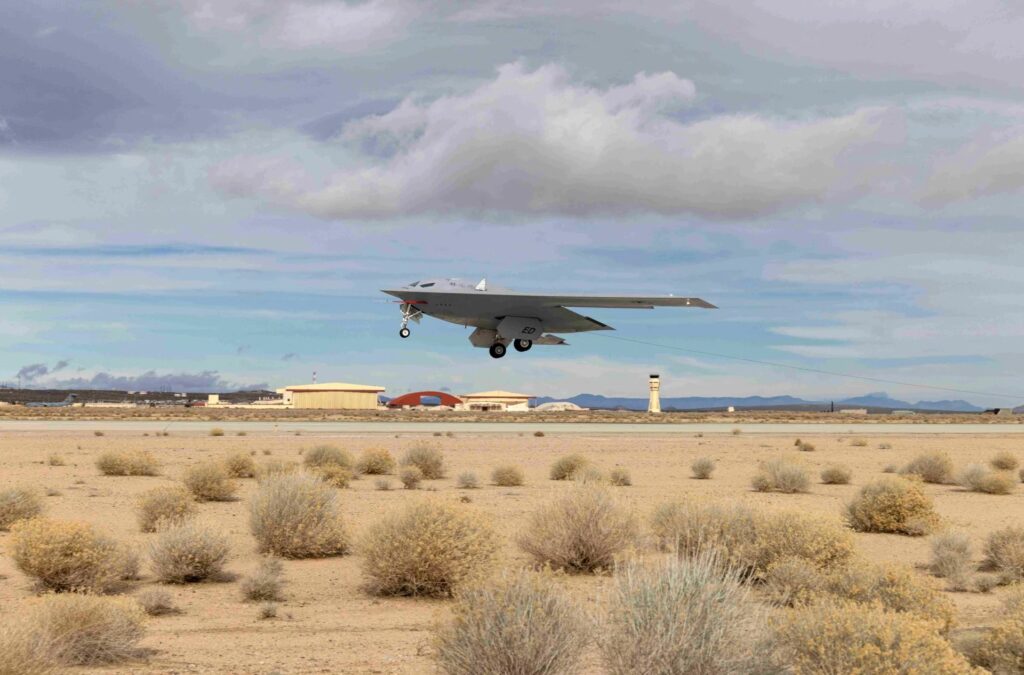
The United States Air Force is taking an unprecedented step to speed up the development of the B,21 Raider, its next-generation stealth bomber, by combining key phases of the aircraft’s flight testing program. The move reflects a broader Pentagon effort to reduce delays and accelerate the delivery of critical military capabilities amid growing global security challenges.
For the first time in the history of the program, an operational pilot has joined a developmental test pilot in the cockpit during the early stages of B,21 flight testing. Traditionally, military aircraft undergo a lengthy sequence of evaluations, beginning with developmental tests focused on engineering performance and airworthiness before moving on to operational testing, where combat effectiveness and mission suitability are assessed by active operational crews.
By integrating these two stages much earlier, the Air Force hopes to cut months, and potentially years, from the overall timeline.
The latest test flights involved an operational test pilot from the Air Force Operational Test and Evaluation Center (AFOTEC) Detachment 5 flying alongside a developmental test pilot from the Air Force Test Pilot School. Officials say this approach allows frontline operational feedback to reach manufacturer Northrop Grumman almost immediately, enabling engineers to address issues before they require expensive redesigns or modifications later in the program.
The initiative is part of a wider modernization strategy affecting several of the Pentagon’s highest priority weapons systems, including the Sentinel intercontinental ballistic missile and the F,47 next generation fighter aircraft. Under new directives, Air Force leadership has been instructed to prioritize resources and eliminate bureaucratic barriers that could slow these projects.
The B,21 Raider is expected to become a cornerstone of America’s nuclear deterrence strategy. As one of the three pillars of the US nuclear triad, alongside land-based intercontinental ballistic missiles and ballistic missile submarines, the stealth bomber is designed to provide long-range strike capabilities against heavily defended targets.
Current plans call for a fleet of at least 200 B,21 aircraft. The Raider will gradually replace the aging B-1B Lancer and B,2 Spirit bombers by 2040 and is expected to eventually succeed the upgraded B,52J Stratofortress during the 2050s. The first B-21s are scheduled to enter operational service in 2028.
Defense officials argue that the changing geopolitical landscape requires a faster and more flexible approach to military acquisition. General Dale White, the Department of War’s direct reporting portfolio manager for critical major weapon systems, said the integration of operational and developmental testing represents the type of cultural shift the Air Force wants to encourage across its procurement programs.
“Integrating operational and developmental tests in the B,21 program exemplifies the acquisition culture we’re instilling throughout the force,” White said. “It’s a smarter and faster mindset that leverages modern production and test tools with the proper sense of urgency, urgency that challenges old processes and moves us to a more agile acquisition system.”
As competition among major powers intensifies, the Air Force believes that compressing testing cycles without compromising safety or effectiveness will be essential to ensuring that advanced systems like the B,21 Raider are ready for service when they are most needed.